Skip to content
ScienceBlog.com
  • Featured Blogs
    • EU Horizon Blog
    • ESA Tracker
    • Experimental Frontiers
    • Josh Mitteldorf’s Aging Matters
    • Dr. Lu Zhang’s Gondwanaland
    • NeuroEdge
    • NIAAA
    • SciChi
    • The Poetry of Science
    • Wild Science
  • Topics
    • Brain & Behavior
    • Earth, Energy & Environment
    • Health
    • Life & Non-humans
    • Physics & Mathematics
    • Social Sciences
    • Space
    • Technology
  • Our Substack
  • Follow Us!
    • Bluesky
    • Threads
    • FaceBook
    • Google News
    • Twitter/X
  • Contribute/Contact

Stellar Eruptions

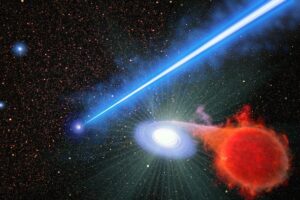
This is an artist's concept looking down into the core of the giant elliptical galaxy M87. A supermassive black hole ejects a 3,000-light-year-long jet of plasma, traveling at nearly the speed of light. In the foreground, to the right is a binary star system. The system is far from the black hole, but in the vicinity of the jet. In the system an aging, swelled-up, normal star spills hydrogen onto a burned-out white dwarf companion star. As the hydrogen accumulates on the surface of the dwarf, it reaches a tipping point where it explodes like a hydrogen bomb. Novae frequently pop-off throughout the giant galaxy of 1 trillion stars, but those near the jet seem to explode more frequently. So far, it's anybody's guess why black hole jets enhance the rate of nova eruptions.

NASA’s Hubble finds that a black hole beam promotes stellar eruptions

Substack subscription form sign up

Comments

  • Sue Ann Hayes on Hidden Nuclear Protein Fuels Pancreatic Cancer’s Deadly Aggression
  • Curtis Webber on The GPS-Killer? This Quantum Device ‘Feels’ Motion Like a Brain—Down to the Atomic Level
  • Ran on How the Age You First Had Sex Could Shape How You Age Decades Later
  • Sparty on How the Age You First Had Sex Could Shape How You Age Decades Later
  • Josh Mitteldorf on A Single TV Segment Sent Leucovorin Prescriptions for Autistic Children Soaring 2,000 Percent
© 2026 ScienceBlog.com | Follow our RSS / XML feed