Skip to content
ScienceBlog.com
  • Featured Blogs
    • EU Horizon Blog
    • ESA Tracker
    • Experimental Frontiers
    • Josh Mitteldorf’s Aging Matters
    • Dr. Lu Zhang’s Gondwanaland
    • NeuroEdge
    • NIAAA
    • SciChi
    • The Poetry of Science
    • Wild Science
  • Topics
    • Brain & Behavior
    • Earth, Energy & Environment
    • Health
    • Life & Non-humans
    • Physics & Mathematics
    • Social Sciences
    • Space
    • Technology
  • Our Substack
  • Follow Us!
    • Bluesky
    • Threads
    • FaceBook
    • Google News
    • Twitter/X
  • Contribute/Contact

Suicide

a neighborhood after midnight

Suicide and Homicide Risks Peak at Night, Study Reveals the Dangers of “The Mind After Midnight”

serene graveyard

In Mexico, people who avoid going to psychologists choose the most violent suicide methods

sad college basketball player female

Suicides skyrocket among US college athletes

In most cells, mitochondria (green) form complex tubular networks that help them distribute energy throughout the cell. Disruption of these mitochondrial networks is a hallmark of many human diseases. Photo credit: UC San Diego Health Sciences

Blood Testing Identifies Biomarkers of Suicidal Thoughts

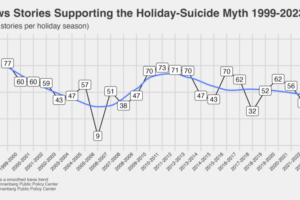
Figure 1. The percentage of holiday-season newspaper stories supporting the false holiday-suicide myth from 1999-2000 through 2022-23. Source: Annenberg Public Policy Center.

What’s behind the holiday-suicide myth

Taxis on a city street

Transportation noise increases risk for suicides

Substack subscription form sign up

Comments

  • Norwood johnson on Electrons in New Crystals Behave as If They Live in Four Dimensions
  • ScienceBlog.com on Hidden Geometry Could Finally Fix Quantum Computers
  • Theo Prinse on America Is Going Back to the Moon. This Time, It Plans to Stay
  • george w on Hidden Geometry Could Finally Fix Quantum Computers
  • Tom Hughes on Years of Exercise, Blood Pressure Drugs Failed to Slow Cognitive Decline in Seniors at Dementia Risk
© 2026 ScienceBlog.com | Follow our RSS / XML feed