Skip to content
ScienceBlog.com
  • Featured Blogs
    • EU Horizon Blog
    • ESA Tracker
    • Experimental Frontiers
    • Josh Mitteldorf’s Aging Matters
    • Dr. Lu Zhang’s Gondwanaland
    • NeuroEdge
    • NIAAA
    • SciChi
    • The Poetry of Science
    • Wild Science
  • Topics
    • Brain & Behavior
    • Earth, Energy & Environment
    • Health
    • Life & Non-humans
    • Physics & Mathematics
    • Social Sciences
    • Space
    • Technology
  • Our Substack
  • Follow Us!
    • Bluesky
    • Threads
    • FaceBook
    • Google News
    • Twitter/X
  • Contribute/Contact

Sunrise

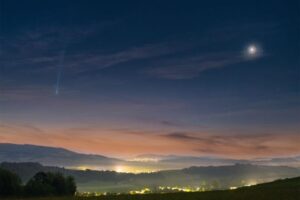
This scene would be beautiful even without the comet. By itself, the sunrise sky is an elegant deep blue on high, with faint white stars peeking through, while near the horizon is a pleasing tan. By itself, the foreground hills of eastern Slovakia are appealingly green, with the Zadňa hura and Veľká hora hills in the distance, and with the lights of small towns along the way. Venus, by itself on the right, appears unusually exquisite, surrounded by a colorful atmospheric corona. But what attracts the eye most is the comet. On the left, in this composite image taken just before dawn yesterday morning, is Comet Nishimura. On recent mornings around the globe, its bright coma and long ion tail make many a morning panoramic photo unusually beautiful. Tomorrow, C/2023 P1 (Nishimura) will pass its nearest to the Earth for about the next 434 years.

Beautiful Comet Nishimura

Substack subscription form sign up

Comments

  • Marco Messina on More Than a Third of Americans Have Lost Relationships Over Politics
  • Anon on Why Fructose Behaves Less Like a Calorie and More Like a Hormone
  • Mark Mellinger on Living Plastic Can Self-Destruct on Command
  • Marie Feret on The Silent Frequency That Makes Old Buildings Feel Haunted
  • Dax on The Silent Frequency That Makes Old Buildings Feel Haunted
© 2026 ScienceBlog.com | Follow our RSS / XML feed