Skip to content
ScienceBlog.com
  • Featured Blogs
    • EU Horizon Blog
    • ESA Tracker
    • Experimental Frontiers
    • Josh Mitteldorf’s Aging Matters
    • Dr. Lu Zhang’s Gondwanaland
    • NeuroEdge
    • NIAAA
    • SciChi
    • The Poetry of Science
    • Wild Science
  • Topics
    • Brain & Behavior
    • Earth, Energy & Environment
    • Health
    • Life & Non-humans
    • Physics & Mathematics
    • Social Sciences
    • Space
    • Technology
  • Our Substack
  • Follow Us!
    • Bluesky
    • Threads
    • FaceBook
    • Google News
    • Twitter/X
  • Contribute/Contact

Supermassive black hole

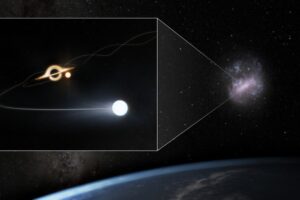
Artist’s impression of a hypervelocity star ejected from the Large Magellanic Cloud (shown on right). When a binary star system ventures too close to a supermassive black hole, the intense gravitational forces tear the pair apart. One star is captured into a tight orbit around the black hole, while the other is flung outward at extreme velocities—often exceeding thousands of kilometers per second—becoming a hypervelocity star. The inset illustration depicts this process: the original binary’s orbital path is shown as interwoven lines, with one star being captured by the black hole (near center of inset) while the other is ejected into space (lower right).

Runaway Stars Reveal Hidden Black Hole in Milky Way’s Nearest Neighbor

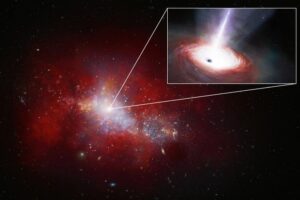
Artist’s Impression of Fastest-feeding Black Hole in the Early Universe

Astronomers Discover Unprecedented ‘Feasting’ Black Hole in Early Universe

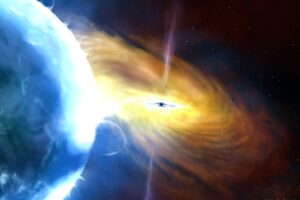
Illustration: a black hole accretion.

Biggest Explosion Ever

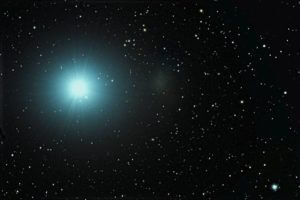
The ultra-faint Milky Way companion galaxy Leo I appears as a faint patch to the right of the bright star, Regulus.

Astrophysicists hunt for second-closest supermassive black hole

Substack subscription form sign up

Comments

  • Karoly Mirnics on Common Prescription Drugs May Disrupt Cholesterol Pathways in the Womb and Raise Autism Risk
  • Aizen on Laziness helped lead to extinction of Homo erectus
  • Norwood johnson on Electrons in New Crystals Behave as If They Live in Four Dimensions
  • ScienceBlog.com on Hidden Geometry Could Finally Fix Quantum Computers
  • Theo Prinse on America Is Going Back to the Moon. This Time, It Plans to Stay
© 2026 ScienceBlog.com | Follow our RSS / XML feed