Skip to content
ScienceBlog.com
  • Featured Blogs
    • EU Horizon Blog
    • ESA Tracker
    • Experimental Frontiers
    • Josh Mitteldorf’s Aging Matters
    • Dr. Lu Zhang’s Gondwanaland
    • NeuroEdge
    • NIAAA
    • SciChi
    • The Poetry of Science
    • Wild Science
  • Topics
    • Brain & Behavior
    • Earth, Energy & Environment
    • Health
    • Life & Non-humans
    • Physics & Mathematics
    • Social Sciences
    • Space
    • Technology
  • Our Substack
  • Follow Us!
    • Bluesky
    • Threads
    • FaceBook
    • Google News
    • Twitter/X
  • Contribute/Contact

sustainable energy

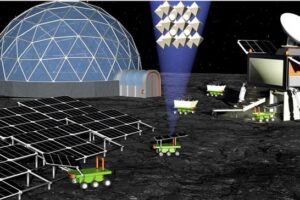
Vision of future solar cell fabrication on the Moon, utilizing raw regolith. Shown are robots that source raw regolith and bring it to a production facility, which fabricates perovskite-based moon solar cells. Later automated rovers or astronauts install the produced solar cells to power future Moon-habitats or even cities.

Moon Dust Solar Cells Could Revolutionize Space Power

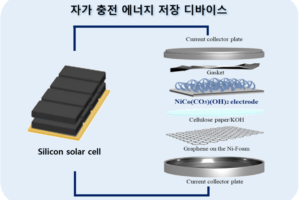
A schematic diagram of a self-charging energy storage device

Korean Scientists Develop Breakthrough Solar-Powered Charging Tech

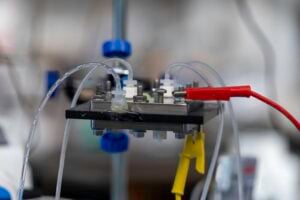
Reactor prototype. Credit Photo by Gustavo Raskoksy/Rice University.

New reactor could make direct air capture more energy efficient

Concept of a lithium vapor cave, which is proposed to shield the interior of a tokamak from the intense heat generated by plasma.

Study Pinpoints Ideal Location for Liquid Metal Heat Shield in Fusion Reactors

This image depicts the inductively heated metamaterial reactor with catalysts filling the ceramic foam baffle. It is producing carbon monoxide and water from the reverse water gas shift reaction. | Dolly Mantle

Revolutionary Electric Reactor Could Slash Industrial Carbon Emissions

hydrogen powered airliner

Hydrogen-Powered Planes Could Revolutionize Short-Haul Flights by 2045

Interior of the Joint European Torus (JET) tokamak experimental fusion machine with a photo of the plasma overlaid.

JET Achieves World Record in Fusion Energy Output

Solar panels in a grassy field | Caltech

Better Energy Harvesting with ‘Law-Breaking’ Device

A zeppelin or blimp

Solar-powered airships could make air travel climate-friendly

At slow shutter speeds, the atomic structure of GeTE looks ordered but blurred. Faster exposures reveal a clear intricate pattern of dynamic displacements. Credit: Jill Hemman/ORNL, U.S. Dept. of Energy

Camera with shutter speed of 1 trillionth of a second sees through dynamic disorder of atoms

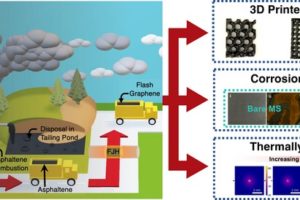
Researchers at Rice are pursuing the “sustainable valorization” of asphaltene by turning it into graphene useful for composite materials. Illustration by M.A.S.R. Saadi

Researchers turn asphaltene into graphene

Substack subscription form sign up

Comments

  • Karoly Mirnics on Common Prescription Drugs May Disrupt Cholesterol Pathways in the Womb and Raise Autism Risk
  • Aizen on Laziness helped lead to extinction of Homo erectus
  • Norwood johnson on Electrons in New Crystals Behave as If They Live in Four Dimensions
  • ScienceBlog.com on Hidden Geometry Could Finally Fix Quantum Computers
  • Theo Prinse on America Is Going Back to the Moon. This Time, It Plans to Stay
© 2026 ScienceBlog.com | Follow our RSS / XML feed