Skip to content
ScienceBlog.com
  • Featured Blogs
    • EU Horizon Blog
    • ESA Tracker
    • Experimental Frontiers
    • Josh Mitteldorf’s Aging Matters
    • Dr. Lu Zhang’s Gondwanaland
    • NeuroEdge
    • NIAAA
    • SciChi
    • The Poetry of Science
    • Wild Science
  • Topics
    • Brain & Behavior
    • Earth, Energy & Environment
    • Health
    • Life & Non-humans
    • Physics & Mathematics
    • Social Sciences
    • Space
    • Technology
  • Our Substack
  • Follow Us!
    • Bluesky
    • Threads
    • FaceBook
    • Google News
    • Twitter/X
  • Contribute/Contact

tau protein

Senior friends having dinner for Christmas evening

Father with Alzheimer’s? You May Be More at Risk of Brain Changes

WashU Medicine researcher Kanta Horie, PhD, places a sample in a mass spectrometer that measures protein levels in blood plasma and other fluids. Horie co-led the development of a blood test for Alzheimer’s disease that diagnoses and stages the disease by using mass spectrometry to measure the level of a protein called MTBR-tau243.

Highly accurate blood test diagnoses Alzheimer’s disease, measures extent of dementia

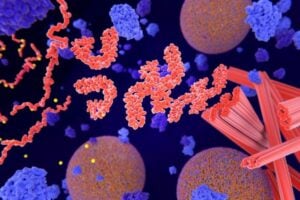
Pathological phosphorylation (yellow) of Tau proteins (red-orange) leads to disintegration of microtubuli in the neuron axon an aggregation of the tau proteins. The transport of synaptic vesicles (orange-blue) is interrupted. Credit: selvanegra on iStock

Achilles’ Heel of Alzheimer’s: Scientists Pinpoint Crucial Protein Variant Driving Brain Cell Damage

The research team from the INc-UAB that conducted the study. From left to right: Ángel Deprada, Arnaldo Parra-Damas, Paula Sotillo, Carles Saura y Maria Dolores Capilla-López. © UAB

Key Alzheimer’s Proteins Attack Different Brain Regions, Study Shows Need for Combined Treatment

Or Shemesh, Ph.D.

Surprising Protective Role of Tau Protein Against Herpes Virus in Alzheimer’s

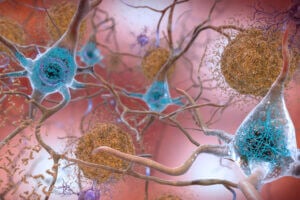
In the Alzheimer’s affected brain, abnormal collections of the tau protein accumulate and form tangles (seen in blue) within neurons, harming synaptic communication between nerve cells. Credits:Image: National Institute on Aging, NIH

How Key Enzyme Transforms Brain Protein in Alzheimer’s

Zebrafish Credit: Kuznetsov_Peter

Common Glaucoma Drug Shows Promise in Fighting Dementia

The brain of a 7-day-old fruit fly with Tau expressed in a neuronal circuit used by the fly in olfactory memory. The green outlines the neurons, which are starting to swell and degenerate due to the Tau protein. The red shows where Tau is building up in clusters along the neurons, starting to form the clumps that eventually become rope-like fibrils.

Promising ‘first’ in Alzheimer’s drug development

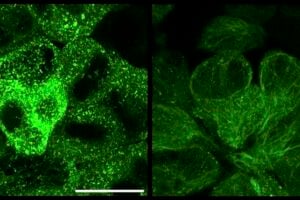
Cells containing tau aggregates (green) before (left) and 13 hours after treatment with RING-nanobody (right)

Therapy targets and destroys tau tangles in Alzheimer’s treatment

An elderly couple walking together

Why Progress in Alzheimer’s Disease Treatment Has Taken 30 Years

Espresso machine

Espresso can prevent Alzheimer’s protein clumping in lab tests

Substack subscription form sign up

Comments

  • Norwood johnson on Electrons in New Crystals Behave as If They Live in Four Dimensions
  • ScienceBlog.com on Hidden Geometry Could Finally Fix Quantum Computers
  • Theo Prinse on America Is Going Back to the Moon. This Time, It Plans to Stay
  • george w on Hidden Geometry Could Finally Fix Quantum Computers
  • Tom Hughes on Years of Exercise, Blood Pressure Drugs Failed to Slow Cognitive Decline in Seniors at Dementia Risk
© 2026 ScienceBlog.com | Follow our RSS / XML feed