Skip to content
ScienceBlog.com
  • Featured Blogs
    • EU Horizon Blog
    • ESA Tracker
    • Experimental Frontiers
    • Josh Mitteldorf’s Aging Matters
    • Dr. Lu Zhang’s Gondwanaland
    • NeuroEdge
    • NIAAA
    • SciChi
    • The Poetry of Science
    • Wild Science
  • Topics
    • Brain & Behavior
    • Earth, Energy & Environment
    • Health
    • Life & Non-humans
    • Physics & Mathematics
    • Social Sciences
    • Space
    • Technology
  • Our Substack
  • Follow Us!
    • Bluesky
    • Threads
    • FaceBook
    • Google News
    • Twitter/X
  • Contribute/Contact

Theoretical Physics

Artist’s impression of a warp bubble collapse (AI)

Gravitational Waves from Failed Warp Drives: A New Frontier in Space Exploration

Comparison between CMB data resolution collected by Planck and SPT-3G

Cosmologists Grapple with Growing Tension in Understanding Universe’s Expansion

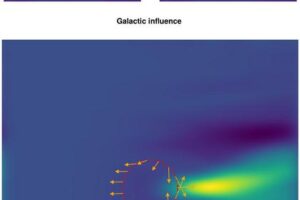
Dynamical friction. The panels depict sparse areas of the universe with dark colour and dense areas with light colour. The upper panels show the density around a galaxy if the galaxy's gravity bends (left) or does not bend (right) the trajectories of dark matter particles. The lower panel shows the difference between them, or how the galaxy affects the distribution of dark matter. The arrows represent the acceleration caused by the overdensity behind the galaxy, from which the friction on the centre of the galaxy is deducted. Since the arrows have different directions and strengths in different areas, the tidal forces are able to change the shape of a galaxy.

Lopsided galaxies shed light on the speed of dark matter

Researchers have discovered Pines' demon, a collection of electrons in a metal that behaves like a massless wave.

Demon Hunting: Physicists confirm 67-year-old prediction of massless, neutral composite particle

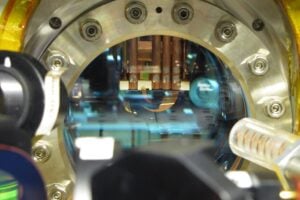
Vacuum chamber containing the atom chip

Paradoxical quantum phenomenon measured for the first time

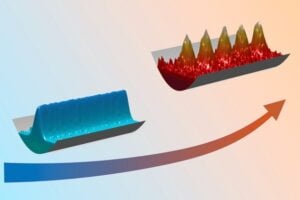
When a quantum liquid is heated, crystalline structures can appear.

Quantum liquid becomes solid when heated

A new collaboration aims to push the boundaries of knowledge about the fundamental character of four-dimensional space-time. (Composite: Rhiannon Montelius. Image Sources: Unsplash and PxHere.)

Unlocking the Secrets of a 4D Cosmos
Substack subscription form sign up

Comments

  • Norwood johnson on Electrons in New Crystals Behave as If They Live in Four Dimensions
  • ScienceBlog.com on Hidden Geometry Could Finally Fix Quantum Computers
  • Theo Prinse on America Is Going Back to the Moon. This Time, It Plans to Stay
  • george w on Hidden Geometry Could Finally Fix Quantum Computers
  • Tom Hughes on Years of Exercise, Blood Pressure Drugs Failed to Slow Cognitive Decline in Seniors at Dementia Risk
© 2026 ScienceBlog.com | Follow our RSS / XML feed