Skip to content
ScienceBlog.com
  • Featured Blogs
    • EU Horizon Blog
    • ESA Tracker
    • Experimental Frontiers
    • Josh Mitteldorf’s Aging Matters
    • Dr. Lu Zhang’s Gondwanaland
    • NeuroEdge
    • NIAAA
    • SciChi
    • The Poetry of Science
    • Wild Science
  • Topics
    • Brain & Behavior
    • Earth, Energy & Environment
    • Health
    • Life & Non-humans
    • Physics & Mathematics
    • Social Sciences
    • Space
    • Technology
  • Our Substack
  • Follow Us!
    • Bluesky
    • Threads
    • FaceBook
    • Google News
    • Twitter/X
  • Contribute/Contact

tissue engineering

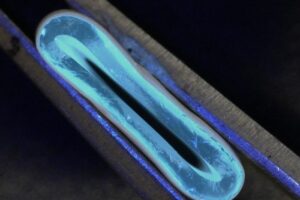
Image of a 3D printed blood vessel.

3D-Printed Blood Vessels: A Game-Changer for Heart Bypass Surgery

Stephanie Bryant, a researcher in the BioFrontiers Institute at the University of Colorado Boulder, will be receiving a substantial grant to find a possible cure for osteoarthritis works with Graduate Research Assistant Laurel Stefani, a Biomedical Engineering PhD major from Richardson, TX. (Photo by Casey A. Cass/University of Colorado)

Joints that could heal themselves? Researchers could get there in five years

Illustration of surgeon holding a heart

Hydrogels can help mend a broken heart

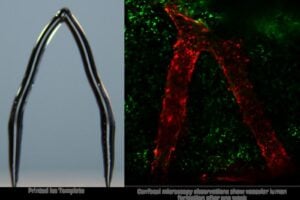
3D ice printing can create artificial blood vessels in engineered tissue

3D ice printing can create artificial blood vessels in engineered tissue

Bovine muscle cells grown for meat make their own growth factors, removing an expensive ingredient from the liquid growth media

Cultivated meat costs could fall significantly with new cells

An Anthrobot is shown, depth colored, with a corona of cilia that provides locomotion for the bot

Scientists build tiny biological robots from human cells

Human nose structure 3D printed with a support material.

Cell-friendly bioprinting at high fidelity enhances its medical applicability

We’re closer to engineering blood vessels

We’re closer to engineering blood vessels

Illustration of egg recycling process

Pushing frontiers through upcycling: Eggshell waste for bone graft material

Fat contributes texture and distinct flavor to farm raised beef (shown here) and other meats. Researchers have replicated the texture and composition of natural fat in fat tissue grown from cells.

Lab-grown fat could give cultured meat real flavor and texture

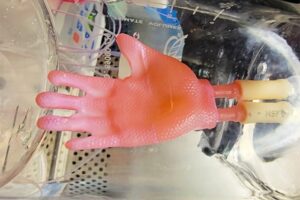
Creating a "glove" of engineered skin for grafting.

Bioengineered skin grafts that fit like a glove

Glue gun

Engineered cells act like glue, could help heal wounds, regrow nerves

Substack subscription form sign up

Comments

  • Norwood johnson on Electrons in New Crystals Behave as If They Live in Four Dimensions
  • ScienceBlog.com on Hidden Geometry Could Finally Fix Quantum Computers
  • Theo Prinse on America Is Going Back to the Moon. This Time, It Plans to Stay
  • george w on Hidden Geometry Could Finally Fix Quantum Computers
  • Tom Hughes on Years of Exercise, Blood Pressure Drugs Failed to Slow Cognitive Decline in Seniors at Dementia Risk
© 2026 ScienceBlog.com | Follow our RSS / XML feed