Skip to content
ScienceBlog.com
  • Featured Blogs
    • EU Horizon Blog
    • ESA Tracker
    • Experimental Frontiers
    • Josh Mitteldorf’s Aging Matters
    • Dr. Lu Zhang’s Gondwanaland
    • NeuroEdge
    • NIAAA
    • SciChi
    • The Poetry of Science
    • Wild Science
  • Topics
    • Brain & Behavior
    • Earth, Energy & Environment
    • Health
    • Life & Non-humans
    • Physics & Mathematics
    • Social Sciences
    • Space
    • Technology
  • Our Substack
  • Follow Us!
    • Bluesky
    • Threads
    • FaceBook
    • Google News
    • Twitter/X
  • Contribute/Contact

Tissue regeneration

Photograph of a common European starfish (Asterias rubens) with a regenerating arm. Starfish can shed their arms (a process called autotomy) when attacked by predators and later regenerate the lost arm. Researchers at Queen Mary University of London have discovered the mechanisms behind autotomy, identifying a neurohormone that triggers arm loss in starfish.

Starfish Survival Secret: Scientists Uncover Hormone Behind Limb Detachment

A digital illustration of a human shoulder joint, with the rotator cuff tendons and bursa highlighted in different colors.

Removing Shoulder Bursa During Rotator Cuff Surgery May Impair Healing

infographic about gel

Innovative gel offers new hope for treating gastrointestinal leaks

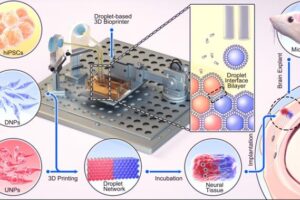
Droplets containing human iPSC-derived neural progenitors were 3D-printed to form 2-layer cerebral cortical tissue, which was cultured before implantation into a mouse brain slice. DNPs: deep-layer neural progenitors; UNPs: upper-layer neural progenitors. Image credit: Yongcheng Jin, University of Oxford.

3D printing method shows promise for repairing brain injuries

Understanding what turns regeneration on and off could lead to advances in medical treatments and interventions, including implications related to cancer. (Image credit: Rattiya Thongdumhyu / Shutterstock)

Regeneration might be a whole-body affair

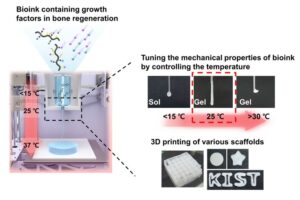
Tuning mechanical properties of bioink according to temperature and 3d scaffold printing

Safe bioink for artificial organ printing

Substack subscription form sign up

Comments

  • Karoly Mirnics on Common Prescription Drugs May Disrupt Cholesterol Pathways in the Womb and Raise Autism Risk
  • Aizen on Laziness helped lead to extinction of Homo erectus
  • Norwood johnson on Electrons in New Crystals Behave as If They Live in Four Dimensions
  • ScienceBlog.com on Hidden Geometry Could Finally Fix Quantum Computers
  • Theo Prinse on America Is Going Back to the Moon. This Time, It Plans to Stay
© 2026 ScienceBlog.com | Follow our RSS / XML feed