Skip to content
ScienceBlog.com
  • Featured Blogs
    • EU Horizon Blog
    • ESA Tracker
    • Experimental Frontiers
    • Josh Mitteldorf’s Aging Matters
    • Dr. Lu Zhang’s Gondwanaland
    • NeuroEdge
    • NIAAA
    • SciChi
    • The Poetry of Science
    • Wild Science
  • Topics
    • Brain & Behavior
    • Earth, Energy & Environment
    • Health
    • Life & Non-humans
    • Physics & Mathematics
    • Social Sciences
    • Space
    • Technology
  • Our Substack
  • Follow Us!
    • Bluesky
    • Threads
    • FaceBook
    • Google News
    • Twitter/X
  • Contribute/Contact

underwater technology

Ohio State logo

New technology lights way for accelerating coral reef restoration

Researchers developed a single-photon Raman lidar system that operates underwater and can remotely distinguish various substances They demonstrated the system by using it to detect varying thicknesses of gasoline oil in a quartz cell that was 12 meters away from the system in a large pool.

New single-photon Raman lidar can monitor for underwater oil leaks

Oceans to get better protection with connected underwater technology

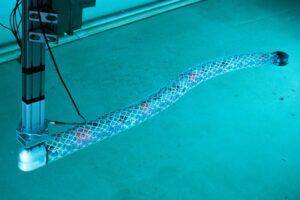
Researchers have come up with an innovative approach to building deformable underwater robots using simple repeating substructures. The team has demonstrated the new system in two different example configurations, one like an eel, pictured here in the MIT tow tank. Credits:Credit: Courtesy of the researchers

Engineers devise a system to produce efficient aquabots

Substack subscription form sign up

Comments

  • Curtis Webber on The GPS-Killer? This Quantum Device ‘Feels’ Motion Like a Brain—Down to the Atomic Level
  • Ran on How the Age You First Had Sex Could Shape How You Age Decades Later
  • Sparty on How the Age You First Had Sex Could Shape How You Age Decades Later
  • Josh Mitteldorf on A Single TV Segment Sent Leucovorin Prescriptions for Autistic Children Soaring 2,000 Percent
  • Josh Mitteldorf on A Single TV Segment Sent Leucovorin Prescriptions for Autistic Children Soaring 2,000 Percent
© 2026 ScienceBlog.com | Follow our RSS / XML feed