Skip to content
ScienceBlog.com
  • Featured Blogs
    • EU Horizon Blog
    • ESA Tracker
    • Experimental Frontiers
    • Josh Mitteldorf’s Aging Matters
    • Dr. Lu Zhang’s Gondwanaland
    • NeuroEdge
    • NIAAA
    • SciChi
    • The Poetry of Science
    • Wild Science
  • Topics
    • Brain & Behavior
    • Earth, Energy & Environment
    • Health
    • Life & Non-humans
    • Physics & Mathematics
    • Social Sciences
    • Space
    • Technology
  • Our Substack
  • Follow Us!
    • Bluesky
    • Threads
    • FaceBook
    • Google News
    • Twitter/X
  • Contribute/Contact

Very Large Telescope

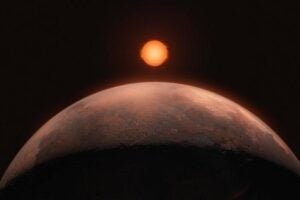
This artist’s impression shows Barnard b, a sub-Earth-mass planet that was discovered orbiting Barnard’s star. Its signal was detected with the ESPRESSO instrument on ESO’s Very Large Telescope (VLT), and astronomers were able to confirm it with data from other instruments. An earlier promising detection in 2018 around the same star could not be confirmed by these data. On this newly discovered exoplanet, which has at least half the mass of Venus but is too hot to support liquid water, a year lasts just over three Earth days.

Astronomers Discover Sub-Earth Planet Orbiting Closest Single Star to Our Sun

Substack subscription form sign up

Comments

  • Simon on A New Theory Says DMT Entities Might Be Real, and Proposes How to Test It
  • Sue Ann Hayes on Hidden Nuclear Protein Fuels Pancreatic Cancer’s Deadly Aggression
  • Curtis Webber on The GPS-Killer? This Quantum Device ‘Feels’ Motion Like a Brain—Down to the Atomic Level
  • Ran on How the Age You First Had Sex Could Shape How You Age Decades Later
  • Sparty on How the Age You First Had Sex Could Shape How You Age Decades Later
© 2026 ScienceBlog.com | Follow our RSS / XML feed