Skip to content
ScienceBlog.com
  • Featured Blogs
    • EU Horizon Blog
    • ESA Tracker
    • Experimental Frontiers
    • Josh Mitteldorf’s Aging Matters
    • Dr. Lu Zhang’s Gondwanaland
    • NeuroEdge
    • NIAAA
    • SciChi
    • The Poetry of Science
    • Wild Science
  • Topics
    • Brain & Behavior
    • Earth, Energy & Environment
    • Health
    • Life & Non-humans
    • Physics & Mathematics
    • Social Sciences
    • Space
    • Technology
  • Our Substack
  • Follow Us!
    • Bluesky
    • Threads
    • FaceBook
    • Google News
    • Twitter/X
  • Contribute/Contact

Virology

illustration of hiv and cell nucleus

Simulations show how HIV sneaks into the nucleus of the cell

Ohio State logo

SARS-CoV-2 BA.2.86 is less resistant to vaccine, but may be a problem in the lung

High-resolution illustration of cells and virus

Researchers Unveil Elusive HIV Protein Structure, Paving the Way for Targeted Treatments

Dr. Amitinder Kaur, principal investigator and professor of microbiology and immunology at Tulane National Primate Research Center.

Exposure to common virus shields against birth defects and miscarriage

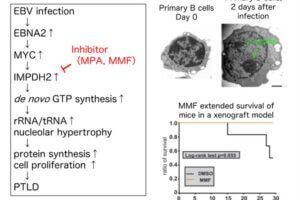
New study shows how the Epstein-Barr virus transforms B cells

How the Epstein-Barr virus transforms cells

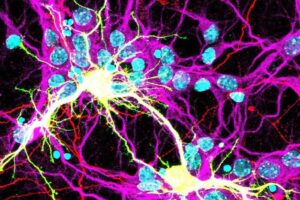
Image of fused neurons (yellow) expressing Spike S fusogen from the SARS-CoV-2 virus and the human receptor hACE2.

Brain cells can fuse from COVID-19

Phage image based on that published in Gold et al, Nature Communications

Looks like Marge Simpson: Phage structure captured for the first time

HIV virus closeup

HIV can persist for years in myeloid cells of people on antiretroviral therapy

Eye with tears

COVID-19 virus can be detected in tears

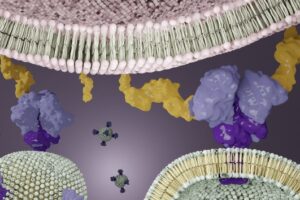
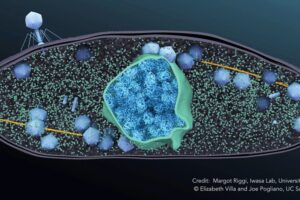
A jumbo phage infects a bacterium. A nucleus-like compartment (green) is formed to protect the newly synthesized phage genomes from bacterial defense systems. The capsids (gray) of the new phage travel along filaments called PhuZ (yellow) to be delivered to the nucleus where they dock in order to package phage DNA. Eventually, the bacterial cell lyses and the new phage emerge ready to infect new bacteria. Credit: Margot Riggi, Iwasa Lab, University of Utah. Copyright Elizabeth Villa and Joe Pogliano, UC San Diego

Therapeutic Potential of Bizarre ‘Jumbo’ Viruses Tapped for $10M HHMI Emerging Pathogens Project

Ohio State logo

2 health sciences professors named fellows of the National Academy of Inventors

Newer posts
← Previous Page1 Page2
Substack subscription form sign up

Comments

  • Ashok Kumar on Machine Learning Matched the Right Lifestyle Fix to Each Depressed Patient, Doubling Remission Rates
  • Curtis Webber on The GPS-Killer? This Quantum Device ‘Feels’ Motion Like a Brain—Down to the Atomic Level
  • Ran on How the Age You First Had Sex Could Shape How You Age Decades Later
  • Sparty on How the Age You First Had Sex Could Shape How You Age Decades Later
  • Josh Mitteldorf on A Single TV Segment Sent Leucovorin Prescriptions for Autistic Children Soaring 2,000 Percent
© 2026 ScienceBlog.com | Follow our RSS / XML feed