Skip to content
ScienceBlog.com
  • Featured Blogs
    • EU Horizon Blog
    • ESA Tracker
    • Experimental Frontiers
    • Josh Mitteldorf’s Aging Matters
    • Dr. Lu Zhang’s Gondwanaland
    • NeuroEdge
    • NIAAA
    • SciChi
    • The Poetry of Science
    • Wild Science
  • Topics
    • Brain & Behavior
    • Earth, Energy & Environment
    • Health
    • Life & Non-humans
    • Physics & Mathematics
    • Social Sciences
    • Space
    • Technology
  • Our Substack
  • Follow Us!
    • Bluesky
    • Threads
    • FaceBook
    • Google News
    • Twitter/X
  • Contribute/Contact

virtual reality

Greg Sword, Ph.D., studies desert locusts and other swarming insects like crickets and is a researcher in the Behavioral Plasticity Research Institute at Texas A&M University. New research provides a new, science-based theory about how these pests move as a collective. (Sam Craft/Texas A&M AgriLife)

Virtual Reality Exposes How Locusts Really Think in Massive Swarms

Illustration of a person walking down a forest path

Watching Nature Videos Can Reduce Physical Pain, Brain Scans Reveal

hand on fire

Virtual Reality Study Shows Our Brains Can Amplify Pain When Surprised

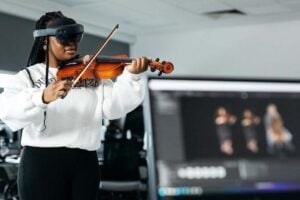
Musicians collaborate remotely with just an iPhone and VR headset, using software that creates a synchronized avatar for performance, practice, or teaching.

Virtual Reality Platform Eliminates Key Barrier to Remote Music Collaboration

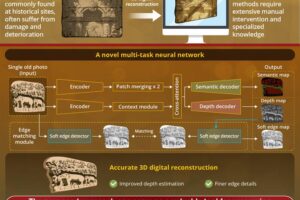
The innovative multi-task neural network achieves simultaneous depth estimation and soft-edge detection in a single network, producing clear 3D reconstructed images of relief-type cultural heritage objects from a single old photo.

AI Brings Ancient Temple Carvings Back to Life Using Historical Photos

Researchers from MIT and elsewhere created a system that enables users to have an online, text-based conversation with an AI-generated simulation of their potential future self. Credits:Credit: Future You; Melanie Gonick, MIT

MIT Researchers Develop AI System That Simulates Users’ Future Selves

Immersive VR goggles for mice unlock new potential for brain science

Immersive VR goggles for mice unlock new potential for brain science

Rat

Rats, too, have an imagination

Mature woman crossing the street

Certain navigational mistakes could be early signs of Alzheimer’s disease

Virtual-reality tech is fast becoming more real

National Institute on Alcohol Abuse and Alcoholism Launches an Educational Virtual Reality Experience for Teens

Ohio State logo

Turning old maps into 3D digital models of lost neighborhoods

Curbing crime with 3D avatars and intelligent design

Renee Abbott and Ana Diaz Artiles are looking into multisensory virtual reality technology as a tool to support the behavioral health of astronauts on long-duration missions. Texas A&M Engineering

How multisensory virtual reality can support future astronauts

Substack subscription form sign up

Comments

  • Karoly Mirnics on Common Prescription Drugs May Disrupt Cholesterol Pathways in the Womb and Raise Autism Risk
  • Aizen on Laziness helped lead to extinction of Homo erectus
  • Norwood johnson on Electrons in New Crystals Behave as If They Live in Four Dimensions
  • ScienceBlog.com on Hidden Geometry Could Finally Fix Quantum Computers
  • Theo Prinse on America Is Going Back to the Moon. This Time, It Plans to Stay
© 2026 ScienceBlog.com | Follow our RSS / XML feed