Skip to content
ScienceBlog.com
  • Featured Blogs
    • EU Horizon Blog
    • ESA Tracker
    • Experimental Frontiers
    • Josh Mitteldorf’s Aging Matters
    • Dr. Lu Zhang’s Gondwanaland
    • NeuroEdge
    • NIAAA
    • SciChi
    • The Poetry of Science
    • Wild Science
  • Topics
    • Brain & Behavior
    • Earth, Energy & Environment
    • Health
    • Life & Non-humans
    • Physics & Mathematics
    • Social Sciences
    • Space
    • Technology
  • Our Substack
  • Follow Us!
    • Bluesky
    • Threads
    • FaceBook
    • Google News
    • Twitter/X
  • Contribute/Contact

weather mapping

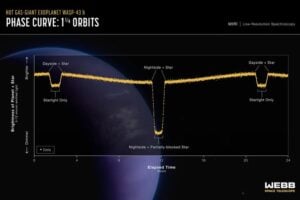
This phase curve, captured by the MIRI low resolution spectrometer on NASA’s James Webb Space Telescope, shows the change in brightness of the WASP-43 system over time as the planet orbits its star. The system appears brightest when the hot dayside of the planet is facing the telescope, just before and after it passes behind the star. The system grows dimmer as the planet continues its orbits and the nightside rotates into view. It brightens again after passing in front of the star as the dayside rotates back into view. WASP-43 b is a hot Jupiter roughly 280 light-years away, in the constellation Sextans.

Webb Telescope Unveils Extreme Weather on Distant Exoplanet WASP-43 b

Substack subscription form sign up

Comments

  • Marie Feret on The Silent Frequency That Makes Old Buildings Feel Haunted
  • Dax on The Silent Frequency That Makes Old Buildings Feel Haunted
  • Karoly Mirnics on Common Prescription Drugs May Disrupt Cholesterol Pathways in the Womb and Raise Autism Risk
  • Aizen on Laziness helped lead to extinction of Homo erectus
  • Norwood johnson on Electrons in New Crystals Behave as If They Live in Four Dimensions
© 2026 ScienceBlog.com | Follow our RSS / XML feed