Skip to content
ScienceBlog.com
  • Featured Blogs
    • EU Horizon Blog
    • ESA Tracker
    • Experimental Frontiers
    • Josh Mitteldorf’s Aging Matters
    • Dr. Lu Zhang’s Gondwanaland
    • NeuroEdge
    • NIAAA
    • SciChi
    • The Poetry of Science
    • Wild Science
  • Topics
    • Brain & Behavior
    • Earth, Energy & Environment
    • Health
    • Life & Non-humans
    • Physics & Mathematics
    • Social Sciences
    • Space
    • Technology
  • Our Substack
  • Follow Us!
    • Bluesky
    • Threads
    • FaceBook
    • Google News
    • Twitter/X
  • Contribute/Contact

Wound care

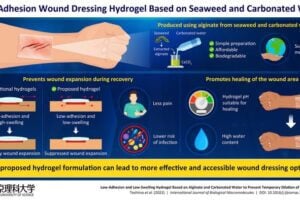
Alginate is a biocompatible and biodegradable substance found in seaweed. Now, researchers from Tokyo University of Science have used alginate from seaweed washed ashore, CaCO3, and carbonated water to develop a hydrogel which exhibits lower skin adhesion and swelling. These properties, though exactly opposite of conventional wound dressings, can help prevent the expansion of the wound site during recovery and the obtained hydrogel has high wound healing efficacy.

Revolutionary seaweed and carbonated water based hydrogel for treating skin wounds

Honey dipper dripping honey. Pixabay

Researchers revisit ancient honey & vinegar mixture to stop infections

The researchers investigated the effects of bioactive glass doped with ionic silver on biofilms formed by Pseudomonas aeruginosa, and the study showed that specific preparation, storage and application techniques can minimise the transformation of silver ions to silver chloride and so retain antimicrobial activity.

Glass-Infused Silver Shows Promise in Chronic Wound Healing

Two images: Blood drops, and an arm being sprayed

Spray fights both infections and antibiotic resistance

Substack subscription form sign up

Comments

  • David A on Why You’re Losing Muscle on Weight Loss Drugs, and What a Gut Hormone Might Do About It
  • Marco Messina on More Than a Third of Americans Have Lost Relationships Over Politics
  • Anon on Why Fructose Behaves Less Like a Calorie and More Like a Hormone
  • Mark Mellinger on Living Plastic Can Self-Destruct on Command
  • Marie Feret on The Silent Frequency That Makes Old Buildings Feel Haunted
© 2026 ScienceBlog.com | Follow our RSS / XML feed