Skip to content
ScienceBlog.com
  • Featured Blogs
    • EU Horizon Blog
    • ESA Tracker
    • Experimental Frontiers
    • Josh Mitteldorf’s Aging Matters
    • Dr. Lu Zhang’s Gondwanaland
    • NeuroEdge
    • NIAAA
    • SciChi
    • The Poetry of Science
    • Wild Science
  • Topics
    • Brain & Behavior
    • Earth, Energy & Environment
    • Health
    • Life & Non-humans
    • Physics & Mathematics
    • Social Sciences
    • Space
    • Technology
  • Our Substack
  • Follow Us!
    • Bluesky
    • Threads
    • FaceBook
    • Google News
    • Twitter/X
  • Contribute/Contact

X

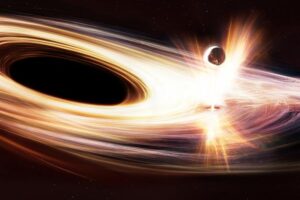
Artist’s impression of the accretion disc around the massive black hole Ansky and its interaction with a small celestial object

From boring to bursting: a giant black hole awakens

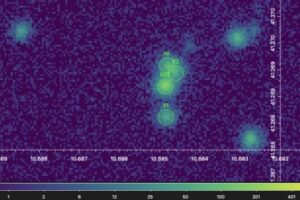
X-ray data gathered by the Chandra telescope from the center of M31, highlighting the four nuclear sources — S1, SSS, N1, and P2. P2 corresponds to the position of the supermassive black hole at the center of the Andromeda galaxy.

When a Black Hole Winks at You

In this visualization, the LEXI instrument is shown onboard Firefly Aerospace’s Blue Ghost Mission 1, which will deliver 10 Commercial Lunar Payload Services (CLPS) payloads to the Moon. Firefly Aerospace

NASA’s Recycled X-ray Instrument Set to Capture First Global Images of Earth’s Magnetic Shield

AI-generated representation of an accreting supermassive black hole, surrounded by gas spiraling toward it along the equatorial plane.

Study Reveals How Early Universe’s Giant Black Holes Grew So Quickly

A 3D reconstruction of a skyrmion derived from X-ray images.

Scientists Capture First 3D X-ray Images of Mysterious Magnetic Skyrmions

An artist's rendering of what's called an active galactic nucleus at the center of NGC 4151. The galaxy's black hole sits at the center, immediately surrounded by an accretion disk shown in blue.

First data from XRISM space mission provides new perspective on supermassive black holes

SLAC received the second LCLS-II-HE cryomodule from Jefferson Lab on March 5, 2024. In Jefferson Lab fashion, it was decorated and delivered to celebrate the nearest holiday – this time St. Patrick's Day.

New Upgrade Will Supercharge Atomic Vision of the World’s Most Powerful X-Ray Laser

Gold nanoparticles are key to University of Texas at Dallas research that has changed researchers’ understanding of how kidneys work at the fundamental level.

X-ray Imaging with Gold Nanoparticles May Outperform Blood Tests in Detecting Kidney Disease

DNA strand

Maternal vs Paternal X-Chromosomes: New Study Reveals Unexpected Tissue Preferences

A 3D rendered image of the spiral galaxy NGC 4151, with a bright central region representing the active galactic nucleus. The image zooms in to show a glowing accretion disk surrounding a supermassive black hole, with twin jets of particles emanating from the disk's center. Colorful spectral lines are overlaid on the image, highlighting the iron fingerprints detected by XRISM's Resolve instrument.

XRISM Telescope Reveals Iron Fingerprints in Nearby Galaxy

Infrared image of the shockwave (red arc) created by the massive giant star Zeta Ophiuchi in an interstellar dust cloud. The tenuous winds of sun-like main-sequence stars are much more difficult to observe

Stellar winds of three sun-like stars detected for the first time

X-ray laser studies help researchers identify early steps in the freezing process to better understand how clouds make ice and their effect on climate. (Greg Stewart/SLAC National Accelerator Laboratory)

Unlocking the mysteries of freezing in supercooled water droplets

This artist’s illustration depicts the “tidal disruption event” (TDE) called ASASSN-14li, which is the focus of the latest study. As a star approached too closely to the supermassive black hole at the system, the strong gravity tore the star apart. This artist’s impression depicts the aftermath of this destruction. After the star was ripped apart, some of its gas (red) was left orbiting around and falling into the black hole. A portion of the gas was driven away in a wind (blue). Image credit: NASA/CXC/University of Michigan/J. Miller et al; Illustration: NASA/CXC/M.Weiss

A giant black hole destroys a massive star

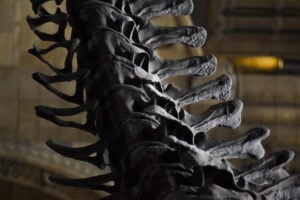
Dinosaur spine

Unveiling the Secrets of Ancient Dinosaurs: Cutting-Edge X-ray Technology Sheds Light on Prehistoric World

Older posts
Page1 Page2 Next →
Substack subscription form sign up

Comments

  • Norwood johnson on Electrons in New Crystals Behave as If They Live in Four Dimensions
  • ScienceBlog.com on Hidden Geometry Could Finally Fix Quantum Computers
  • Theo Prinse on America Is Going Back to the Moon. This Time, It Plans to Stay
  • george w on Hidden Geometry Could Finally Fix Quantum Computers
  • Tom Hughes on Years of Exercise, Blood Pressure Drugs Failed to Slow Cognitive Decline in Seniors at Dementia Risk
© 2026 ScienceBlog.com | Follow our RSS / XML feed