

I begin from the paradigm that aging is not a random process but an adaptation, a programmed self-destruction. This was my entree into the field 27 years ago, and has been the theme of much of my research, including two books. For a summary of the evidence, here’s a blog post from 2015, and here’s the non-technical version of my book.
Once you accept that the body is killing itself on a schedule, you have to ask how the schedule is maintained. Just as growth is programmed in early life and then puberty is initiated by turning on sex hormones, aging happens when inflammation and auto-immunity and insulin resistance are gradually switched on when the body attains a certain age. This implies a master clock, probably the same clock that governs development also controls aging.
Where is that clock and how does it work? If we had an answer to these questions, we could reset the aging clock and an 80-year-old body would act like a 30-year-old body, with all the robust repair and regenerative mechanisms fully engaged.
The aging clock that we seek must have two conflicting properties. Of course, it must keep time reliably to trigger the phenotypes of growth, development, and then senescence on schedule. It must also be homeostatic. Homeostasis is a fundamental property of life. All biological systems tend to restore their state when deranged by the environment. If the clock is perturbed, it must be able to find its way back to a remembered biological age.
| Homeostasis is a defining feature of living organisms, perhaps the most fundamental property of life itself. The word refers to the capacity of a system to maintain its state in the face of slings and arrows of outrageous fortune. For example, we can swim in ice water or we can trek through the Sahara and our bodies maintain a core temperature pretty close to 98.6ºF. We can drink Coca-Cola or we can fast for a week, and still the body keeps enough glucose in the blood to feed our cells without poisoning us with excessive blood sugar. We can take powerful proton pump inhibitors that jam with the body’s mechanism for creating stomach acid, but after a few months the body ramps up the acid factory as much as needed to digest our food.The point is that the body has many jobs that it needs to do, and it is exquisitely adapted to accomplish the most important of these no matter what are the outward circumstances. In the long run, the most important component of Darwinian fitness is the ability to keep on keeping on when the unexpected happens. Homeostasis. |
But how can a clock be homeostatic? If the body’s clock is knocked far off the biologically-determined age, where is the reference information from which it can be reset?
The existence of a clock is implied by the paradigm in which aging is an adaptive program. The need for homeostasis is a general property of biological systems. The only way that the two conditions can be met simultaneously is if there are several independent time-keeping mechanisms, and they are constantly exchanging information. This condition derives from theoretical considerations. I concede that this is a dangerous way to draw conclusions about biology, which has always been primarily an experimental science. So I am going out on a limb to put forth this hypothesis: There ought to be several independent time-keeping mechanism in the bodies of complex organisms like the human animal, and there is continual cross-talk by which they are able to establish consensus, and reset the readout if one clock should differ substantially from the others.
I have written in this column about a central clock in the neuroendocrine center of the brain, the suprachiasmatic nucleus, as documented (independently) by Claudia Cavadas (Lisbon) and Dongshen Cai (NYC). Steve Horvath has convinced us that there is a decentralized clock in the epigenetic state of dispersed cells around the body. Perhaps this counts as more than one clock, since Horvath has measured differences in aging rates in different organs. Epigenetic changes in stem cells may deserve the status of a separate clock.Telomere length in stem cells may constitute another clock. The immune system appears to have its own aging schedule, which was the subject of Roy Walford’s first theory of aging. Perhaps oxidative status of the dispersed mitochondria constitutes a fifth clock. A new possibility is raised by the research from Michael Levin’s Tufts University laboratory. Levin has demonstrated a role for electrical patterns in morphogenesis, healing, and regeneration. His model for cancer is not genetic; rather he has demonstrate that he can create tumors from normal genomes by disrupting their electrical connection to one another, and he can cure cancer in highly-mutated tumors without killing the cells, merely by restoring the cells’ electrical connectivity. Levin has speculated that electrical patterning is lost with age because many vertebrates are able to regenerate limbs or parts of limbs early in life, and gradually lose this capacity as they mature.
We should not be surprised to discover other, independent timekeepers as well. After all, the body must be coerced into killing itself, despite robust Darwinian adaptations that support individual survival and fecundity. If there were an easy path to mutating aging out of existence, then natural selection operating on a short time frame would have found it (with disastrous consequences for the species and the ecosystem).
If my hypothesis is correct, then all these clocks are exchanging signals, cross-checking to establish a consensus age and resetting accordingly. How do the various clocks exchange information? The obvious place to look is signal molecules in the blood. These may be hormones or other large proteins; they may be short peptides; they may be RNAs or ribozymes; they may be extracellular vesicles containing a package of coordinated signal molecules of various types. Age signaling may be accomplished with a combination of all the above. This reasoning leads to the inference that exchanging young blood plasma for old ought to be a robust anti-aging strategy. Besides erythrocytes and leukocytes, the blood carries many thousands of different signals as dilute molecular species dissolved in plasma. Some of these, I suggest, constitute primary information about the age state of the body. This information must be capable of resetting all the body’s different aging clocks.
Of course, the work has commenced nearly two decades ago. Experiments in heterochronic parabiosis. Irina and Mike Conboy did the first experiments in the modern era while they were graduate students at Stanford. Harold Katcher wrote up theory of why this work ought to be the portal to robust rejuvenation. The Conboys have gone on to promote a perspective in which old age is established affirmatively by molecular species in the blood of old animals. In their model, diluting old blood with neutral saline albumen is a path to rejuvenation. In cooperation with Dobri Kiprov, they have initiated a human trial in rejuvenation based on blood dilution.
Katcher and Tony Wyss-Coray and Amy Wagers have championed the converse perspective, that senescence is linked to a dearth of youthful signals in the blood of older animals. Katcher has done proof-of-concept experiments in rats. Wyss-Coray has built a company based on injecting blood factors to treat Alzheimer’s Disease. The company, called Alkahest, has been acquired by the Spanish giant, Grifols, which has been a major player in plasmapheresis therapies. Dan Stickler has a clinic in Texas offering blood plasma from young donors. David Haase at the Maxwell Center has long experience offering plasmapheresis as a therapy.
I think it likely that the most effective strategies for rejuvenation will involve both removal of pro-aging factors and addition of anti-aging factors to the blood plasma. Discovering what these factors are and how they work ought to be a major target for research in the field of medical gerontology. One easy place to start is with extracellular vesicles. These are larger than molecules, smaller than cells, and they are normally filtered out in plasmapheresis. But they may play a crucial role in plasma exchange as an anti-aging strategy; it will be important to know.
Reality check
How well can we expect the new plasma transfusion therapies to work? We have some experience that should guide our expectations.
Two summers ago, I was hit by a car while riding my bicycle and lost most of the blood in my body. Heroic surgery kept me from bleeding to death, against all odds. I received blood during that first surgery and more blood was lost and replenished during 7 follow-up surgeries. The median age of blood donors in America is about 47. I was 72. It’s possible that replacement of the majority of my blood with younger donors had a rejuvenating effect, but if there was any benefit at all, it was not dramatic enough to be noticeable to me or my family.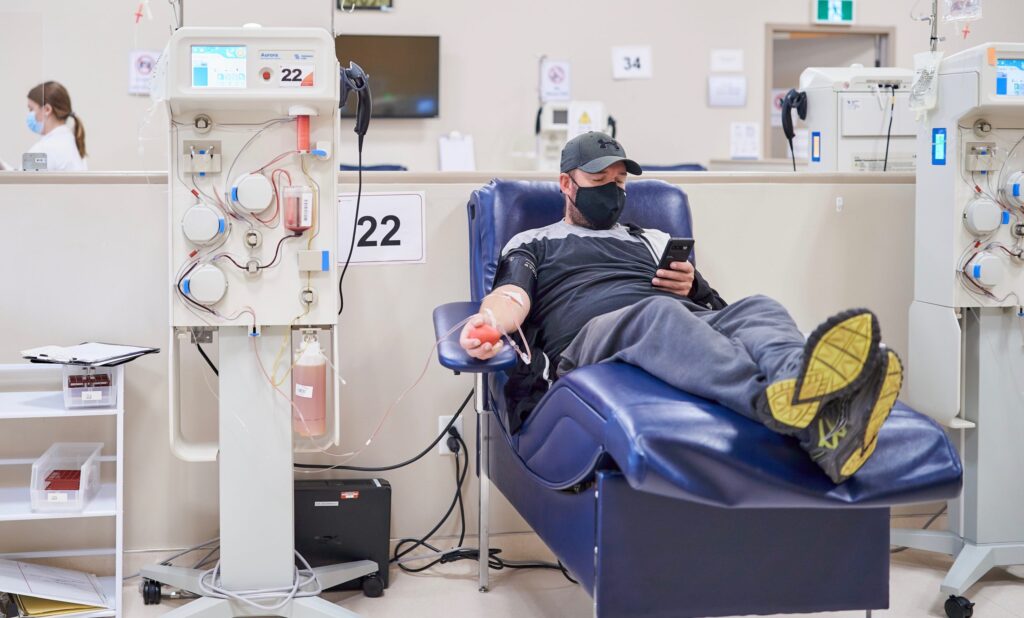
5 million people a year receive blood transfusions. Some of them are very old, and none of them has skipped out of the transfusion clinic with youthful hair color and de-wrinkled foreheads.
A history of blood donation year after year has a substantial benefit for life extension, but it is not dramatic. Giving a pint of blood is equivalent to a 10% dilution, and habitual donors do this a few times per year. (I was donating blood several times a year before my 2021 hospitalization.) Based on standard life tables, 30% decrease in mortality is equivalent to about 3 years of added life.
From this, I would expect that my proposed homeostatic age-resetting mechanism works slowly. We don’t know specifically the lifetime of aging signals in the blood because we don’t know what these signals are; but studies of generic protein turnover in blood plasma suggest ten days or so as a reasonable guess. In Katcher’s rats, the figure is closer to 2 days.
From this, we can say it is likely that resetting the rat’s biological clock takes at least several times 2 days, and resetting the human clock requires at least several times 10 days. It may require repeated transfusions every 10 days over a period of months to see the full effect.
Concerning the effectiveness of E5 in Katcher’s rats, we are still learning. The biomarkers, including Horvath age, were very promising. Longevity seemed to be increased only modestly, however — except for , the last remaining rat (out of 8) who has now broken records for rat longevity at 46 months. Harold’s reported rejuvenation of skin on one hand based on a single application of E5 is an intriguing anecdote that encourages us to hope for the best.
I’m going to pose a much more speculative argument that rejuvenation through transfusions of young blood will be effective, but will not change paradigms about human lifespan. I conjecture that the in the world have special access to technologies that are unavailable to you and me. Have some of them been getting blood transfusions from young donors? David Rockefeller died six years ago, just short of 102 years old. Queen Elizabeth died at 96. Evelyin de Rothschild died last year at 91. is still alive at 99. is 98. and are each 92 and they look it.
The bottom line
I remain optimistic about Harold Katcher’s work and about plasma exchange in general, but we still have a lot of work to do.
And by the way
There are other ways to die, unrelated to age. Bioweapons research has spawned a worldwide epidemic, killing millions, and next time could be worse. We live in a time when collective threats to our existence may soon become as great as the mortality burden imposed by age.
Aging evolved for the purpose of stabilizing ecosystems. Human beings have shown themselves to be adept at destabilizing ecosystems, and now we want to further expand our numbers and extend our power of nature. Mankind cannot “transcend” nature. Humans cannot live outside the context of Gaia’s ecosystem. If we try, it will be the extinction not of Gaia but of the human race.
I believe that the pursuit of longevity is not only scientifically feasible but also worthwhile. But this grand project must be pursued in tandem with an even grander project, which is to change our relationship to naturally ecology from a miner and exploiter to a cooperative steward.
There is evidence that the native population of America had such an ethos, together with the wisdom and the science to create richer ecosystems for their own sake and for the sake of nature’s abundance and diversity. It is required of humanity that we quickly learn that lost art, on pain of extinction.
Discussion
54 reader comments
Imported threads are marked Archive. New comments are welcome and moderated for spam.
https://www.medrxiv.org/content/10.1101/2024.08.02.24310303v1
Latest clinical trial in humans (2024) with regards to TPE's effects on biomarkers of aging.
@josh - is there any chance to make your book - Cracking the Aging Code - available for Kindle on Amazon UK? Thanks. Rob
Look for it under the title What Good is Death.
Got it, thanks. Didn't realise it was the same book.
IMHO, aging occurs simply because muscles lose conditioning as we age. Thus we become susceptible to the effects of stress as we age. Things like inflammation, lowered immune system, reflux, falls, etc.etc. all become more frequent as we age, eventually killing us.
The entities that created us thus make room for bigger and better versions of life,
Why do yeast cells and roundworms age? Same reason or different?
If Conboy is correct that, "dilution is the solution to pollution" ( simple saline dilution of old blood was equivalent to plasma transfusion of young plasma). Then the experiment for anti-aging is currently running with millions of human data points, across the USA. Following new plasma donators, with tests prior and on subsequent visits would illuminate if plasma donation and saline infusion change your epigenetic markers. (your "old" plasma is replaced with saline every 2-4 weeks) Plasma donators are primarily motivated by money ( it is often a very important $300-400 /month income). So receiving an additional stipend to allow followup of their biomarkers would likely not be a problem. This would be an easy, not very expensive study to run. If plasma donation is superior or equal to plasma infusion, then this circumvents all the problems associated with plasma transfusions: Plasma donation:= easy-monthly scheduling, infrastructure already in place, FDA approved, and you get paid to make yourself feel better, no possible infectious agents transferred.
HGH--- my personal experience (and one more marathon running buddy) is that the $$ we spent on it were wasted. We saw very little if any gain. We were in our mid 50's, active/competitive long distance runners.
Thank you for this reference, Dermot! I will write about it if I can find time.
The gist is that a big chunk of the human genome consists of insertions by retroviruses over millions of years that have been silenced successfully. But as we age, some of these insertions tend to get de-methylated and become active again. One result is auto-immunity, as there are human cells that are expressing alien proteins. Another result is that healthy, young cells go into senescence, triggering a cascade of SASP.
This has implications for treatments for aging that suppress these retroviruses, and also implications for understanding the detrimental effects of mRNA vaccination on the immune system.
You hit on the part I was interested in, at the end. The implication on how common autoimmune diseases will start popping up, as well as cancers and other blood issues, post mRNA experiment. When do you think we'll see peak mayhem for this disgusting experiment, Josh? And why would a guy who otherwise is smart, such as Greg Cochran, not be able to understand how much of a hoax this whole thing was from the beginning? My thought was (not trying to make fun, just an explanation) that because he was in really bad physical shape and overweight, he was among the scared and fear mongering, which is sad. He was vicious when I posted at his site, too, referencing all sorts of logic and common sense regarding how little damage the virus actual did to healthy people, as per John Ioannidis original evaluation - and everyone else's who showed that the whole thing was propaganda.
Resurrection of endogenous retroviruses during aging reinforces senescence
Cell. January 19 2023 Liu et al
https://www.sciencedirect.com/science/article/pii/S0092867422015306
Very interesting article
Today's isue of the British newspaper the Guardian features an article on E5.
Dummy Post to receive emails
Hi everybody, I have a question for Akshay (of course). This days I came across several articles about Sima (she looks not in her best shape in the images, but yet 47 months old). The point is that I find such statements as the following:
"Sima", a 47 months-old female rat, is being treated with E5, a treatment intended to recreate the circulatory environment of a young mammal; the maximum recorded lifespan for this species is 45.5 months."
But Sima hasn't been treated for months, isn't it? She only got the two series of 4 E5 shots every other day and after 90 days. Am I wrong? Or has she received extra E5?
In all the articles it states she is being treated.
The point is that what makes her longevity really weird, is that the treatment happened that long ago. We still don't know what would happen if the treatment was continued in time, do we?
Is there such an experiment in the way, Akshay? Will it be done with cats with a chronical treatment?
Thanks for your patience Akshay.
I've noticed before when looking at lifespan curves, that you often get 1 or 2 mice/rats etc., that live considerably longer than their peers. It is like a centenarian effect; they just seem good at surviving in an old state. I expect that is what we are seeing here, only pushed to the right by her earlier treatments (you are right, from my understanding of what Akshay has said in the past, she is no longer being treated).
New article I saw today on modifying blood with an anti-inflammatory to reverse againg
https://studyfinds.org/anti-inflammatory-drug-blood-young/
It seems that it is a worthwhile strategy to lower inflammation using existing meds/supplements to manufacture young blood in our body.
https://www.theguardian.com/science/2023/feb/08/anti-ageing-scientists-extend-lifespan-of-oldest-living-lab-rat
Making the news some again.