

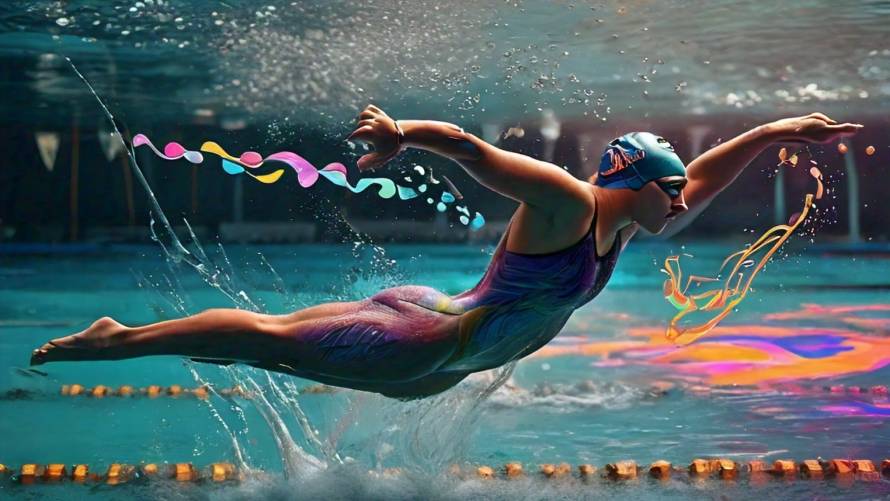
Researchers have shed new light on the propulsion mechanism behind swimming by studying the water flow generated by swimmers using the dolphin-kick technique.
While observing transparent water with the naked eye or a camera is difficult, the team employed particle image velocimetry, a method used in fluid dynamics, to visualize water-flow patterns. The study, conducted in an experimental circulating-water channel, investigated how water flow changes as swimmers vary their speed during the dolphin-kick.
The findings revealed that as swimmers increased their speed, the water-flow velocity also increased during the lower-limb action of the underwater dolphin-kick, creating a strong vortex during the kicking motion. This phenomenon may contribute to the enhanced propulsive force experienced by swimmers. Moreover, the researchers observed that the flow generated during the downward-kick phase was recycled during the transition to the upward-kick phase, with this effect becoming more pronounced at higher swimming speeds. This study is the first to document water-flow changes during dolphin-kick swimming at different speeds.
“This study marks the first observation of water-flow changes during dolphin-kick swimming at varying speeds,” the researchers noted.
The research is expected to further advance the understanding of water flow, a crucial aspect of swimming research. Furthermore, it provides scientific evidence for instructors to adopt kick-swimming techniques in their training programs.
This work was supported by Japan Science and Technology Agency, Grant Number 22 K19725.
#DolphinKickSwimming #WaterFlowDynamics #SwimmingResearch #AquaticPropulsion