

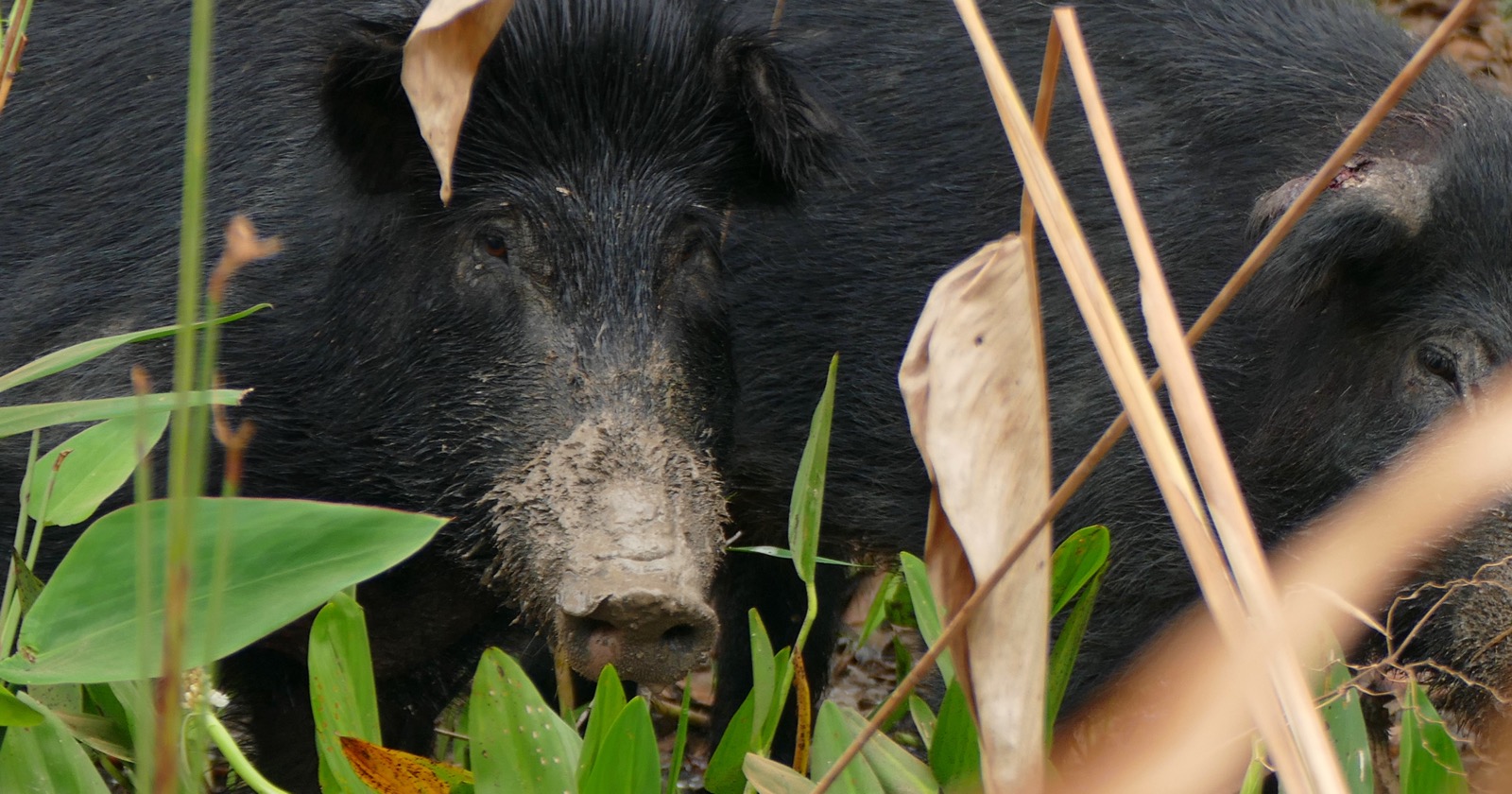
In 1912, a small group of 13 or 14 wild hogs, bought through an agent in Berlin, began a journey that would end on a mountaintop in North Carolina. The agent had sold them as boar from Russia’s Ural Mountains. They went by rail, then by ox wagon up to Hooper Bald, in the Snowbird Mountains of Graham County.
They were headed for a hunting preserve. The Whiting Manufacturing Company had bought a large tract of land there in 1908, and George Gordon Moore, an adviser to the English investors behind the venture, was allowed to set up a 1,600-acre game preserve on Hooper Bald. Starting in 1912, he stocked it with buffalo, elk, mule deer, wild turkeys and bears, some of them Russian. The hogs went into their own fenced lot.
But most of the animals didn’t last. Some of the bears climbed out of their stockade and were shot by local mountaineers, and the other imports faded away or were taken off the mountain. The boar did the opposite. They rooted their way out of the lot, came and went as they pleased, and kept multiplying.
In the early 1920s, according to a 1959 North Carolina Wildlife Resources Commission pamphlet by Perry Jones, Moore’s foreman, Cotton McGuire, invited friends with packs of dogs to hunt the boar inside the lot. By then there were an estimated 60 to 100 of them. The hunters killed two. The boar killed or maimed at least a dozen dogs, sent some of the hunters up trees, and tore through the fence into the mountains.
They settled in Graham County and across the state line in Monroe County, Tennessee. By the 1940s they had reached the southwestern corner of Great Smoky Mountains National Park, which straddles the Tennessee-North Carolina border. The park started an eradication programme in 1959 and has since removed more than 10,000 hogs. Smokies Life reports that the boar’s descendants have kept expanding their range in the park since the 1970s.
Wild hogs, in other words, are not new to Tennessee. They had been living in the mountains along the state line for more than half a century before they began spreading across the rest of the state.
Open season
In 1999, the Tennessee Wildlife Resources Agency (TWRA) tried to rein in the hogs by opening a statewide wild hog season with no bag limit. Hunters could kill as many as they liked. It didn’t work. According to the agency, the population expanded the most during that stretch of unlimited hunting.
The hogs didn’t spread on their own. New populations began turning up in parts of the state that had never had them, and TWRA traces them to illegal stocking: people moving hogs into new areas so they would have something to hunt close to home. A season with no limit made wild hogs game worth having, and the easiest way to have them nearby was to put them there.
It didn’t take many. Hooper Bald had already shown that 13 or 14 hogs could become as many as 100 in about a decade. According to the US Department of Agriculture, a sow can have two litters of 4 to 12 piglets every 12 to 15 months, and the US Geological Survey says females often start breeding before they turn one. Drop a few hogs into a new county, and within a couple of years their offspring are having offspring of their own.
Shooting couldn’t keep up, and sometimes it made things worse. Wild hogs travel in family groups called sounders. Barry Cross, a TWRA outreach coordinator, has explained that shooting into a sounder might take a few animals, but it breaks up the rest, and they move onto neighbouring land.
TWRA now says wild hogs have gone from 15 counties to nearly 80 of the state’s 95. It isn’t all 95, whatever you may have heard. But nearly 80 counties is most of Tennessee.
Part boar, part farm pig
Not every one of those hogs descends from the Hooper Bald boar. A 2020 genetics study in Molecular Ecology, led by USDA geneticist Timothy Smyser, found that invasive feral swine across the US carry a mix of wild boar and domestic pig ancestry. The researchers linked that mixed ancestry, along with people moving pigs to new places, to how quickly the animals have spread.
The study looked at feral swine nationally, not Tennessee alone. But it fits what TWRA describes: escaped and released animals of mixed origin, spread farther and faster by people.
Taking away the reason
In 2011, TWRA changed the rules. Wild hogs lost their big-game status and were reclassified as a destructive species, to be controlled by methods other than sport hunting. The agency stated the reason plainly: to remove the incentive to relocate them. It is now illegal in Tennessee to possess, transport or release live wild hogs.
Rather than trying to catch everyone who released hogs illegally, Tennessee went after the motive. Once hogs were no longer treated as game, there was little reason to move them into new areas.
Trapping did the rest. TWRA turned to traps fitted with cameras and sensors, so officers could watch from a distance and drop the door only once a whole sounder was inside. WKRN reported in 2021 that, with a few exceptions, the wild hog population in Middle Tennessee was under control.
The damage had already been done. TWRA’s 2015 survey invited 5,000 randomly selected farmers and landowners in counties with wild hogs, and 1,620 took part. From their answers, the agency estimated more than $26 million in damage, plus nearly $2 million that landowners spent on control, for a total of $28.31 million. It is an estimate built from survey responses, not a count of every damaged field, but it puts a number on a problem the 1999 rule helped spread.
Someone always wanted them
Tennessee has wild hogs in about 80 of its 95 counties because people moved them there to hunt, and a sow’s ability to turn a handful into a herd within a few years did the rest. A hog released once kept breeding long after the hunter who released it had moved on.
Every stage of this story starts with someone wanting hogs. In 1912, a preserve brought wild boar to Hooper Bald because its wealthy guests wanted something to hunt. Nearly a century later, hunters spread hogs across Tennessee for the same reason. For years, the state’s answer was to let them shoot as many as they liked. In 2011, it tried the opposite and made hogs worthless as game.
