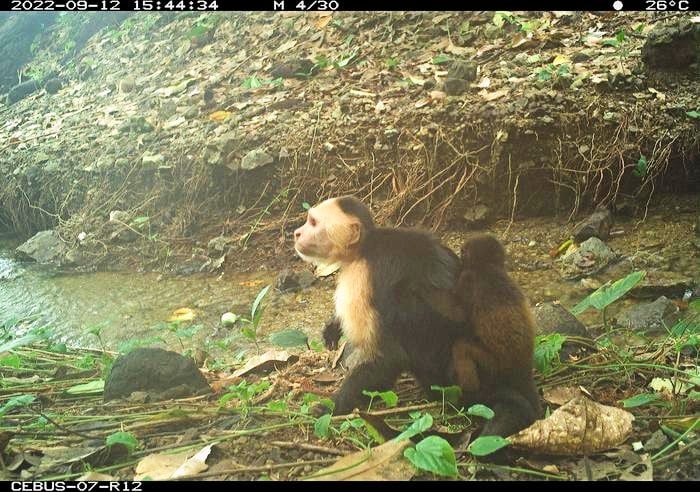
On an island off Panama’s coast, scientists have documented a peculiar new behavior among white-faced capuchin monkeys that began with one curious individual and spread into a concerning cultural phenomenon. Using motion-triggered cameras, researchers captured young male capuchins abducting and carrying baby howler monkeys for days at a time—with no apparent benefit to themselves but deadly consequences for the infants.
The discovery, published May 19 in Current Biology, provides a rare glimpse into the origins and spread of a cultural tradition in wild animals. Researchers from the Max Planck Institute of Animal Behavior (MPI-AB) documented 11 different baby howler monkeys being carried by five immature male capuchins over a 15-month period on Jicarón Island in Panama’s Coiba National Park.
What makes this finding particularly significant is that researchers witnessed the precise moment a social tradition was born—something rarely documented in wild animal populations. The cameras captured not only the first occurrence but the entire progression as the behavior spread from one innovative monkey to others in his group.
The Birth of a Bizarre Tradition
The unusual behavior first appeared in January 2022, when doctoral researcher Zoë Goldsborough spotted something strange in the camera footage.
“It was so weird that I went straight to my advisor’s office to ask him what it was,” recalls Goldsborough, who is conducting her dissertation at MPI-AB.
After combing through thousands of images and videos, Goldsborough discovered that one particular subadult male capuchin—whom she named “Joker”—had carried four different howler infants for up to nine days. Then, five months later, the behavior resurfaced—this time performed by four additional young male capuchins.
The footage revealed that over 15 months, these five capuchins carried 11 different howler babies. The infants, all less than four weeks old, were observed clinging to the backs or bellies of their carriers as the capuchins went about their normal activities, including using stone tools to crack open food.
Not Adoption, But Abduction
While researchers initially considered whether this might be a case of interspecies adoption, several factors pointed to a darker reality:
- The howler infants appeared at an unusually high rate (sometimes two simultaneously)
- Adult howlers were captured on camera calling to their missing infants
- Capuchins actively prevented escape attempts by the infants
- In one case, other capuchins threatened an adult howler attempting to retrieve its infant
- At least four of the carried infants died, likely from malnourishment
“The capuchins didn’t hurt the babies,” emphasizes Goldsborough, “but they couldn’t provide the milk that infants need to survive.”
What makes this behavior particularly puzzling is the apparent lack of benefit for the capuchins. They don’t eat the infants, don’t play with them, and don’t receive more attention from group mates while carrying them.
“We don’t see any clear benefit to the capuchins,” says Goldsborough, “but we also don’t see any clear costs, although it might make tool use a little trickier.”
Why Would This Behavior Spread?
The researchers suggest that the behavior of the initial carrier, who showed no aggression toward his captives, might represent misdirected alloparental care—a misplaced instinct to care for infants. But the later adopters, who sometimes acted aggressively toward the infants they carried, appear to be participating in something more akin to a fashion trend.
Could these highly intelligent primates simply be bored? The team thinks this might be a key factor.
“Survival appears easy on Jicarón. There are no predators and few competitors, which gives capuchins lots of time and little to do. It seems this ‘luxurious’ life set the scene for these social animals to be innovators,” explains Meg Crofoot, managing director at the MPI-AB and one of the project’s founders.
She adds: “This new tradition shows us that necessity need not be the mother of invention. For a highly intelligent monkey living in a safe, perhaps even under-stimulating environment, boredom and free time might be sufficient.”
Animal Culture With Destructive Outcomes
The study offers an unprecedented window into how animal cultural traditions can emerge and spread, even when they serve no obvious adaptive purpose. It also raises important questions about the darker side of animal culture.
“We show that non-human animals also have the capacity to evolve cultural traditions without clear functions but with destructive outcomes for the world around them,” says Brendan Barrett, a group leader at MPI-AB and Goldsborough’s advisor.
Barrett thinks the more interesting question isn’t why this tradition arose, but why it emerged in this particular location. Jicarón Island is home to the only known population of stone tool-using capuchins in the genus Cebus, another cultural innovation unique to this population.
Interestingly, both the tool-using and infant-carrying behaviors are performed primarily by young males, suggesting a possible connection between these two socially learned traditions.
The camera monitoring period ended in July 2023, and researchers don’t yet know if the behavior has persisted or spread further. If it continues to impact the endangered howler population on the island, it could potentially become a conservation concern.
“Witnessing the spread of this behavior had a profound effect on all of us,” says Crofoot. “We therefore feel even more responsible to keep learning from this natural population of primates who, to our knowledge, are the only ones on earth to be practicing this strange tradition.”
As for the actual mechanism of abduction—how small capuchins manage to take infants from adult howlers weighing nearly three times their size—the mystery remains. The cameras, positioned on the ground, don’t capture activity in the trees, where the abductions likely occur. But the study has created an unprecedented record of a cultural fad’s exact origin and spread, providing valuable insights into the complex social dynamics of our primate relatives.
Discover more from Wild Science
Subscribe to get the latest posts sent to your email.
