
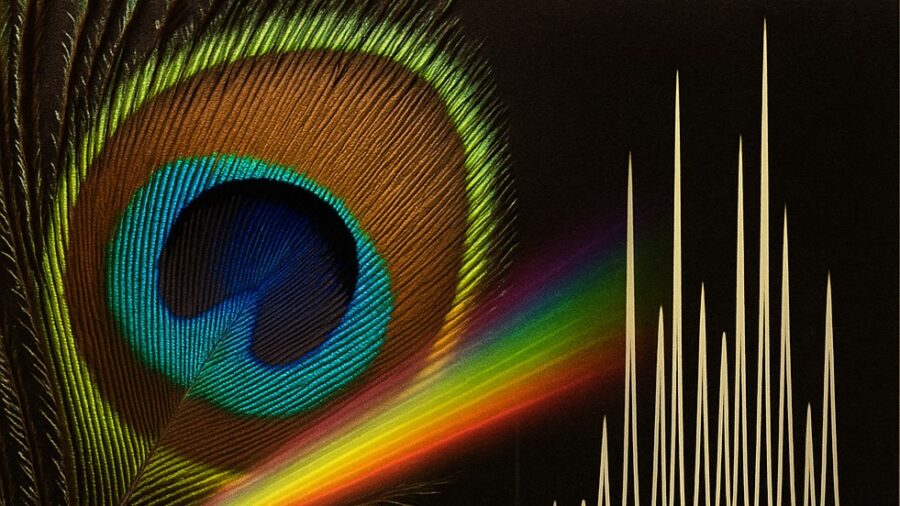
When scientists infused peacock feathers with a fluorescent dye and hit them with pulsed laser light, something remarkable happened: they started to lase. Not randomly, but with clear and repeatable emission lines that revealed something deeper inside the feather. The study, published in Scientific Reports, shows that the eyespots of male Indian peafowl feathers harbor hidden, persistent microstructures that behave like tiny resonators—scattering light in precise, unexpected ways.
Laser Emission from Nature’s Palette
The research team, led by Nathan J. Dawson of Florida Polytechnic University, applied rhodamine 6g (R6g) dye to tail feathers from Indian peafowl (Pavo cristatus), known for their iridescent eyespots. By cycling the dye solution on and off the barbules and then illuminating them with a pulsed green laser, the scientists observed sharp laser peaks in the emission spectrum. These peaks appeared consistently across different color regions of the eyespot, including green, yellow, brown, and blue zones.
This was surprising. Typically, laser action in biological material is attributed to random feedback, where scattered light bounces unpredictably among particles. But here, the same spectral lines kept appearing—even in different feathers. Something more organized was at work.
Key Findings
- Laser emission occurred only after multiple dye infusion and drying cycles, suggesting dye infiltration and keratin loosening are crucial.
- Sharp laser peaks appeared at consistent wavelengths across different feathers and color zones.
- Laser thresholds were lower than expected for random lasers, indicating efficient feedback in very small gain volumes.
- Reflection spectra showed low dispersion at color band edges, suggesting those bands were not the laser’s source of feedback.
Not a Random Laser, Not a Crystal
The researchers ruled out traditional explanations for biological lasing. Photonic crystals in the feather’s colorful regions weren’t responsible—laser peaks didn’t shift with changes in those structures. Nor were whispering gallery modes likely, since the required circular cavities don’t naturally form in feather microarchitecture. Instead, the authors propose that mesoscopic structures, potentially formed or revealed during the dye infusion process, act as tiny laser cavities.
“The system presented in this article is akin to a roulette table in which the ball always lands in either red 7 or black 28,” the authors wrote. “On that table, the inside betting gambler is transformed in a savvy investor while the house quickly goes out of business.”
Small Structures, Big Insights
By analyzing how these laser lines emerge and shift with pump power, the team estimated the size of the internal resonators. Their calculations suggest tiny, consistent optical cavities—possibly just a few micrometers long—may be embedded throughout the eyespot barbules. These structures are small enough to evade detection by optical microscopy, yet orderly enough to produce highly stable laser feedback.
What might nature use them for? Probably nothing. The peacock evolved those iridescent feathers for show, not light amplification. But by pushing them past their biological role, scientists have revealed a new way to probe hidden architectures in complex materials. It’s laser spectroscopy meets evolutionary art.
Beyond Beauty: A New Tool for Biophotonics
This study isn’t just a curious tale of glowing feathers. It offers a proof-of-concept for using laser dyes and pump lasers to uncover nanoscale structure in biological materials. The method could become a new analytical tool in the growing field of biophotonics, helping scientists detect subtle resonances in tissues, bones, or even cells.
Sometimes, looking for light in the wrong place is exactly how you find something new.
Journal and DOI
Published in Scientific Reports, Volume 15, Article 20938 (2025)
DOI: https://www.nature.com/articles/s41598-025-04039-8
Discover more from Wild Science
Subscribe to get the latest posts sent to your email.