
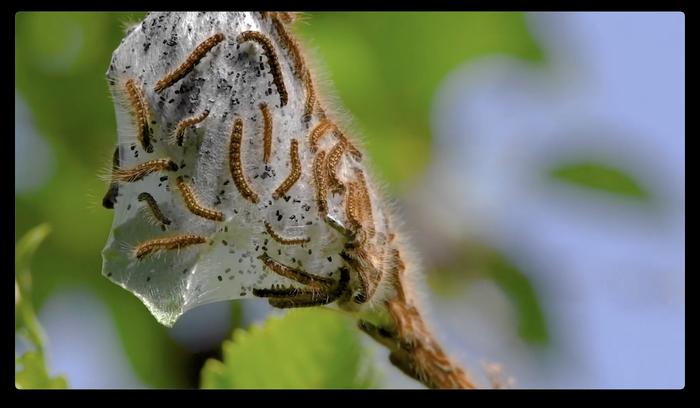
Every decade or so, western tent caterpillars descend in hairy, squirming waves, covering trees, fences, and even houses, only to disappear almost overnight.
A new study in the Journal of Animal Ecology by University of British Columbia researchers, led by Dr. Judith Myers, draws on 50 years of field data to explain this striking boom-and-bust cycle. The research shows that viral disease and shifting reproduction rates are the twin engines driving population peaks and crashes, and that these native insects have proven surprisingly resistant to climate change.
From Quiet Woods to Crawling Chaos
Western tent caterpillars (Malacosoma californicum pluviale) are found from British Columbia to California, and east to Manitoba. Most years, they are all but invisible, quietly feeding on red alder and fruit tree leaves. But during outbreak years, their silky communal shelters appear everywhere, their numbers high enough to strip orchards bare. In 2012, a severe outbreak on Salt Spring Island even forced the cancellation of the annual apple festival.
Eggs hatch in April, and larvae cluster in sunlit silken tents for warmth. By early June, they disperse to pupate, often clustering on vertical surfaces like walls or fenceposts. After one or two years of high densities, populations crash, leaving behind only a few scattered tents until the next build-up years later.
The Science Behind the Swarms
Dr. Myers’ half-century of research, much of it in collaboration with Simon Fraser University’s Dr. Jenny Cory, reveals that two main factors shape the caterpillar cycle:
- Viral infection: A species-specific baculovirus spreads rapidly at peak densities, killing large numbers of larvae. Infected caterpillars release millions of virus particles into the environment when they die.
- Reproductive shifts: Female moth fecundity (eggs laid) rises during population growth but drops one to two years before the peak, contributing to the decline phase.
These patterns repeat in near-synchrony across multiple island and mainland sites. In fact, some female moths can fly tens of kilometres to recolonize areas where local populations have collapsed.
No Climate Impact Detected
One surprising finding: despite slight spring warming over the past decades, the long-term data show no evidence that climate change has altered the cycle. The caterpillars’ ability to bask for warmth or hide from heat seems to buffer them against temperature shifts. Experiments suggest that changes in food quality and quantity, combined with sublethal viral effects, play a larger role than weather in determining fecundity.
“Over 50 years, we haven’t seen any effect of global warming on these insect populations. They’re highly adapted to the environment,” said Dr. Myers.
When to Expect the Next Wave
The last major outbreak occurred in 2023 on Galiano Island and nearby sites. This year, researchers found just one tent in their Galiano study area. Based on the 8–11 year cycle, populations should start climbing again within the next six to eight years, peaking sometime in the early 2030s.
How to Spot and Manage an Outbreak
- Check fruit trees in April for tiny hairy larvae and silky tents.
- Remove egg masses in winter or tents in early spring to protect backyard trees.
- Commercial growers often use Btk, a safe microbial insecticide, early in the season for best results.
- Remember: natural viral outbreaks help control numbers, so panic is rarely necessary.
Lessons From a Long Study
This decades-long project stands as one of the most detailed records of cyclic insect dynamics in North America. It shows that population crashes are not random events, but the predictable outcome of ecological and biological feedback loops. While the western tent caterpillar may be an orchard pest during its peak years, it is also an important piece of the local ecosystem — and a case study in how animal populations self-regulate over time.
Journal: Journal of Animal Ecology
DOI: 10.1111/1365-2656.70104
Discover more from Wild Science
Subscribe to get the latest posts sent to your email.