
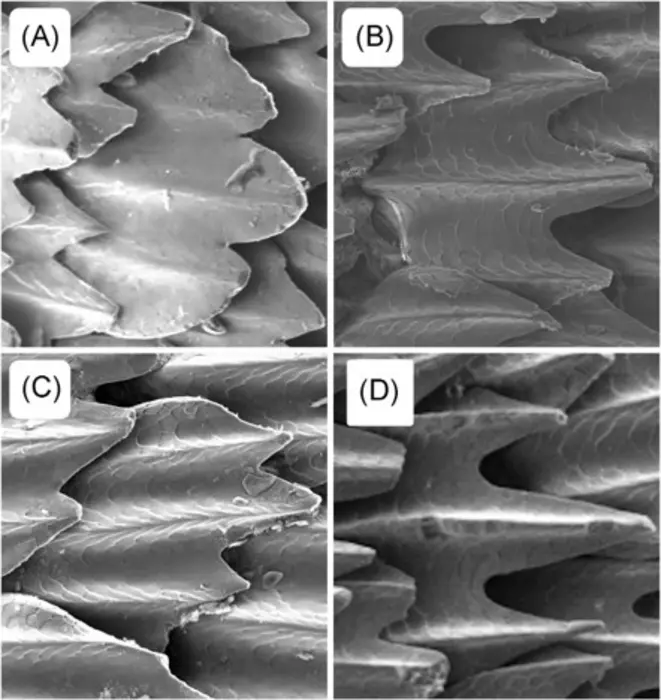
Under the microscope, shark skin looks like a tiled road of tiny teeth. In a new study, Florida Atlantic University scientists used high-resolution imaging to show how those tooth-like tiles, called dermal denticles, shift shape and spacing as bonnethead sharks grow. The result is a clearer view of how evolution tunes a living armor for speed, protection, and the rough demands of adulthood.
The team sampled skin from 24 bonnethead sharks, spanning embryos to mature males and females, then zoomed in with scanning electron microscopy. They quantified features that govern performance in water, including denticle shape, crown width and length, the number and width of ridges, ridge angles, and how much each denticle overlaps its neighbors. Most metrics changed with maturity. Crown width, ridge number, ridge width, ridge angle, and overlap all increased with age, while overall denticle length held steady. The picture that emerges is not of a static shell, but of a responsive surface that matures for hydrodynamics and durability.
Look closely at the images and you can see the transformation: on an embryo, many denticles appear narrower, spaced farther apart, and less overlapped; on an adult, they sit shoulder to shoulder, ridges thicker and angles steeper, like shingles laid tight to shed the current. It is a subtle redesign that pays off in two currencies sharks value, speed and survival.
Growing Into Speed, Built For Wear
Why would denticles widen, gain ridges, and overlap more as sharks age? Fluid dynamics offers one answer. Wider crowns with more and thicker ridges can trip microvortices that smooth flow, reduce drag, and help maintain attached water over fast-moving skin. Overlap creates a continuous textured field that resists larger, wasteful turbulence. The study found that embryos had roughly half the overlap length seen in juveniles and adults, which is consistent with a low need for hydrodynamic tuning before free swimming begins.
Protection is the second answer. Heavier overlap and increased structural complexity likely stiffen the skin and spread force, which matters as sharks encounter predators, abrasive habitats, and mating. Prior work in other species has shown tougher female skin and higher denticle density where males bite during copulation. Here, the authors report minimal sex differences in the abdominal region they examined, with one notable exception: males showed slightly larger ridge angles. That could reflect sex specific swimming demands or reinforcement during mating, but the result is measured, not speculative, and limited to the region studied.
“These changes help reduce drag in the water and strengthen the skin against physical challenges like predators or mating-related injuries.”
One result stood out for what did not change. Across life stages, median denticle length was stable. That stability, paired with wider crowns and greater overlap, hints at a developmental program that expands coverage and texture without elongating the basic unit. Replacement also matters. Sharks can shed and regrow denticles, which may allow the surface to be retuned as body size, swimming speed, and life history shift.
From Microscopes To Materials
The study relied on a straightforward but powerful pipeline. Researchers prepared standardized skin squares from between the first and second dorsal fins, sputter coated them with gold, and captured electron micrographs aligned to the natural flow direction. They measured five central denticles per image to derive regional averages per shark, then used two way ANOVAs with post hoc tests to assess effects of maturity, sex, and body region. The statistical signal was consistent: maturity dominated variation; sex and body region did not, for this abdominal zone.
There is a practical horizon here. Denticles are evolution’s riblets. Quantifying how angles, widths, and overlaps shift with size could inform engineered surfaces for swimwear, hulls, pumps, or medical devices where drag reduction and anti wear properties matter. The authors also point to biomechanics and robotics as fields that can borrow from this modular, replaceable, self renewing armor. As one co author noted, better tools drove better insights.
“Using scanning electron microscopy and precise morphometric software allowed us to see and measure the tiny details of shark denticles like never before.”
One caution: electron microscopy views only the surface. Future work with micro CT could capture three dimensional crown geometry and subdermal anchoring, clarifying how external shape relates to internal support. Mapping more body regions would also test how local flow and function sculpt regional denticle diversity.
For now, the take home is simple. Bonnethead skin grows up. It shifts from pointed, lightly overlapped tiles to wider, more overlapped shingles with thicker, steeper ridges. The redesign favors smoother flow and tougher skin, exactly what a young shark needs as it graduates from protected beginnings to the contested, high friction world of adult life.
Integrative and Comparative Biology: 10.1093/icb/icaf115
Discover more from Wild Science
Subscribe to get the latest posts sent to your email.