

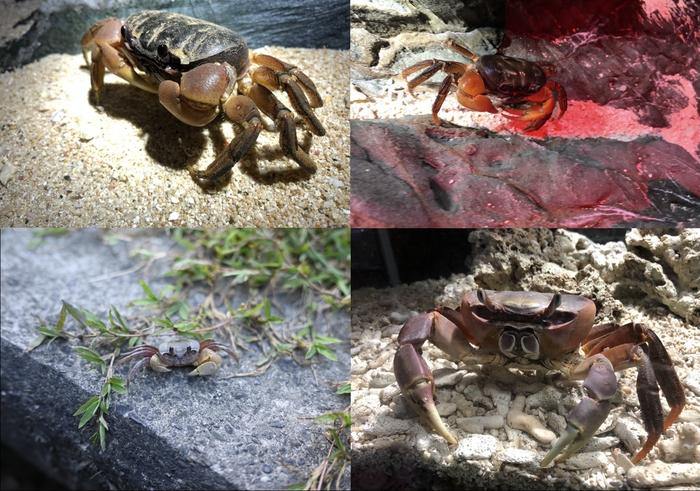
Set a crab down on a beach and watch what happens. It doesn’t hesitate, doesn’t pivot awkwardly like a dog trying to reverse. It simply goes, sliding sideways as if the lateral direction were always the natural one, as if moving perpendicular to its own body axis were the most obvious thing in the world. You might take that oddity for granted. A team of biologists at Nagasaki University didn’t. They spent years filming 50 species of live crabs in arenas of sand and seawater, tracking every scuttle, every burst of movement, and what they found lurking in the data was a surprise that reaches back 200 million years: the sideways walk happened once. Just once. And it may have changed everything.
The study, published in eLife, presents the largest comparative dataset on crab locomotion ever assembled, and its findings cut against a reasonable assumption. Given how useful sideways walking seems, you might expect it to have evolved several times independently, the way wings did, or eyes, or the crab-shaped body itself. But the analysis says otherwise.
True crabs, the group formally called Brachyura, are by almost any measure a spectacular evolutionary success. There are roughly 7,900 described species, outnumbering their closest relatives by an enormous margin; hermit crabs and their kin manage around 3,400, clawed lobsters and crayfish barely 800. Brachyura have colonised virtually every aquatic habitat on the planet, from deep-sea hydrothermal vents to freshwater streams in the tropics to the high-tide margins where they skitter between rocks on exposed shores. “Sideways locomotion may have contributed significantly to the ecological success of true crabs,” says Yuuki Kawabata, the study’s senior author. That word “may” is doing a lot of work in that sentence. It turns out the relationship between sideways walking and crab diversity is rather more layered than it first appears.
An Experiment in Circular Arenas
To trace the evolutionary history of a behaviour, you first need data on the behaviour itself, and that data barely existed. Kawabata and his colleagues from Nagasaki University and collaborating institutions in Taiwan, Japan, and Alabama collected live crabs from intertidal flats, fish markets, and public aquaria, then filmed each species for 10 minutes inside circular arenas filled with whatever substrate matched the animal’s natural habitat (dry sand, seawater, brackish mud, or fresh water). From the footage, they extracted a simple metric: the Forward-Sideways Index, a number that runs from fully sideways at one end to fully forward at the other.
The result was striking. There were no in-between cases. Not a single species hovered near the middle of the scale. Of the 50 species tested, 35 scored as sideways movers and 15 as forward movers, with a conspicuous gap separating the two groups. Locomotion in crabs, it seems, is not a spectrum. It’s a binary.
That sharpness matters for what came next. By layering the behavioural data onto a recently published crab phylogeny built from 10 genes across 344 species, the team reconstructed the likely ancestral state at each branch point in the crab family tree. The picture that emerged placed the origin of sideways locomotion at the base of a group called Eubrachyura, the most species-rich division of true crabs, roughly 200 million years ago. The timing is notable: this was the early Jurassic, immediately following the Triassic-Jurassic extinction, a period when Pangaea was splitting apart, shallow marine habitats were expanding rapidly, and ecological niches were opening up across what had recently been devastated seafloors. “This single event contrasts starkly with carcinisation, which has occurred repeatedly across decapod species,” Kawabata notes.
Carcinisation, for those who haven’t encountered it, is one of evolution’s stranger recurring jokes: the tendency for crustaceans of various unrelated lineages to independently arrive at a broad, flat, crab-like body plan. Hermit crabs, king crabs, porcelain crabs, even a distant group called the coconut crab have all independently wandered toward something resembling a true crab. But here’s the catch: none of them walk sideways. King crabs move forward. Porcelain crabs move backward. The crab shape keeps converging; the crab walk does not. “This highlights that while body shapes may converge multiple times, behavioural changes such as sideways walking can be rare,” Kawabata says.
Why Is Sideways Walking So Hard to Evolve?
The physical requirements are substantial. Sideways locomotion demands a thorax elongated along the direction of travel (which, for a sideways-walker, means the left-right axis rather than the front-back axis), greater joint flexibility in the lateral plane, and a rewired nervous system. Previous anatomical work found that sideways-walking crabs have fewer motor neurons controlling their proximal leg muscles, a fundamental change in the neural architecture of movement. The body and nervous system have to commit. You cannot, it turns out, walk sideways and forward with equal facility; the Forward-Sideways Index distributions make that plain. Crab spiders and some leafhopper nymphs may have managed something similar, but beyond those groups the behaviour appears to be essentially absent from the rest of the animal kingdom. An evolutionary rarity that, once achieved, didn’t need to be achieved again.
And yet, for all that stability, the sideways walk has been lost. Multiple times. The team inferred around 10 independent reversions to forward locomotion scattered across the eubrachyuran family tree. Some make immediate sense. Soldier crabs (Mictyris) march forward in vast coordinated columns across tidal flats; their social, synchronised movement may have pushed them back toward the ancestral gait. Spider crabs (Majidae) festoon themselves with seaweed and sponges for camouflage rather than relying on speed to escape predators. Pea crabs (such as Arcotheres) tuck themselves inside mussels and oysters, trading manoeuvrability for shelter. When predator escape by rapid lateral movement is no longer your primary survival strategy, maintaining the neuromuscular infrastructure for sideways walking is perhaps a costly indulgence. Evolution, characteristically, doesn’t maintain what it doesn’t need.
A Key Innovation, but Not the Only One
The authors are careful about what the finding does and doesn’t claim. The coincidence of timing between the origin of sideways locomotion and the post-extinction opening of ecological opportunity means that disentangling the two is difficult. “To disentangle the relative roles of innovation and environmental change, we need further analyses of trait-dependent diversification, fossil-informed timelines and performance tests that link true crabs’ sideways movement to adaptive advantages,” Kawabata says. The sideways walk may have been the key that unlocked a door; the empty ecological rooms behind it were also essential.
What the study does establish firmly is that the 7,400-odd species of Eubrachyura all owe their distinctive mode of travel to a single ancestral moment, probably on a Jurassic seafloor somewhere in a world whose continents were just beginning to pull apart. The roughly 150 species in the closest outgroup walk forward. Eubrachyura, having made that one transition, diversified into nearly every marine and freshwater habitat on Earth. Whether sideways walking caused that explosion, enabled it, or simply accompanied it remains an open question. But somewhere in the Jurassic, a forward-walking ancestor took a step to the side, and the crab world has never quite looked back.
Source: Taniguchi J et al. “Evolution of sideways locomotion in crabs.” eLife (2026). DOI: https://doi.org/10.7554/eLife.110015.1
Frequently Asked Questions
Why do crabs walk sideways in the first place?
Sideways locomotion lets crabs move rapidly in both lateral directions at roughly equal speed, which makes their escape direction unpredictable to a predator. The structural requirements are significant: a laterally elongated thorax and modified joint flexibility allow high-speed sideways bursts in a way that a front-to-back body plan simply doesn’t permit. The new research suggests this advantage was powerful enough that, once it evolved, the behaviour was retained across nearly all of the 7,400-plus species of Eubrachyura.
Do all crabs walk sideways?
No. Around 15 of the 50 species studied move predominantly forward, and the researchers inferred roughly 10 independent evolutionary losses of sideways locomotion across the crab family tree. Species that camouflage themselves with seaweed (spider crabs), live hidden inside bivalves (pea crabs), or move in coordinated social columns (soldier crabs) have all apparently lost the need for rapid sideways escape and reverted to forward walking. Even some animals with crab-shaped bodies, such as king crabs and porcelain crabs, move forward rather than sideways.
How did scientists figure out when sideways walking evolved?
The team combined filmed observations of 50 live crab species with a genetic phylogeny built from 10 genes across 344 species. By assigning each branch of the family tree a locomotion state and running ancestral-state reconstruction models, they traced the single origin of sideways locomotion to the base of Eubrachyura, approximately 200 million years ago, in the early Jurassic period shortly after the Triassic-Jurassic extinction event.
Why haven’t other animals evolved sideways walking?
Sideways locomotion demands deep changes to body architecture: a reoriented thorax, modified joint planes, and a rewired nervous system with fewer motor neurons controlling the proximal leg muscles. It also forces a trade-off, since forward and sideways locomotion appear to be mutually exclusive gaits with no intermediate forms. Outside of true crabs, only crab spiders and certain leafhopper nymphs seem to have managed anything comparable, suggesting the evolutionary hurdle is genuinely high.
Could this research tell us anything about how other animal behaviours evolved?
The study offers a broader framework for thinking about locomotor innovation: that a single rare behavioural transition can be highly stable once established, while body-plan convergences (like the crab shape appearing in multiple unrelated lineages) can occur repeatedly. The researchers argue this shows morphological and behavioural evolution can be decoupled, with body forms converging multiple times while the fundamental behavioural innovation remains locked in a single lineage.