
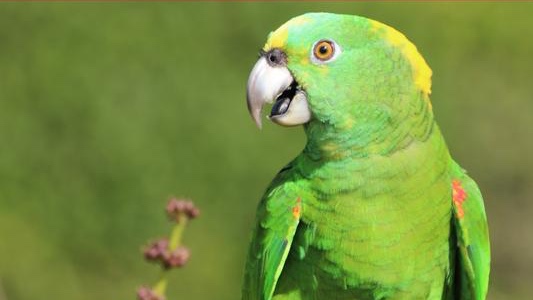
Late afternoon in a Costa Rican cattle pasture, and Christine Dahlin is sitting beneath a large tree with an old-school video camera and a directional microphone, waiting. The yellow-naped amazons that nest here won’t show up for a while yet — they spend their days foraging in small flocks elsewhere, only returning to their breeding territories as evening approaches. When a mated pair finally lands and a neighbouring couple drifts too close, though, things get loud. “The warble duets would get really fast and really loud when there was a territory dispute,” says Dahlin, a biologist at the University of Pittsburgh at Johnstown. “They just sounded very irate and like they were getting in each other’s faces.”
Those frenzied, overlapping calls might sound like chaos. They aren’t. After more than a decade of painstaking analysis — fieldwork across three years in Costa Rica, followed by years of undergraduate students manually sorting hundreds of calls by ear and eye — Dahlin and her team have shown that the warble duets of these critically endangered parrots are structured by syntactic rules, contain word-like pairings called collocates, and draw on a lexicon of at least 36 distinct call types. The findings, published in the Journal of Avian Biology, amount to one of the most detailed demonstrations yet of language-like complexity in wild parrot communication.
We already knew parrots could talk, of course. Captive macaws chat with their keepers, cockatoos belt out tunes for phone cameras. Research has even shown that some can use words in context — when Polly speaks up, she may genuinely want that cracker. But what parrots do with their vocal abilities in the wild has been far harder to study, in part because the birds are green, tropical, and given to roaming widely. Dahlin has spent years trying to change that. “Ultimately I really want to understand how these birds are communicating in the wild,” she says. “I want to know what they are saying, and how they are saying it.”
Yellow-naped amazons (Amazona auropalliata) range from southern Mexico to southern Costa Rica and live complicated social lives. They’re a fission–fusion species, congregating in large flocks at night, splitting into smaller foraging groups by day, then retreating to defended breeding territories during the nesting season. That layered social structure matters; the social complexity hypothesis predicts that animals with more elaborate social systems should evolve correspondingly complex communication. And these parrots have two types of duet to test the idea against: a simpler “primary duet” built from just four call types, and the far richer warble duet.
Dahlin had previously found syntax in the primary duets. The warble version, with its bigger repertoire and faster tempo, was another question. “One hypothesis is that maybe warble duets have different notes simply to show their prowess,” she says — the parrots wheel them out mainly during border disputes, so perhaps the point was sheer variety, a show of force. “Or maybe it’s something else entirely.” Before she could investigate matching patterns between rival pairs, she needed a basic inventory. “That started this whole process.”
The fieldwork happened from 2006 to 2008 at a site called Ahogados in north-west Costa Rica; the analysis took considerably longer. Out of more than 1,100 recorded duets from 13 mated pairs, only about 50 turned out to be warble duets (the rest were primary), containing upwards of 450 individual calls. Pairs of trained undergraduates sorted each call by viewing spectrograms and listening, a process Dahlin describes as tedious but necessary — and their classifications proved 92 per cent repeatable. The team identified 36 call types, plus another 11 oddities that appeared only once. “There are actually more than 36,” Dahlin says. “Some were rare, some only appeared once, so we didn’t even put them into a category.”
Then came an unexpected analytical detour. Owen Small, an undergraduate who’d been using a program called Voyant Tools in a humanities class to analyse literature, brought the idea to the lab. “We have this program we’re using to analyze literature,” he told Dahlin. “Do you think we could use it for the birds?” They gave it a try, treating each call type as a word and each duet as a sentence. “Voyant was able to run the same analysis as if it were a body of writing,” Dahlin says. “And the results show the parallels between these complex signals the birds are giving and our own language.”
What the software found was striking. Nineteen pairs of call types co-occurred more often than chance predicted — collocates, in linguistic terms, the parrot equivalent of how “eat” and “food” tend to cluster together in English. Four other pairs actively avoided each other, a kind of negative grammar. Some calls were timed to appear at specific points in a duet — beginning, middle, or end — while others floated freely. Males and females alternated their contributions in tightly coordinated, antiphonal fashion, with females consistently leading each note pair, and roughly half the call types were used predominantly or exclusively by one sex. Despite all these rules, almost every single duet the team recorded was unique. Only two sequences out of 52 were ever repeated in their entirety.
That combination of structure and flexibility is what makes the finding so suggestive. The parrots aren’t just stringing random notes together, but they aren’t reciting fixed scripts either. “They’re making multiple decisions,” Dahlin says. “Are they going to duet at all? If so, what kind? And what notes are they giving? All of this is happening very rapidly, and they have to do it in coordination with their partner.”
Whether any of those calls carry distinct meanings — whether collocate pairings function like phrases — remains an open question. The team can’t yet say that specific combinations convey specific messages the way Campbell’s monkeys string calls together to signal predators or falling trees. The variation might instead serve a signalling function: pairs with bigger repertoires could be advertising their quality to rivals, much as songbirds with more complex songs tend to hold better territories. The few physical altercations Dahlin observed in the wild were all preceded by warble duets, not primary ones, hinting that the more complex vocalisations serve as a potent warning before things get truly physical.
There’s an urgency underneath all of this, though. Yellow-naped amazons are critically endangered, and previous research by Dahlin’s group has shown that poaching and habitat loss are already disrupting the cultural transmission of the birds’ dialects. If we want to crack the code of their vocal system — to understand whether those 36-plus call types and their intricate rules carry something approaching meaning — the clock is running. Dahlin, at least, has material to work with. “I’ve got years of sound recordings to dive into,” she says. The parrots, one hopes, will still be singing when she’s ready with answers.
Study link: https://nsojournals.onlinelibrary.wiley.com/doi/10.1002/jav.03552
Discover more from Wild Science
Subscribe to get the latest posts sent to your email.