
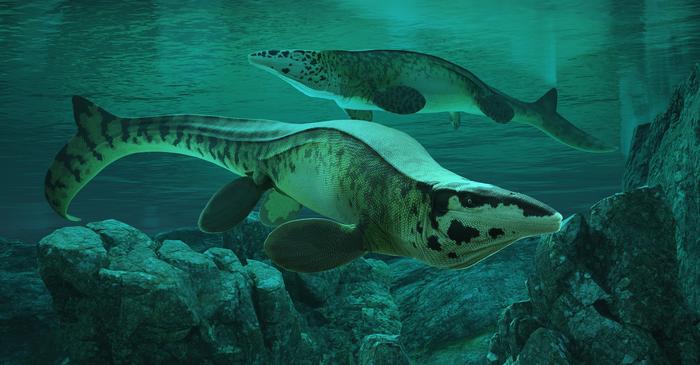
The fossil had been catalogued, labelled and largely ignored for years. It sat in the research collection of the American Museum of Natural History under the name Tylosaurus proriger, a moderately famous marine reptile from the Late Cretaceous, the sort of specimen that turns up in mosasaur reviews as a known quantity. Amelia Zietlow, then a Ph.D. student at the museum’s Richard Gilder Graduate School, took a look at it and thought something was off. The teeth, for one thing, were too serrated. The bones were too big.
She was right. The animal in front of her, along with more than a dozen fossils scattered across other institutions, turned out to be a different beast entirely. A bigger one. And on Thursday, in the Bulletin of the American Museum of Natural History, Zietlow and her colleagues gave it a name that paleontology had somehow not yet got around to using: Tylosaurus rex.
King of the tylosaurs. About forty-three feet long, give or take. Roughly twice the length of the largest great white sharks alive today, and prowling what is now north Texas some 80 million years ago, when most of the continent’s midsection was an inland sea. The press release announcing the find leans, perhaps inevitably, into the obvious gag. “Everything is bigger in Texas and that includes the mosasaurs, apparently,” Zietlow said.
Mosasaurs were not dinosaurs, although they shared the planet with them. They were marine reptiles, distant cousins of modern monitor lizards and snakes, that returned to the sea and ran the Cretaceous oceans for the last twenty-odd million years before the asteroid struck. Several lineages independently evolved flippers, long tails, and the kind of body size that lets you eat almost anything you fancy. Tylosaurines were the first of them to go truly gigantic, breaking the eight-metre mark long before Mosasaurus itself got the headline role in Jurassic World.
What made the Texas specimens odd was that they were not just larger versions of T. proriger, the Kansas-dwelling species that has been the textbook tylosaur for a century and a half. For a while, that was the working assumption. Bigger animal, same species, probably just an older individual that had kept growing. Ontogeny, in other words, rather than taxonomy.
The new analysis rules that out. Zietlow’s team found T. rex specimens that overlap in body size with adult T. proriger but still carry their own distinct suite of features: heavier jaws, beefier neck musculature, those finely serrated teeth that are unusual for mosasaurs as a group. The Texas animals also turn up roughly four million years later in the rock record than their Kansas cousins. Different time, different place, different creature.
And, by the look of things, a much nastier one. The holotype is a giant skeleton discovered in 1979 along an artificial reservoir near Dallas, now displayed at the Perot Museum. Another specimen, nicknamed “The Black Knight,” is missing the tip of its snout and carries a fractured lower jaw, injuries that the researchers say could only have been delivered by another animal of the same species. “Besides being huge, roughly twice the length of the largest great white sharks, T. rex appeared to be a much meaner animal than other mosasaurs,” said Ron Tykoski, vice-president of science at the Perot Museum and a co-author on the study. “Through our study and examination of well-preserved fossils collected throughout the north Texas region, we have evidence of violence within this species to a degree not previously seen in other Tylosaurus specimens.”
The Sea Tyrant That Almost Was
The story actually began in the late 1960s. A paleontologist named John Thurmond, going through tylosaur material from northeast Texas, noticed that the animals were unusually large and might well represent something new. He gave them a working nickname, “Tylosaurus thalassotyrannus,” sea tyrant, with a self-aware note that the name was a cliché. The proposal never made it into formal publication. Thurmond’s intuition sat on a shelf for half a century.
The Zietlow team’s renaming, in some sense, simply finishes the job. It also drags into daylight a clutch of famous fossils that had been hiding in plain sight. “Bunker,” a colossal specimen on display at the University of Kansas since 1911, now belongs to T. rex. So does “Sophie,” at Yale’s Peabody Museum. Generations of visitors have walked past these animals, read T. proriger on the placard, and never guessed they were looking at the largest mosasaur their continent ever produced.
There is a quieter, more interesting story underneath all this, though. The dataset that mosasaur researchers have been using to work out who is related to whom has barely changed in nearly thirty years. Zietlow and her colleagues rebuilt it from scratch, adding new anatomical characters and reorganising the tylosaurine family tree along the way. Their results suggest that quite a lot of the field’s settled wisdom about mosasaur evolution may not be settled at all. “This discovery is not just about naming a new species,” Zietlow said. “It highlights the need to revisit long-standing assumptions about mosasaur evolution and to modernize the tools we use to study these iconic marine reptiles.”
That has an awkward implication. If T. rex spent decades misclassified as a big old T. proriger, what else is sitting in museum drawers right now, mislabeled, possibly representing entirely unknown species that nineteenth- and twentieth-century paleontologists waved off as juveniles or oversized adults? The authors flag this in their paper, in the careful language that journal abstracts demand. Reading between the lines, it could be quite a lot.
Co-author Michael Polcyn of Southern Methodist University put the broader claim plainly. “These findings reshape both the physical and evolutionary picture of mosasaurs, underscoring Texas as a key region for understanding ancient marine ecosystems and signaling a new era of research into the evolutionary history of these formidable predators.” The serrated-toothed sea king has been sitting in collections, in some cases, since before the First World War. Nobody noticed. That is perhaps the most genuinely unsettling part of the whole business: not that giants are still being found, but that they have been here, named and accessioned, all along.
https://doi.org/10.1206/0003-0090.482.1.1
Frequently Asked Questions
Is Tylosaurus rex related to Tyrannosaurus rex?
No, the two share a name (rex meaning “king”) but nothing closer. Tyrannosaurus rex was a land-dwelling theropod dinosaur. Tylosaurus rex is a mosasaur, a marine reptile more closely related to modern monitor lizards and snakes than to any dinosaur. They did overlap in time, though, both swimming and stomping around in the Late Cretaceous.
How big was Tylosaurus rex compared to other mosasaurs?
Body length estimates for the new species run from about 7.7 to 13.2 metres, putting the largest individuals at roughly 43 feet. That makes it one of the biggest mosasaurs ever described, comparable in scale to the famous Mosasaurus. The previously known T. proriger, by contrast, topped out closer to 9.5 metres.
Why did it take so long to recognise this species?
Most of the T. rex specimens had been sitting in museum collections for decades, labelled as T. proriger. Researchers tended to assume the larger Texas fossils were just older, fully grown individuals of the known species. Zietlow’s team showed the size differences were paired with distinct anatomical features, ruling out the growth-stage explanation.
Could other museum fossils turn out to be unknown species too?
Quite possibly. The new study warns that the longstanding habit of attributing size variation to age, combined with poor locality records for many historical mosasaur fossils, may have masked other species hiding in plain sight. Re-examining old collections with modern phylogenetic tools is likely to keep producing surprises.
Discover more from Wild Science
Subscribe to get the latest posts sent to your email.