
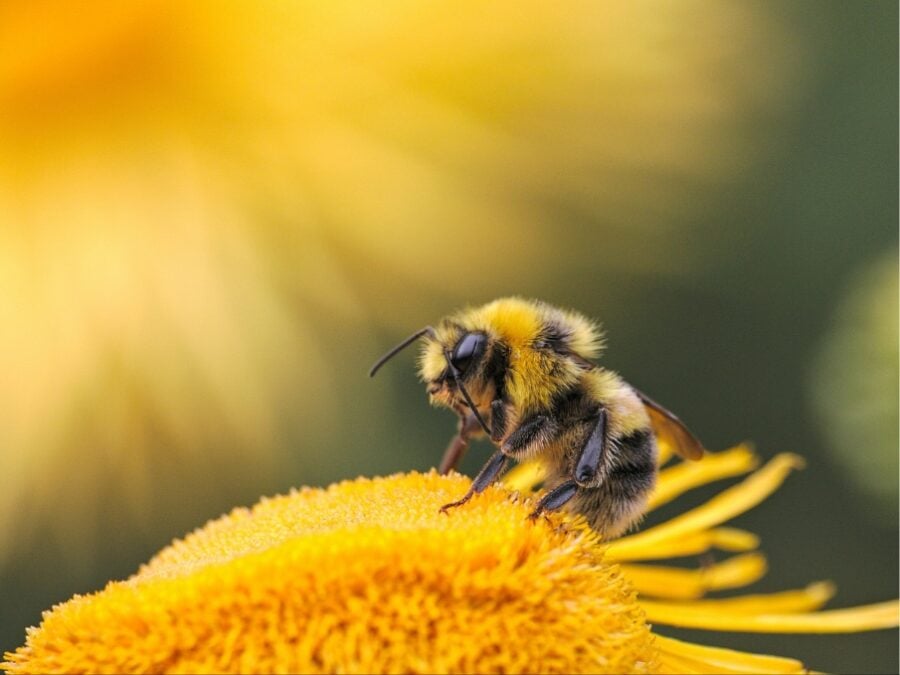
The queen is not in charge. Not really. In a bumble bee colony, the most consequential decisions about who gets to become the next monarch are made by workers, those smaller, supposedly subordinate females that spend their days hauling pollen and tending to brood. A new study from Penn State has confirmed something rather unsettling for anyone who likes their social hierarchies tidy: caste is determined not from the top down but from the ground up, through a chemical handoff between nurses and larvae that plays out over a narrow two-day window deep in a developing bee’s larval life.
The mechanism turns on juvenile hormone, a molecule that has been knocking around insect biology since before the dinosaurs. Elevated levels of it, it turns out, are what tip a female larva toward becoming a queen rather than a worker.
What the Penn State team found, though, was that the hormone reaches the larvae not from some royal decree but through food. Workers incorporate juvenile hormone into the regurgitated nectar-and-pollen mixture they feed to larvae. The more of it a larva ingests, and at the right moment, the more likely it is to grow large enough to become a queen. “A single female egg in bumblebees holds the blueprint for two completely different life paths: the giant, reproductive queen or the small, sterile worker,” said Seyed Ali Modarres Hasani, postdoctoral researcher at Penn State and lead author on the paper. The researchers traced this using a chemically labelled version of the hormone, d3-juvenile hormone III, which they applied to workers and then tracked as it moved through regurgitate and into larval bodies.
The findings appear in Insect Biochemistry and Molecular Biology, and they shift something fundamental in how we think about colony structure. The queen bee, in this species at least, is largely irrelevant to the process.
That last point deserves some emphasis. Bumble bee colonies are not all alike in this respect. In Bombus terrestris, a European species often used as a comparison, separating larvae from the queen before a certain developmental stage causes the vast majority of them to become queens. Something about the queen’s presence suppresses gyne production. Not so in Bombus impatiens, the common Eastern bumble bee used in this study. Removing the queen from a colony does essentially nothing to queen production. Pull her out, and the workers carry on as before. This makes impatiens considerably stranger, colony-politically speaking, than its European cousin. Etya Amsalem, associate professor of entomology at Penn State and the study’s corresponding author, has described B. impatiens as something closer to a kingdom without a queen at all.
“Since all these females share the same DNA, it’s a striking example of how the same genotype can produce very different forms,” Amsalem said. The workers and queens that emerge from the same eggs differ enormously in body mass (queens weigh more than 400 milligrams, workers typically around 150 to 200), lifespan, reproductive capacity, and behaviour. The mechanism producing that divergence has been the subject of speculation for decades.
The team ran three main experiments, using small cages containing three workers and a batch of larvae, applying the hormone at different times and by different routes. What happened when juvenile hormone was applied directly to the larvae was, in a way, the most striking result: workers killed most of them. About 70 percent of cages saw workers eliminate larvae that had been directly exposed to the hormone, as though something in the larvae’s chemical signature had marked them as defective or contaminated. In contrast, when hormone was applied to the workers themselves, they passed it along through feeding, larvae grew heavier, and roughly 37 percent of the offspring became queens rather than the 0.3 percent seen in control groups.
Timing was everything. Hasani and the team divided larval development into five two-day windows and applied hormone to workers at each. Only application on days 7 and 8 after hatching produced queens at high rates, corresponding to what the researchers believe is the late third or early fourth larval instar. Earlier application produced nothing. “We also determined that larvae are only sensitive to this hormone on days seven and eight of their development,” Hasani said. Using the labelled hormone, he and his colleagues confirmed that workers physically transfer it into the food they make from nectar and pollen. The critical window is narrow, and missing it means a larva becomes a worker regardless of whatever hormones it may have been bathed in before.
One complication worth noting: applying the labelled hormone to workers also reduced the workers’ own endogenous hormone synthesis, suggesting a feedback loop between circulating hormone levels and the glands that produce it. Which might matter for how this plays out naturally in a colony across the season.
Because what makes this system genuinely interesting is the emergent logic of it. Workers, as a colony ages, gradually activate their ovaries and begin producing males; this process is associated with rising juvenile hormone levels in their bodies. So over the course of a season, as a colony grows and matures, workers are quietly accumulating more hormone, and passing proportionally more of it to the larvae they feed. “Bumblebee workers do not reproduce when the colony is young, but they can activate their ovaries and produce males as the colony ages, which causes an increase in juvenile hormone levels,” Amsalem said. The threshold that tips larvae into queen development only gets crossed when enough workers are in this state simultaneously and a batch of larvae happens to be in its critical window at the right time.
Amsalem noted that producing queens is the colony’s fundamental purpose: each new queen will leave in autumn, mate, overwinter alone, and found a new colony the following spring. The practical implications are there too. “It’s also a practical question since bumble bees are important for pollination, so knowing how to produce queens could improve commercial breeding and management,” she said. Commercial bumble bee operations are already substantial, particularly for greenhouse pollination of tomatoes and soft fruits; understanding exactly what triggers queen production could allow producers to cue it more reliably. Whether the approach translates to other bumble bee species with different caste-determination timing remains an open question, one that the researchers suggest could help untangle when and why this trait evolved across the bumble bee family tree.
https://doi.org/10.1016/j.ibmb.2026.104558
Frequently Asked Questions
Does the queen bee have any role in determining which larvae become queens?
In Bombus impatiens, apparently very little. Unlike some other bumble bee species, removing the queen from this species’ colonies does not trigger increased queen production. The process appears to be driven almost entirely by worker physiology and the hormone levels workers accumulate as the colony ages, making it one of the more unusual examples of a social insect colony operating without centralised reproductive control.
Why do workers sometimes kill larvae that were directly given the hormone?
The study found that in roughly 70 percent of cages where juvenile hormone was applied directly to larvae rather than via workers, the workers eliminated most of those larvae. The researchers think this may be because the larvae’s chemical signature was altered in a way that marked them as damaged or abnormal. It suggests that workers are sensitive not just to the amount of hormone larvae receive but to how it arrives, and that the provisioning pathway itself may be part of the signal.
Could this knowledge be used to produce more queens for commercial pollination?
That is one of the explicit motivations the researchers mention. Bumble bees are commercially important pollinators, particularly for greenhouse crops, and queen production in captive colonies is not always predictable. Understanding that the critical window is days 7 and 8 of larval development, and that it is mediated through worker feeding behaviour rather than the queen, could give producers more precise control over when and how queen production is triggered.
Is juvenile hormone the only thing that determines whether a bee becomes a queen?
Juvenile hormone appears to be a key regulator, but the study describes a system shaped by multiple interacting factors: colony size, the age and reproductive state of workers, the availability of larvae at the right developmental stage, and access to food resources. Smaller or weaker colonies tend to produce males rather than queens, suggesting that queen production requires a kind of demographic and hormonal threshold to be met across the colony as a whole, not just in individual larvae.
Discover more from Wild Science
Subscribe to get the latest posts sent to your email.