
At 18 minutes past six in the evening on 22 September 2021, a single particle slammed into the ice beneath the South Pole. The IceCube detector logged it as IC 210922A, a track of light racing through a cubic kilometre of frozen Antarctic water. It carried roughly 750 trillion electronvolts of energy, far more than anything a particle accelerator on Earth can muster, and the instrument was more than 90 per cent confident it had come from outside our galaxy. The problem, as always with neutrinos, was working out where.
Neutrinos are the Universe’s most elusive messengers. No electric charge, almost no mass, and an almost pathological reluctance to interact with anything, which means they stream through planets and people without noticing either.
For more than half a century, astronomers have caught high-energy neutrinos arriving from space without being able to say what made them. A handful of culprits have been named: the Sun, the supernova of 1987, the active galaxy NGC 1068, the blazar with the unlovely catalogue number TXS 0506+056. But add up everything we have pinned down and it falls well short of the total flood IceCube records, the so-called diffuse neutrino background. Something out there, abundant and so far invisible, has been doing most of the work.
When the 2021 alert went out, telescopes around the world swung toward a patch of sky in the constellation Eridanus. They found nothing. No gamma-ray flare, no X-ray source, no exploding star, no shredded object falling into a black hole.
A couple of days later, Yuji Urata of MITOS Science in Taiwan and his colleagues tried a different wavelength. They pointed the James Clerk Maxwell Telescope on Maunakea at the error region and picked up something startlingly bright in submillimetre light, a glow that no other survey had flagged. They nicknamed it Shadow Blaster.
A galaxy hiding behind a magnifying glass
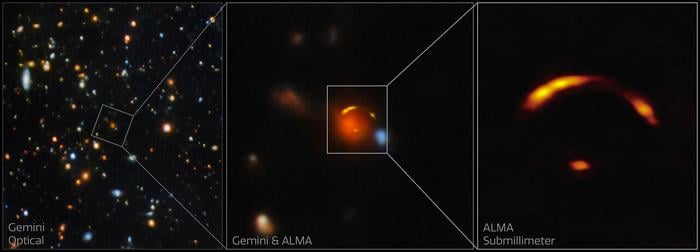
The odds of stumbling on a submillimetre source that bright inside that particular box of sky, just by chance, were around one in a hundred (and possibly closer to one in three hundred, depending on which survey counts you trust). That is uncomfortable enough to take seriously. Sharper follow-up with the Submillimeter Array, and then the Atacama Large Millimeter/submillimeter Array in Chile, revealed why Shadow Blaster looked so improbably luminous: it sits directly behind a massive foreground galaxy whose gravity bends and magnifies its light, smearing it into four distorted images arranged around a cosmic lens.
That lucky alignment is the whole story, in a sense. Without it, the galaxy would be far too faint and far too distant to study in any detail.
To use the lens properly, though, the team first had to understand the galaxy doing the bending. This is where Gemini North came in, with two of its spectrographs prising apart the foreground object. “The combined GMOS and GNIRS data helped us measure the distance to the lensing galaxy and determine that it is a massive elliptical galaxy,” says Urata. “This information was crucial for estimating the lens mass distribution and constructing a model of the gravitational lens.” With the lens characterised, they could finally strip away its distorting effect and see Shadow Blaster as it really is.
And what it really is turns out to be the interesting part.
Stars as particle accelerators
Strip out the magnification and Shadow Blaster sits about 11 billion light-years away, at the epoch astronomers call cosmic noon, when the Universe was furiously building stars. Its core is tiny, maybe half a kiloparsec across, and crammed with gas and dust forming new stars at a rate of several hundred Suns’ worth every year. There is no sign of an active black hole, none of the violent, fast-moving gas outflows that betray a feeding monster at a galaxy’s heart. The molecular gas is dense, concentrated, and relatively calm. In other words, this is starlight doing the heavy lifting, not a black hole. Theory has long predicted that such a packed, gas-rich environment can behave as a natural particle accelerator, where cosmic rays slam repeatedly into gas and spit out neutrinos as a by-product.
“Shadow Blaster possesses the kind of dense, gas-rich environment that theoretical models have long suggested could efficiently produce high-energy neutrinos,” says Urata. Combine that with the absence of any more convincing suspect in the field, and the case starts to look solid.
It is not airtight. A chance alignment cannot be ruled out, and on its own this one galaxy would be expected to fling a detectable neutrino at IceCube perhaps once every few centuries, hardly a smoking gun. The point is not the single galaxy.
The point is that galaxies like Shadow Blaster were everywhere ten billion years ago, churning out stars and cosmic rays in their billions. Individually feeble as neutrino sources, collectively they could account for a serious slice of the background that has puzzled physicists for decades. “Our analysis suggests that this population could contribute up to roughly 20% of the observed diffuse neutrino background measured by IceCube,” says Urata. Most of those galaxies are not conveniently lensed, which is exactly why this one matters: it is a rare, magnified window onto a population we mostly cannot see, the dusty star-forming galaxies that earlier searches kept missing because they hide their light behind thick veils of dust.
If the link holds up, Shadow Blaster would be the first individual dusty star-forming galaxy ever tied to a specific high-energy neutrino. Proving the population’s contribution will need wide, deep submillimetre surveys that no current telescope can deliver, the kind of facility still on the drawing board. For now there is one ghost, one galaxy, and a far-off blaze of newborn stars that may have been seasoning the cosmos with neutrinos since long before the Earth existed.
Source: Urata et al., Nature Astronomy (2026), DOI: 10.1038/s41550-026-02884-9
Frequently Asked Questions
How can a galaxy that doesn’t have a feeding black hole still produce high-energy neutrinos?
The neutrinos come from star formation itself, not a black hole. In a compact, gas-rich core, cosmic rays accelerated by the chaos of intense star birth collide with the surrounding dense gas and produce neutrinos as a by-product. Shadow Blaster shows no black-hole signature at all, which is what makes it such a clean test of the idea that stars alone can run the machinery.
Why does one distant galaxy matter if it would barely register a single neutrino in centuries?
Because it is a stand-in for a whole population. Galaxies like this were extraordinarily common around cosmic noon, and while each is a feeble source on its own, together they could supply a meaningful share of the neutrinos flooding our detectors. Shadow Blaster just happens to be magnified enough that we can study one example in detail.
Is it true that astronomers can’t normally see galaxies like this?
Largely, yes. Dusty star-forming galaxies hide their light behind thick layers of dust and sit billions of light-years away, so most earlier neutrino searches looking for bright flares simply missed them. A chance gravitational lens acted as a natural magnifying glass, boosting Shadow Blaster’s apparent brightness more than tenfold and bringing it within reach.
What would it take to confirm these galaxies as a major neutrino source?
Wide, deep surveys in submillimetre light that can sweep the large patches of sky where neutrino alerts originate. No current telescope can cover that area to the needed depth in a realistic amount of time, so the case rests partly on future facilities being built or proposed for exactly this kind of work.
ScienceBlog.com has no paywalls, no sponsored content, and no agenda beyond getting the science right. Every story here is written to inform, not to impress an advertiser or push a point of view.
Good science journalism takes time — reading the papers, checking the claims, finding researchers who can put findings in context. We do that work because we think it matters.
If you find this site useful, consider supporting it with a donation. Even a few dollars a month helps keep the coverage independent and free for everyone.