

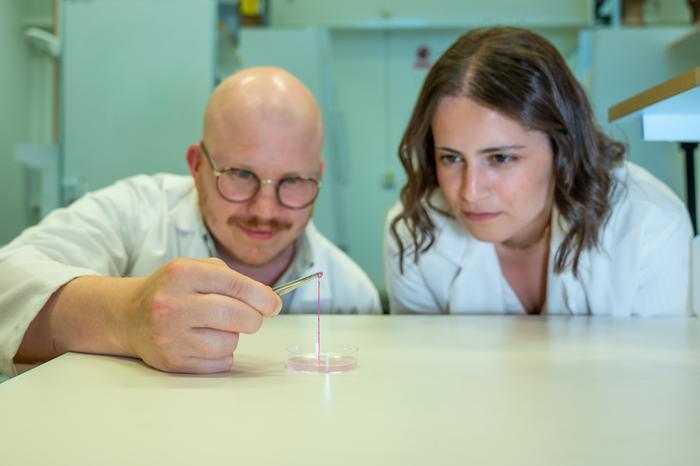
It looks like something from science fiction, but it fits in a syringe. Scientists in Sweden have created a living gel that can be 3D printed directly into skin grafts, potentially offering a way to restore healthy, scar-free skin after severe burns. In a study published in Advanced Healthcare Materials, researchers at Linkoping University and the Center for Disaster Medicine and Traumatology tested the approach in mice, showing that the material supports blood vessel growth, tissue integration, and dermal regeneration.
Why Burns Are So Hard to Heal
Severe burns destroy not only the outer layer of skin, the epidermis, but also the deeper dermis that contains blood vessels, nerves, and hair follicles. While current grafts can replace the epidermis, they rarely restore the dermis, leading to stiff, scarred skin with limited function. As study leader Johan Junker put it, “The dermis is so complicated that we can’t grow it in a lab. We don’t even know what all its components are.”
The Building Blocks of New Skin
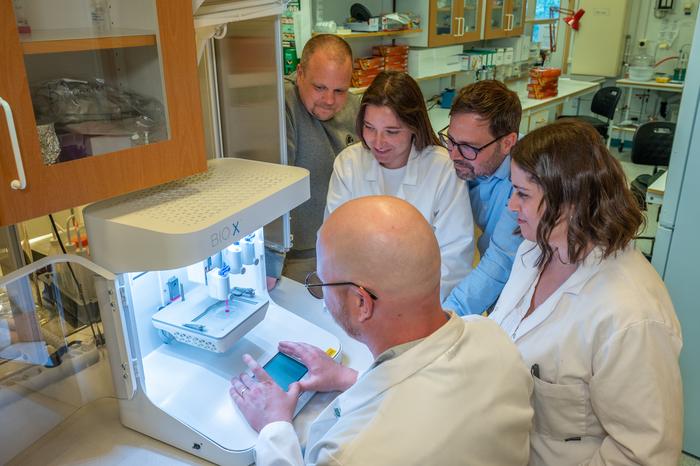
The research team focused on fibroblasts, the main connective tissue cells of the dermis. These cells were grown on porous gelatin beads, providing a scaffold for expansion. The beads were then mixed with a hyaluronic acid-based gel and linked together using a chemical process known as click chemistry. This mixture creates a shear-thinning gel — it flows when pushed through a syringe or printer nozzle, then solidifies on the wound.
“You can use a syringe to apply it to a wound, and once applied it becomes gel-like again. This also makes it possible to 3D print the gel with the cells in it,” said Daniel Aili, professor of molecular physics at Linkoping University.
Key Findings from the Study
- Fibroblasts remained alive and active in the gel for weeks after printing.
- In mouse implants, the constructs developed new blood vessels, crucial for long-term survival of the tissue.
- Cells produced essential extracellular matrix proteins, including collagen and laminin, supporting the formation of functional dermis.
- Grafts containing living cells integrated better with host tissue and remodeled faster than cell-free versions.
Beyond Skin Grafts
The team also published a related study showing they could form elastic hydrogel threads with 98 percent water content. These could be shaped into tiny tubes that might one day act as artificial blood vessels, a persistent challenge in bioengineering thick tissues and organoids.
What Comes Next
While the current experiments were in mice, the researchers plan to test the technology in a porcine wound model, which closely resembles human skin healing. If successful, the approach could lead to patient-specific grafts grown from a small biopsy, printed in the lab, and delivered by syringe or 3D printer to restore damaged skin without the need for large donor sites.
The work was supported by the Erling-Persson Foundation, the European Research Council, the Swedish Research Council, and the Knut and Alice Wallenberg Foundation.
Journal and DOI
Advanced Healthcare Materials, “Biphasic granular bioinks for biofabrication of high cell density constructs for dermal regeneration” (DOI: 10.1002/adhm.202501430)