
Scientists at Queen Mary University of London (QMUL) have made an object disappear by using a composite material with nano-size particles that can enhance specific properties on the object’s surface.
Researchers from QMUL’s School of Electronic Engineering and Computer Science, worked with UK industry to demonstrate for the first time a practical cloaking device that allows curved surfaces to appear flat to electromagnetic waves.
While the research might not lead to the invisibility cloak made famous in J.K Rowling’s Harry Potter novels quite yet, this practical demonstration could result in a step-change in how antennas are tethered to their platform. It could allow for antennas in different shapes and sizes to be attached in awkward places and a wide variety of materials.
Co-author, Professor Yang Hao from QMUL’s School of Electronic Engineering and Computer Science, said: “The design is based upon transformation optics, a concept behind the idea of the invisibility cloak.
“Previous research has shown this technique working at one frequency. However, we can demonstrate that it works at a greater range of frequencies making it more useful for other engineering applications, such as nano-antennas and the aerospace industry.”
The researchers coated a curved surface with a nanocomposite medium, which has seven distinct layers (called graded index nanocomposite) where the electric property of each layer varies depending on the position. The effect is to ‘cloak’ the object: such a structure can hide an object that would ordinarily have caused the wave to be scattered.
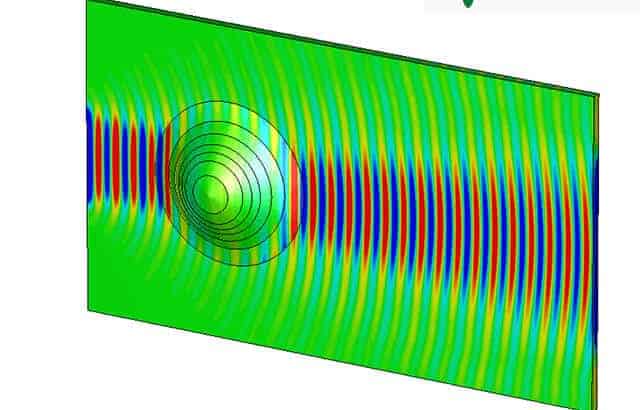 The underlying design approach has much wider applications, ranging from microwave to optics for the control of any kind of electromagnetic surface waves.
First author Dr Luigi La Spada also from QMUL’s School of Electronic Engineering and Computer Science, said: “The study and manipulation of surface waves is the key to develop technological and industrial solutions in the design of real-life platforms, for different application fields.
“We demonstrated a practical possibility to use nanocomposites to control surface wave propagation through advanced additive manufacturing. Perhaps most importantly, the approach used can be applied to other physical phenomena that are described by wave equations, such as acoustics. For this reason, we believe that this work has a great industrial impact.”
ScienceBlog.com has no paywalls, no sponsored content, and no agenda beyond getting the science right. Every story here is written to inform, not to impress an advertiser or push a point of view.
Good science journalism takes time — reading the papers, checking the claims, finding researchers who can put findings in context. We do that work because we think it matters.
If you find this site useful, consider supporting it with a donation. Even a few dollars a month helps keep the coverage independent and free for everyone.
Thanks for the photo