
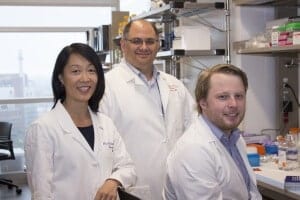
In a study with potentially major implications for the future treatment of autoimmunity and related conditions, scientists from the Perelman School of Medicine at the University of Pennsylvania have found a way to remove the subset of antibody-making cells that cause an autoimmune disease, without harming the rest of the immune system. The autoimmune disease the team studied is called pemphigus vulgaris (PV), a condition in which a patient’s own immune cells attack a protein called desmoglein-3 (Dsg3) that normally adheres skin cells.
Current therapies for autoimmune disease, such as prednisone and rituximab, suppress large parts of the immune system, leaving patients vulnerable to potentially fatal opportunistic infections and cancers.
The Penn researchers demonstrated their new technique by successfully treating an otherwise fatal autoimmune disease in a mouse model, without apparent off-target effects, which could harm healthy tissue. The results are published in an online First Release paper in Science.
“This is a powerful strategy for targeting just autoimmune cells and sparing the good immune cells that protect us from infection,” said co-senior author Aimee S. Payne, MD, PhD, the Albert M. Kligman Associate Professor of Dermatology.
Payne and her co-senior author Michael C. Milone, MD, PhD, an assistant professor of Pathology and Laboratory Medicine, adapted the technique from the promising anti-cancer strategy by which T cells are engineered to destroy malignant cells in certain leukemias and lymphomas.
“Our study effectively opens up the application of this anti-cancer technology to the treatment of a much wider range of diseases, including autoimmunity and transplant rejection,” Milone said.
The key element in the new strategy is based on an artificial target-recognizing receptor, called a chimeric antigen receptor, or CAR, which can be engineered into patients’ T cells. In human trials, researchers remove some of patients’ T cells through a process similar to dialysis and then engineer them in a laboratory to add the gene for the CAR so that the new receptor is expressed in the T cells. The new cells are then multiplied in the lab before re-infusing them into the patient. The T cells use their CAR receptors to bind to molecules on target cells, and the act of binding triggers an internal signal that strongly activates the T cells — so that they swiftly destroy their targets.
ScienceBlog.com has no paywalls, no sponsored content, and no agenda beyond getting the science right. Every story here is written to inform, not to impress an advertiser or push a point of view.
Good science journalism takes time — reading the papers, checking the claims, finding researchers who can put findings in context. We do that work because we think it matters.
If you find this site useful, consider supporting it with a donation. Even a few dollars a month helps keep the coverage independent and free for everyone.