
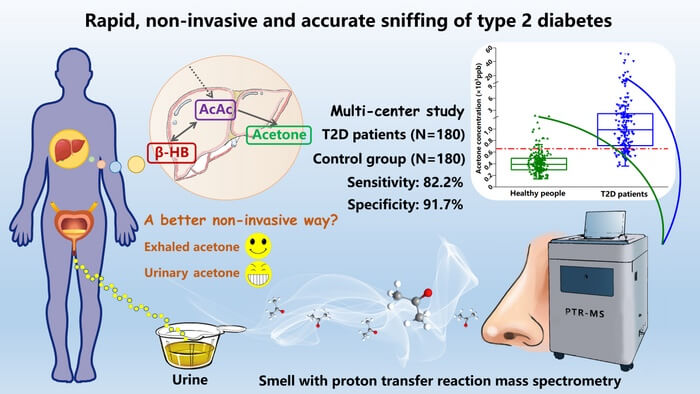
Type 2 diabetes (T2D) accounts for more than 90% of the confirmed cases of diabetes. It has become a common metabolic disease and is expected to affect 380 million worldwide in 2025. At present, clinically used diagnostic tests are mainly based on fasting plasma glucose (FPG), oral glucose tolerance test (OGTT) and glycosylated hemoglobin A1c (HbA1c). Although these methods have high accuracy, they are all invasive tests based on blood detection.
A research team, which is led by Prof. SHEN Chengyin from the Institute of Health and Medical Technology, Hefei Institutes of Physical Science of the Chinese Academy of Sciences, has been looking for a new non-invasive screening method for T2D.
With a self-developed proton transfer reaction-mass spectrometry (PTR-MS), they successfully detected volatile organic compounds (VOCs) from the urine of T2D patients and published the results in Talanta.
The research was based on sniffing urinary acetone by PTR-MS.
Acetone in urine is one of the ketones produced by fat metabolism. Due to insufficient utilization and storage of glucose in blood, T2D patients will accelerate the metabolism of urinary acetone.
In this study, researchers recruited 180 T2D patients and 180 healthy volunteers for multicenter study.
A diagnostic model with an accuracy of 81.3% (sensitivity: 73.3%, specificity: 89.3%) was established by using urinary acetone at center 1, and a threshold of 690.1 ppbv was obtained. The model was verified in the other two centers, and the results were similar. In addition, the accuracy of this method was equivalent to the diagnostic method used in the clinic.
“Sniffing T2D through urinary acetone is safe, non-invasive, fast, and accurate,” said XU Wei, first author of the paper. “We hope that the method can provide reference for screening and diagnosis of T2D.”
ScienceBlog.com has no paywalls, no sponsored content, and no agenda beyond getting the science right. Every story here is written to inform, not to impress an advertiser or push a point of view.
Good science journalism takes time — reading the papers, checking the claims, finding researchers who can put findings in context. We do that work because we think it matters.
If you find this site useful, consider supporting it with a donation. Even a few dollars a month helps keep the coverage independent and free for everyone.