The most common form of ice in the Universe isn’t the completely disordered material scientists have assumed for decades.
Instead, this “space ice” harbors tiny crystals embedded within its structure, according to new research that could reshape our understanding of how planets form and even how life might have arrived on Earth.
Low-density amorphous ice exists throughout the cosmos—in comets, on icy moons, and in the dust clouds where stars and planets are born. Unlike the highly ordered crystalline ice found on Earth, this space ice forms at extremely cold temperatures where there seemingly isn’t enough energy to create organized structures.
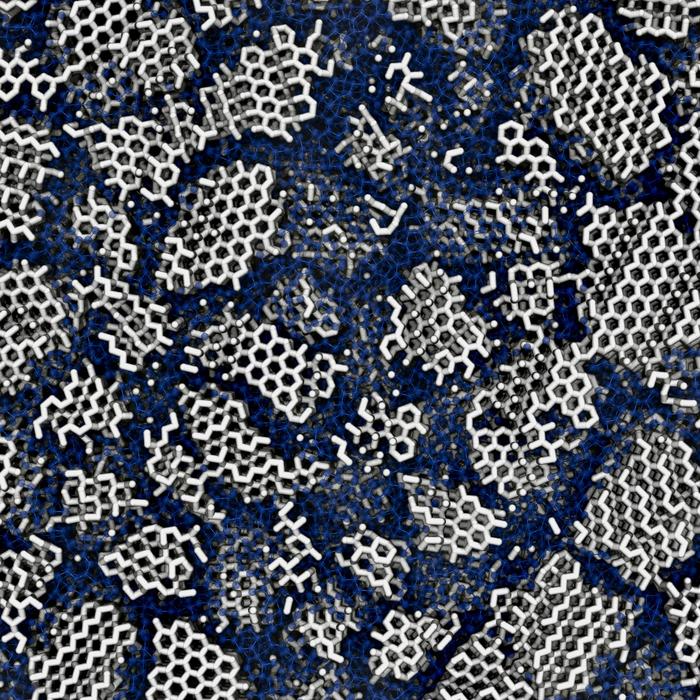
But researchers at University College London and the University of Cambridge have discovered that this assumption was wrong. Their computer simulations, published in Physical Review B, revealed that the ice contains crystalline regions about three nanometers wide—slightly wider than a single strand of DNA.
Hidden Structure Revealed Through Multiple Methods
The research team used two different computer models to simulate water freezing at -120 degrees Celsius at various rates. They found that ice containing up to 20% crystalline material closely matched the structure observed in previous X-ray diffraction experiments.
To confirm their findings, the scientists created real samples of amorphous ice using different methods—from depositing water vapor onto extremely cold surfaces to warming compressed ice formed at nearly -200 degrees Celsius. When they gently heated these samples, each retained distinct structural characteristics based on how it originally formed.
“We now have a good idea of what the most common form of ice in the Universe looks like at an atomic level,” said lead author Dr. Michael B. Davies, who conducted the research as part of his PhD. “This is important as ice is involved in many cosmological processes, for instance in how planets form, how galaxies evolve, and how matter moves around the Universe.”
Implications for Life’s Origins
The discovery has significant implications for theories about how life began on Earth. The Panspermia hypothesis suggests that life’s building blocks arrived here on ice comets, with low-density amorphous ice serving as the transport medium for simple amino acids and other organic molecules.
The new findings suggest this ice might be less effective at carrying these crucial ingredients. “Our findings suggest this ice would be a less good transport material for these origin of life molecules,” Davies explained. “That is because a partly crystalline structure has less space in which these ingredients could become embedded.”
However, the theory isn’t completely undermined. Davies noted that amorphous regions within the ice could still trap and store life’s building blocks.
Key Research Findings:
- Space ice contains up to 20% crystalline material embedded in amorphous structures
- Crystal size measures approximately 3 nanometers—smaller than most viruses
- Different formation methods produce ice with varying structural properties
- The discovery challenges decades of assumptions about cosmic ice behavior
Beyond Cosmology: Technological Applications
The research extends beyond space science into materials technology. Co-author Professor Christoph Salzmann of UCL Chemistry pointed out that the findings raise questions about amorphous materials used in advanced technology.
“Glass fibers that transport data long distances need to be amorphous, or disordered, for their function,” Salzmann said. “If they do contain tiny crystals and we can remove them, this will improve their performance.”
The team also highlighted ice’s potential as a space material. “Ice is potentially a high-performance material in space,” Davies noted. “It could shield spacecraft from radiation or provide fuel in the form of hydrogen and oxygen. So we need to know about its various forms and properties.”
The Bigger Picture
Water remains one of science’s most mysterious substances despite its fundamental role in life. Professor Angelos Michaelides from the University of Cambridge emphasized this point: “Water is the foundation of life but we still do not fully understand it. Amorphous ices may hold the key to explaining some of water’s many anomalies.”
The research team, which previously discovered medium-density amorphous ice in 2023, continues to uncover new forms of this essential substance. Their latest findings suggest that truly amorphous ice—completely without structure—might not exist at all in the cosmos, overturning a fundamental assumption about one of the Universe’s most common materials.
As scientists continue to probe the mysteries of cosmic ice, each discovery brings us closer to understanding not just how planets and stars form, but potentially how life itself began its journey through the cosmos.