

When massive stars die, they don’t always go out with the spectacular fireworks astronomers expect. Sometimes their final explosive jets get trapped inside their own stellar remains, creating enigmatic X-ray flashes that have puzzled scientists for years.
A new study of the closest such event ever detected reveals these “failed” stellar explosions might be far more common than their successful counterparts.
The discovery centers on EP 250108a, a fast X-ray transient detected by the Einstein Probe satellite in January 2025. Located 2.8 billion light-years away, this event provided astronomers with an unprecedented front-row seat to watch a dying star’s final moments unfold across multiple wavelengths of light.
Fast X-ray transients (FXTs) are brief but powerful bursts of X-ray energy that last anywhere from seconds to hours. Until recently, these cosmic flash bulbs remained largely mysterious because they occurred too far away and faded too quickly for detailed study.
When Jets Can’t Escape
The international research team, using telescopes including the Gemini Observatory and SOAR telescope in Chile, tracked EP 250108a’s evolution over six critical days. What they found challenges conventional understanding of how the most massive stars meet their end.
“This FXT supernova is nearly a twin of past supernovae that followed GRBs,” explained Rob Eyles-Ferris, a postdoctoral researcher at the University of Leicester and lead author of one of the companion studies. “Our observations of the early stages of EP 250108a’s evolution show that the explosions of massive stars can produce both phenomena.”
Typically, when stars 15-30 times more massive than our Sun collapse, they can launch jets of material at nearly the speed of light. These jets pierce through the star’s outer layers, creating gamma-ray bursts—the most powerful explosions in the universe. But in EP 250108a’s case, something went wrong.
The data suggests the star’s jets became trapped within its own debris, unable to break free. As these stifled jets interacted with the surrounding stellar material, they decelerated rapidly and converted their kinetic energy into the X-ray emission detected by Einstein Probe.
Key Research Findings:
- The failed jet contained approximately 0.04-0.15 solar masses of shocked material
- Initial expansion velocities reached 40-60% the speed of light before rapidly decelerating
- The progenitor star likely weighed 15-30 times more than our Sun
- Failed jets appear more common than successful ones based on detection rates
Solving the X-ray Mystery
The research team’s analysis revealed that EP 250108a represented a “collapsar engine”—an explosion driven by material falling into a black hole and launching jets. However, unlike successful gamma-ray bursts, these jets remained confined within dense circumstellar material.
To test this hypothesis, the scientists modeled different explosion scenarios. A conventional supernova explosion would require unrealistic amounts of energy and high-speed material to match the observations. But a failed jet model, containing much less fast-moving material, fit the data perfectly.
“The X-ray data alone cannot tell us what phenomena created the FXT,” noted Jillian Rastinejad, a PhD student at Northwestern University who led the second companion study. “Our optical monitoring campaign of EP 250108a was key to identifying the aftermath of the FXT and assembling the clues to its origin.”
A New Window Into Stellar Death
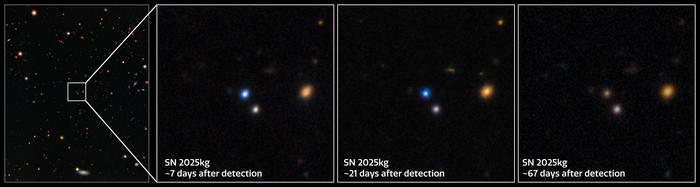
As the trapped jet emission faded, the team watched a more familiar sight emerge: the optical glow of supernova SN 2025kg. This Type Ic broad-lined supernova displayed the characteristic signatures of a massive star’s explosive death, complete with broad absorption lines indicating material moving at thousands of kilometers per second.
The observations paint a picture of stellar death that’s messier and more varied than previously understood. While gamma-ray bursts grab headlines as cosmic monsters, these failed jets might represent the more common reality of how massive stars actually expire.
Since Einstein Probe’s launch, FXTs have been detected several times each month, while historically, gamma-ray bursts occurred roughly once per year. This suggests that failed or weak jets dominate the explosive deaths of massive stars.
The discovery has broader implications for understanding stellar evolution and the diversity of explosive cosmic events. The upcoming Vera C. Rubin Observatory’s Legacy Survey of Space and Time will provide astronomers with vast amounts of time-domain data, potentially revealing many more examples of these exotic stellar deaths.
“This discovery heralds a broader understanding of the diversity in massive stars’ deaths and a need for deeper investigations into the whole landscape of stellar evolution,” Eyles-Ferris concluded.
The research demonstrates how modern astronomy’s rapid-response capabilities are revolutionizing our understanding of transient cosmic phenomena. By catching these brief events in real-time and following up with detailed observations across the electromagnetic spectrum, astronomers are finally solving mysteries that have persisted for decades.