

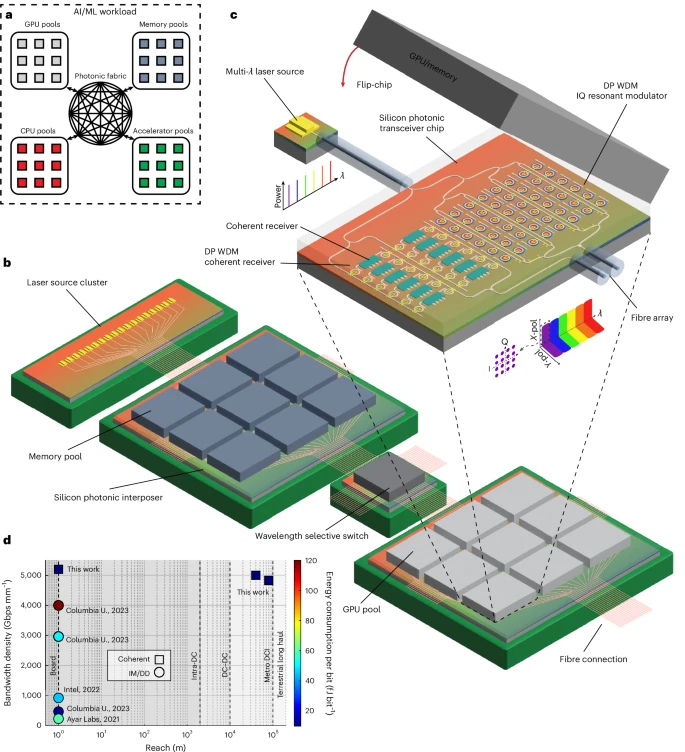
Scientists at Université Laval have created an optical chip no thicker than a human hair that can transmit data at 1,000 gigabits per second, fast enough to transfer the equivalent of 100 million books in seven minutes while consuming the energy needed to warm a single milliliter of water by one degree.
The chip addresses a critical bottleneck in artificial intelligence systems, where power-hungry data centers require massive amounts of information to flow between processors. Current AI systems like ChatGPT demand enormous computational resources, but the connections between processors often become the limiting factor.
Beyond Light Intensity: Harnessing Phase for Speed
Traditional optical communication relies primarily on varying light intensity to encode information. The Laval team’s innovation adds a second dimension by also manipulating the phase of light—essentially its timing shift. This dual approach allows the system to pack significantly more data into each light pulse.
“We’re jumping from 56 gigabits per second to 1,000 gigabits per second,” explains PhD student Alireza Geravand, the study’s lead author. The research, published in Nature Photonics, demonstrates how combining both intensity and phase modulation creates unprecedented performance levels in an ultra-compact device.
The chip uses microring modulators—tiny ring-shaped silicon devices that manipulate light to encode information. Think of them as microscopic traffic controllers for photons, directing light signals with remarkable precision while occupying minimal space.
Key Performance Metrics
- Speed: 1,000 gigabits per second transmission rate
- Energy efficiency: Just 4 joules to transfer 100 million books worth of data
- Size: Active components span only 100 micrometers in width
- Distance: Successfully transmitted over 80 kilometers
Real-World Impact for AI Infrastructure
Modern AI data centers depend on thousands of processors communicating like neurons in a brain. Each processor measures just a few millimeters, but the supporting infrastructure stretches for kilometers. This creates both physical and energy challenges.
The new technology essentially allows these processors to communicate as if they were only meters apart, dramatically reducing both the physical footprint and energy requirements. For AI training, this could mean the difference between waiting hours versus minutes for complex models to process information.
Companies like NVIDIA are already incorporating basic versions of microring modulators, though limited to intensity modulation only. The Laval team’s advance in adding phase modulation represents a significant leap forward in the technology’s capabilities.
A Decade in Development
The breakthrough builds on a foundation laid ten years ago in the same laboratory. Geravand notes that while their lab established the groundwork a decade ago, today’s achievement represents taking the technology “to the next level.”
The research involved a detailed study of how these microring devices behave when transmitting complex optical signals. The team discovered that by embedding pairs of microrings within a specialized configuration, they could eliminate unwanted frequency distortions that previously limited performance.
The chip achieved what researchers call a “record on-chip shoreline bandwidth density” exceeding 5 terabits per second per millimeter—a measure of how much data can flow through a given chip area. This efficiency metric proves crucial for future AI systems where space and energy remain at a premium.
With AI computational demands continuing to grow exponentially, innovations like this optical chip may prove essential for sustaining the technology’s advancement without overwhelming global energy grids. The researchers expect their technology could reach commercial markets within the next few years.