

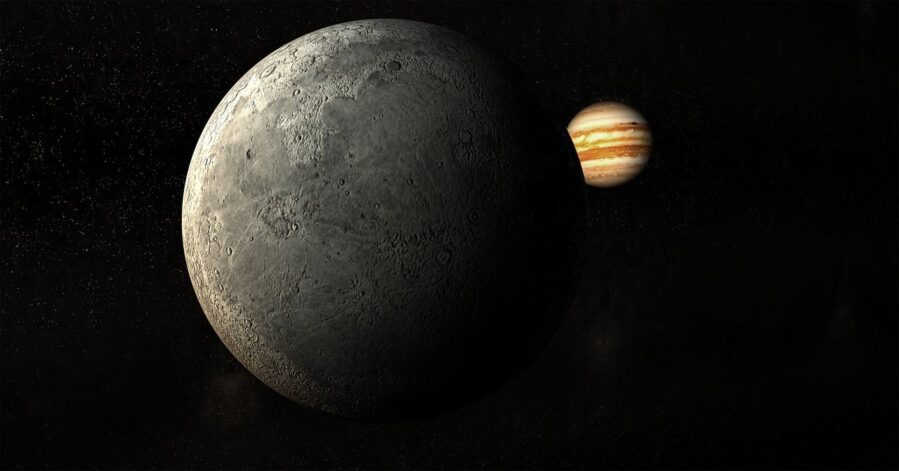
An extreme planet racing around its star in just 16 hours is spiraling toward destruction in a cosmic dance that astronomers say could reveal fundamental secrets about how stars work.
The ultra-hot Jupiter TOI-2109b, located 870 light-years from Earth, represents the closest known gas giant to its host star—and it’s getting closer.
Researchers tracking this planetary death march have confirmed that TOI-2109b’s orbital period is decreasing by at least 10 seconds every three years. While that might sound insignificant, it represents the first reliable measurement of orbital decay in such an extreme system, offering a rare window into stellar physics that remains poorly understood.
“This planet and its interesting situation could help us figure out some mysterious astronomical phenomena that so far we really don’t have much evidence to explain,” said Dr. Jaime A. Alvarado-Montes, a Macquarie Research Fellow who led the international study published in The Astrophysical Journal.
Racing Against Time
TOI-2109b defies easy comprehension. With nearly five times Jupiter’s mass and almost twice its size, this gas giant completes a full orbit in less time than Earth experiences from sunrise to sunset. It sits so close to its F-type star that surface temperatures reach 3,646 Kelvin—hot enough to vaporize most metals.
The planet’s extreme proximity creates intense tidal forces that gradually steal energy from its orbit through stellar interactions. As TOI-2109b loses orbital energy, it spirals inward, accelerating its eventual doom through one of three possible scenarios: tidal disruption, direct stellar collision, or atmospheric stripping that leaves only a rocky core.
Alvarado-Montes and his international team analyzed transit timing data spanning 14 years, combining observations from ground-based telescopes, NASA’s TESS mission, and the European Space Agency’s CHEOPS satellite. The precision required was extraordinary—detecting orbital changes measured in seconds across years of observations.
A Stellar Laboratory
The research team’s models reveal that TOI-2109b’s fate depends critically on its host star’s age, which remains uncertain. Two scenarios emerge from their analysis:
- A “young” star (1-2 billion years old) would produce slow orbital decay, with the planet maintaining a nearly constant period for millions of years
- An “old” star (2.5+ billion years old) would trigger rapid decay, destroying the planet within tens of thousands of years through efficient internal gravity wave dissipation
- Current observations favor the young star scenario, suggesting TOI-2109b faces a prolonged death spiral rather than immediate destruction
- The measured decay rate places the stellar tidal quality factor between 100,000 and 10 million, consistent with theoretical predictions for F-type stars
These measurements provide crucial constraints on stellar tidal dissipation mechanisms—processes that remain among the most poorly understood aspects of stellar physics. The efficiency of energy dissipation through internal waves in stellar convective zones and radiative regions directly affects planetary survival in close orbits.
Beyond One Planet’s Fate
The implications extend far beyond TOI-2109b’s demise. The study suggests that some rocky planets discovered in other solar systems might actually be the stripped cores of former gas giants—a finding that could fundamentally reshape theories of planetary evolution.
Ultra-short-period Jupiters like TOI-2109b are extremely rare, with occurrence rates around 0.5% among Sun-like stars. Their scarcity makes each discovery valuable for understanding planetary formation and migration processes that occurred during the early chaos of solar system assembly.
The research also demonstrates how gravitational interactions, stellar oblateness, and general relativistic effects can mimic orbital decay signals. The team’s detailed modeling separates these competing influences, ensuring their decay measurements reflect genuine tidal evolution rather than observational artifacts.
Future Observations
Continued monitoring over the next three to five years will provide definitive confirmation of the predicted orbital changes. High-precision instruments like the James Webb Space Telescope and continued CHEOPS observations can detect the subtle timing shifts that mark a planetary system’s final chapter.
The work represents a broader effort to understand stellar interiors through their interactions with planetary companions. As Alvarado-Montes notes, TOI-2109b’s extreme environment makes it an ideal laboratory for testing theories that remain difficult to verify in less extreme systems.
For now, TOI-2109b continues its relentless race around its star, each 16-hour orbit bringing it fractionally closer to destruction while revealing secrets about the fundamental processes that govern stars throughout the universe.