

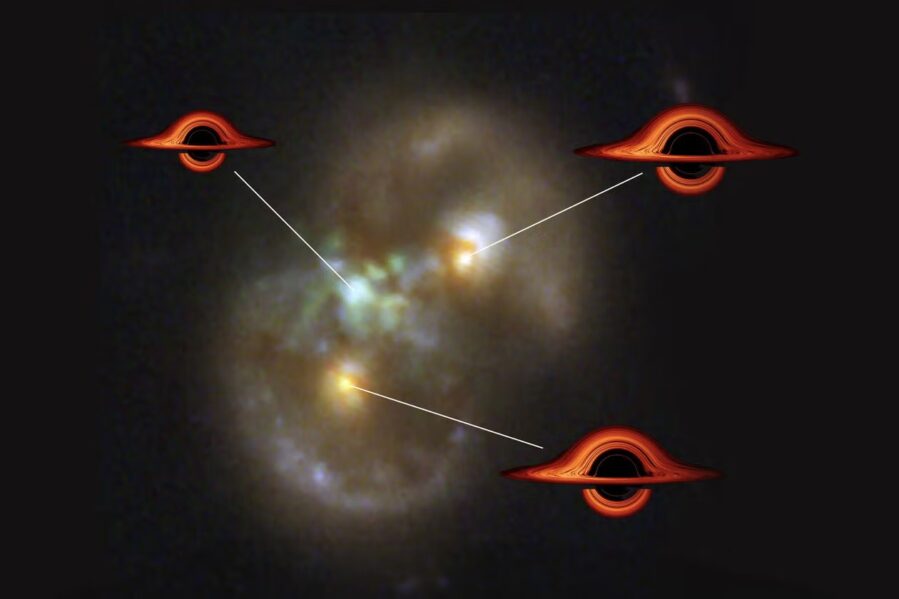
In a discovery that challenges everything astronomers thought they knew about black hole formation, researchers have spotted a supermassive black hole floating in the space between two colliding galaxies—a cosmic orphan that may have been born from the violent crash itself.
The strange system, dubbed the “Infinity” galaxy for its figure-eight appearance, sits 7 billion light-years away and hosts a black hole with the power output of a quasar. But unlike typical supermassive black holes that anchor themselves at galaxy centers, this one occupies the middle ground between two massive stellar nuclei, each surrounded by distinctive rings of stars.
“This is as close to a smoking gun as we’re likely ever going to get,” said Pieter van Dokkum, Yale astronomer and lead author of the study published in The Astrophysical Journal Letters. The discovery emerged from data captured by NASA’s James Webb Space Telescope as part of the COSMOS-Web survey.
A Black Hole Without a Home
Finding a supermassive black hole outside a galaxy nucleus is unusual enough. Discovering that it had recently formed was unprecedented. Van Dokkum and his team used follow-up observations from the Keck Observatory, along with radio data from the Very Large Array and X-ray measurements from the Chandra Observatory, to piece together the cosmic crime scene.
The black hole’s location tells a compelling story. Radio emissions pinpoint its position with remarkable precision—not in either of the two galactic nuclei, but suspended in a cloud of ionized gas stretching 10 kilometers between them. The gas itself glows with the telltale signature of extreme conditions, emitting light with an equivalent width ranging from 400 to 2000 angstroms.
Van Dokkum’s team proposes that two disk galaxies collided nearly head-on roughly 50 million years ago. During the cosmic smashup, gas clouds compressed and shocked at the collision site—similar to what happens in galaxy cluster collisions like the famous Bullet Cluster, but on a smaller scale.
Birth of a Monster
The collision theory addresses a long-standing puzzle in astrophysics. Webb telescope observations have revealed supermassive black holes in the early universe that are too massive to have grown from stellar remnants in the time available. This has led scientists to propose “heavy seed” formation scenarios, where large gas clouds collapse directly into black holes without first forming stars.
The Infinity galaxy may demonstrate this process in action. Key observations support the direct-collapse hypothesis:
- The black hole weighs approximately 1 million solar masses and radiates near its theoretical maximum efficiency
- Its radio emissions show a steep spectral signature consistent with a young, recently activated black hole
- The surrounding gas shows extreme equivalent widths, suggesting minimal contamination from ordinary starlight
- The black hole’s velocity matches the midpoint between the two receding galaxy nuclei
The X-ray luminosity alone reaches 1.5 × 10^44 ergs per second—approaching quasar levels despite the black hole’s relatively modest mass. Combined with powerful radio emissions, these signatures point to a recently ignited engine rather than an ancient wanderer.
Cosmic Forensics
The team’s detective work extends beyond the black hole itself. By measuring the velocities of gas in the stellar rings and accounting for the system’s orientation, they estimate the galaxies are separating at 260 kilometers per second. This suggests the collision occurred approximately 50 million years ago—recent enough that the black hole could have grown from an initial seed of 300,000 solar masses.
Yale astrophysicist Priyamvada Natarajan, a co-author and longtime advocate of heavy seed theories, sees the discovery as validation of extreme formation scenarios. The conditions that created this black hole—turbulent, metal-rich gas compressed by galactic collision—mirror the chaotic environments thought to exist in the early universe when the first supermassive black holes formed.
The research also hints at additional complexity. Both galactic nuclei likely harbor their own supermassive black holes, potentially making this a triple black hole system. Each nucleus contains roughly 100 billion solar masses of stars compressed into regions smaller than 1 kiloparsec—extraordinarily dense even by galactic standards.
Looking Forward
Van Dokkum emphasizes that additional observations are needed to confirm the findings. Future James Webb Space Telescope spectroscopy could map the gas dynamics in detail and search for velocity signatures that would distinguish between in-situ formation and a captured wandering black hole.
The discovery opens a window into extreme physics that may have been common in the early universe. If confirmed through simulations and follow-up observations, the Infinity galaxy would provide the first direct evidence that supermassive black holes can form through runaway gravitational collapse in the right conditions.
As van Dokkum notes, everything about this galaxy system defies expectations. The symmetric double-ring morphology resembles the nearby galaxy II Hz 4, but the central black hole transforms it from an interesting collision remnant into a laboratory for testing fundamental theories about how the universe’s most massive objects come to be.
