
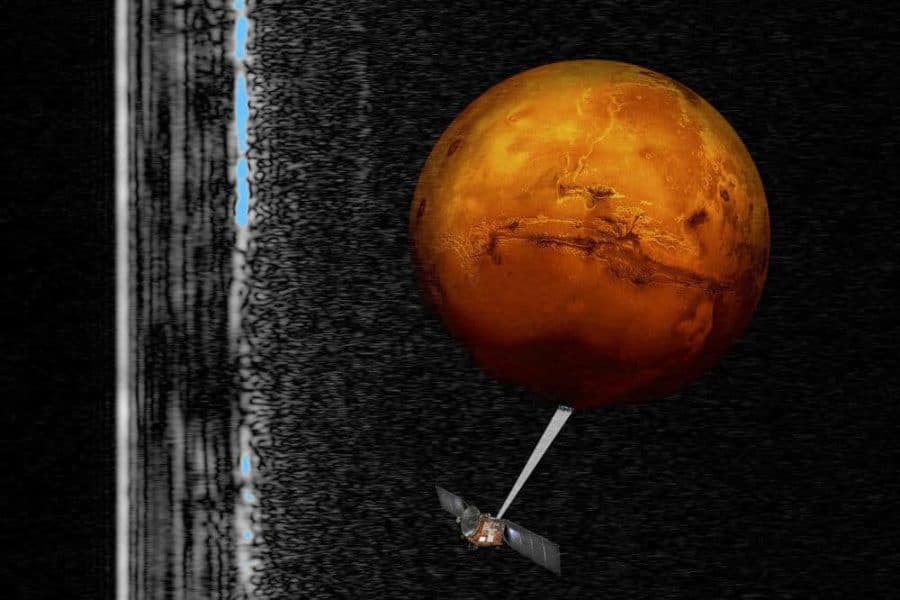
High-energy cosmic rays, once thought to be life’s enemy, could instead be its unlikely ally.
A new study from New York University Abu Dhabi suggests that galactic cosmic rays (GCRs) penetrating the subsurfaces of Mars, Europa and Enceladus may trigger chemical reactions that generate enough energy to support microbial life deep underground. This discovery introduces the concept of a “Radiolytic Habitable Zone,” a theoretical region where life might thrive far from sunlight, powered not by stars or volcanoes but by cosmic radiation breaking apart water molecules to release usable energy.
Cosmic Radiation and the Possibility of Hidden Ecosystems
Led by astrophysicist Dimitra Atri, the research team at NYU Abu Dhabi’s Center for Astrophysics and Space Science (CASS) modeled how cosmic rays interact with underground water or ice. When GCRs strike these molecules, they initiate a process called radiolysis, producing reactive species like electrons and hydrogen. Some terrestrial microbes—such as Desulforudis audaxviator in South African gold mines—already survive this way, living without sunlight and relying on radiation-induced energy sources.
Using the GEANT4 simulation toolkit, Atri’s team calculated how much energy this radiolysis process could deliver on three major astrobiological targets: Mars, Jupiter’s moon Europa and Saturn’s icy moon Enceladus. The results were striking. Enceladus came out on top, offering the most potential energy for subsurface microbial metabolism, followed by Mars and then Europa.
Key Findings from the Study
- Enceladus could support the highest density of microbial life powered by cosmic-ray radiolysis
- Mars’s subsurface holds promise for life just below its ice-covered polar caps
- Europa’s oxidants and internal CO2 might fuel chemistry needed for metabolism
- The “Radiolytic Habitable Zone” is proposed as a new framework for extraterrestrial life
- Energy available from GCRs is sufficient to sustain basic metabolic functions
Rethinking the Boundaries of Life
“This discovery changes the way we think about where life might exist,” said Atri. “Instead of looking only for warm planets with sunlight, we can now consider places that are cold and dark, as long as they have some water beneath the surface and are exposed to cosmic rays.”
Unlike the classic “Goldilocks Zone” which focuses on distance from a star for surface liquid water, the Radiolytic Habitable Zone considers whether underground water can be energized by ionizing radiation. Since cosmic rays pervade the galaxy, this model vastly broadens the range of potentially life-supporting environments.
From Mars to Moons: A Search Beneath the Surface
On Mars, ancient lakebeds suggest a once-habitable past. Today, any life would likely need to retreat below the surface. The study identified about 0.6 meters below the Martian ground as the optimal depth for maximum energy deposition by cosmic rays—enough to potentially support bacterial metabolism.
For Europa and Enceladus, where liquid oceans lie beneath thick ice shells, the calculations point to depths of 1 to 2 meters as hotspots for radiolysis-driven energy. Enceladus, with its geysers and plumes, also appears to have higher levels of organic molecules and possible electron donors like acetates.
Next Steps for Exploration
The findings carry significant implications for upcoming missions. NASA’s Europa Clipper and ESA’s ExoMars rover could be retooled to detect signs of radiolytic life beneath icy or rocky crusts. Likewise, the proposed Enceladus Orbilander mission might benefit from targeting thin-ice regions where cosmic rays penetrate more easily.
In these shadowed realms, life may not photosynthesize but could still persist—powered by the invisible hand of cosmic radiation, capturing electrons and crafting the molecules of metabolism in utter darkness.
Journal Information
Published in the International Journal of Astrobiology on July 28, 2025
Title: Estimating the potential of ionizing radiation-induced radiolysis for microbial metabolism on terrestrial planets and satellites with rarefied atmospheres
Authors: Dimitra Atri, Margaret Kamenetskiy, Michael May, Archit Kalra, Aida Castelblanco, Antony Quiñones-Camacho
DOI: 10.1017/S1473550425100025
ScienceBlog.com has no paywalls, no sponsored content, and no agenda beyond getting the science right. Every story here is written to inform, not to impress an advertiser or push a point of view.
Good science journalism takes time — reading the papers, checking the claims, finding researchers who can put findings in context. We do that work because we think it matters.
If you find this site useful, consider supporting it with a donation. Even a few dollars a month helps keep the coverage independent and free for everyone.