

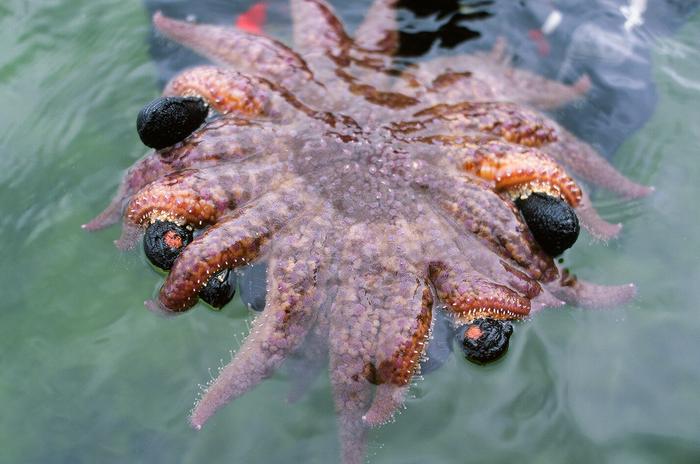
In the underwater war to save North America’s kelp forests, a brainless, multi-armed predator may be a powerful ally.
New research led by undergraduates at the University of California, Santa Cruz, shows that the sunflower sea star (Pycnopodia helianthoides) triggers a strong fear response in red sea urchins, causing them to flee and stop eating kelp. The finding sheds light on how the return of these long-absent predators could help reverse the collapse of critical marine habitats that support fisheries, biodiversity, and global economies.
Creating a ‘Landscape of Fear’
Kelp forests are among the most productive and valuable ecosystems on the planet. They shelter young abalone and rockfish, protect coastlines, and contribute to an estimated $500 billion in global economic activity each year. But in places like California and Oregon, these forests have vanished over the past decade. The main culprit? Overgrazing by sea urchins—particularly after a mysterious 2013 disease wiped out the sunflower sea stars that once kept urchin populations in check.
Now, researchers have shown that these sea stars don’t need to eat urchins to influence them. Just being nearby is enough. “We show that the sea stars create a ‘landscape of fear’ among red sea urchins in degraded urchin barrens that reduces grazing on kelp,” said study senior author Kristy Kroeker, a professor of ecology and evolutionary biology at UC Santa Cruz.
How the Experiment Worked
To test the sea stars’ influence, the student researchers conducted field experiments near Sitka, Alaska, where kelp beds have been decimated by urchins. The team placed caged sunflower sea stars on the ocean floor alongside tethered kelp blades. Empty cages served as controls. After just 24 hours, red sea urchins avoided the sea-star-adjacent kelp by about 6 feet—despite their hunger and the availability of food.
- Red urchins fled cages containing sunflower sea stars
- Green urchins were unaffected and continued eating kelp
- Kelp grazing was reduced by over 70% within 25 cm of the predator
- The fear effect extended across an 8.5 square meter radius
“My educated guess is that they will deter purple urchin grazing as well, but it’s a question of how much and for how long,” Kroeker added, referencing the most aggressive kelp-grazing species in the region.
Predator Power Without the Kill
This type of indirect predator influence, known as a non-consumptive effect, is increasingly recognized as a powerful force in ecosystem recovery. Instead of eating their prey, predators simply alter their behavior. In this case, the sunflower sea stars’ chemical cues, released into the water, sent red urchins packing. The sea stars were confined in mesh cages and didn’t make physical contact with the urchins.
Lead author Rae Mancuso, a UC Santa Cruz undergraduate who helped lead the diving team, called the experience transformative. “I feel very grateful to have had the privilege of working on this study alongside my peers,” Mancuso said. “I hope the findings… contribute in some way to the restoration of our all-important kelp forests.”
Implications for Restoration
The study’s authors suggest that reintroducing sunflower sea stars could be a viable, passive method of discouraging urchin grazing—offering an alternative to the labor-intensive and costly practice of manually removing urchins by hand.
More research is needed to test whether free-roaming sea stars would deter purple sea urchins as effectively, and whether the fear effect would last long enough to allow kelp recovery. But the findings open the door to new, more natural interventions in underwater ecosystem restoration.
“We’re seeing an ecologically meaningful behavioral shift in hungry, gonad-deficient urchins who still choose to avoid kelp near sea stars,” the authors write. That could be just the edge kelp forests need to recover.
Journal and Citation
Published July 9, 2025, in the journal Proceedings of the Royal Society B: Biological Sciences