
Now, researchers have harnessed this natural wonder to develop self-propelling ice that could transform defrosting technologies and even power small energy-harvesting devices.
Decoding the Racetrack Playa’s Moving Boulders
The inspiration comes from a place that has long fascinated scientists and tourists alike. Death Valley’s Racetrack Playa features rocks that trail furrows across the dry lake bed, as if they had moved of their own accord. This phenomenon puzzled researchers for decades until a series of studies, including a 2014 investigation headed by Professor Richard Norris at Harvard University, solved the riddle. The boulders are propelled when rainwater pools, freezes, and later melts, creating thin sheets of ice that catch the wind and push the rocks over slick, wet ground.
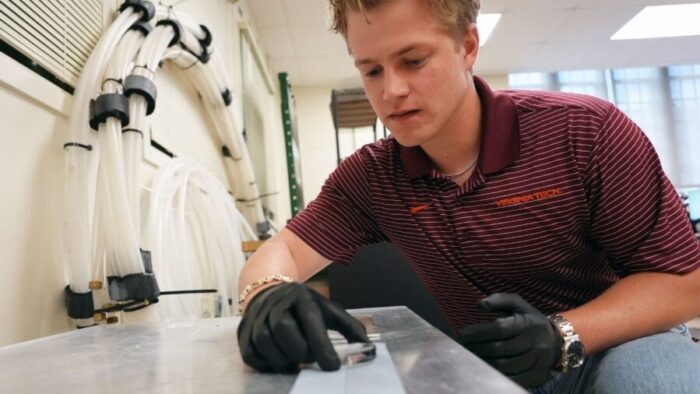
For Virginia Tech’s Jonathan Boreyko and his team, replicating the mysterious rock races inside the lab was just the beginning. Their breakthrough came when they engineered a patterned aluminum plate that could direct the motion of melting ice completely autonomously, with no wind.
Building a Track for Melting Ice
The basic design was straightforward: cut a series of herringbone-shaped grooves into a metal plate. The asymmetric channels created a directional flow for the meltwater as the ice above slowly liquefied. Unlike a calm skate, the underlying meltwater worked like a river current, guiding the ice disk forward without any external pushes.
- Death Valley rocks move due to a combination of frozen lakes and wind-driven sheets of melting ice
- The Virginia Tech team’s surfaces have engineered grooves that direct meltwater, pushing ice with no wind
- This technique may lead to rapid defrosting surfaces and new energy harvesting devices
Ph.D. student Jack Tapocik, lead author on the study published in ACS Applied Materials & Interfaces, compared the process to tubing on a river: instead of gravity, the shape of the underlying channels sets the direction of the ice disk’s journey.
“A good analogy is tubing on a river except here, the directional channels cause the flow instead of gravity.”
Slingshot Surprise: When Coatings Change the Rules
Hoping to accelerate the effect, the team coated their grooved plate with a water-repellent finish. To their surprise, the ice stuck tight rather than gliding smoothly. As meltwater channeled beneath, the disk clung in place until, suddenly, it broke free and shot forward in a burst. This so-called Laplace ice slingshot, as lead investigator Boreyko explains, results from an uneven surface tension: when pooled meltwater accumulates at one edge, the mismatch sends the ice disc careening away.
The researchers observed two main types of motion:
- Continuous glide: On bare aluminum, patterned channels allow for a steady, directed slide as meltwater flows under the ice disk.
- Slingshot bursts: With water-repellent coating, the ice sticks until a puddle at the front edge creates enough surface tension to hurl the disk across the plate.
Why It Matters: From Racing Disks to Future Devices
The speed and controllability of this ice motion have immediate applications. Boreyko envisions rapid-defrost surfaces that clear ice more efficiently, saving energy and time in refrigeration and transportation. He also imagines patterned tracks arranged in circles, where a rotating melting object topped with magnets could generate small amounts of electricity, effectively turning melting ice into a miniature power generator.
The team’s discoveries required patience and cross-disciplinary efforts at Virginia Tech’s Nature-Inspired Fluids and Interfaces Lab. The initial concept took shape in 2019, followed by years of experiments and modeling. Contributors included Saurabh Nath (now at the University of Pennsylvania), Sarah Propst (now at Johns Hopkins University), and Venkata Yashasvi Lolla (now at UC Berkeley), with support from the John Jones Faculty Fellowship.
What Comes Next?
By translating a slow, natural puzzle into a fast, engineered process, the lab has set the stage for future innovation in anti-icing, surface science, and green energy. The research not only brings science fiction-style motion closer to reality but also demonstrates how inspiration from places like Death Valley can yield tangible, technological advances. As Boreyko notes, the next step is to take these racing disks from sliding lines to spinning circuits, connecting nature’s mysteries to the technologies of tomorrow.
ScienceBlog.com has no paywalls, no sponsored content, and no agenda beyond getting the science right. Every story here is written to inform, not to impress an advertiser or push a point of view.
Good science journalism takes time — reading the papers, checking the claims, finding researchers who can put findings in context. We do that work because we think it matters.
If you find this site useful, consider supporting it with a donation. Even a few dollars a month helps keep the coverage independent and free for everyone.