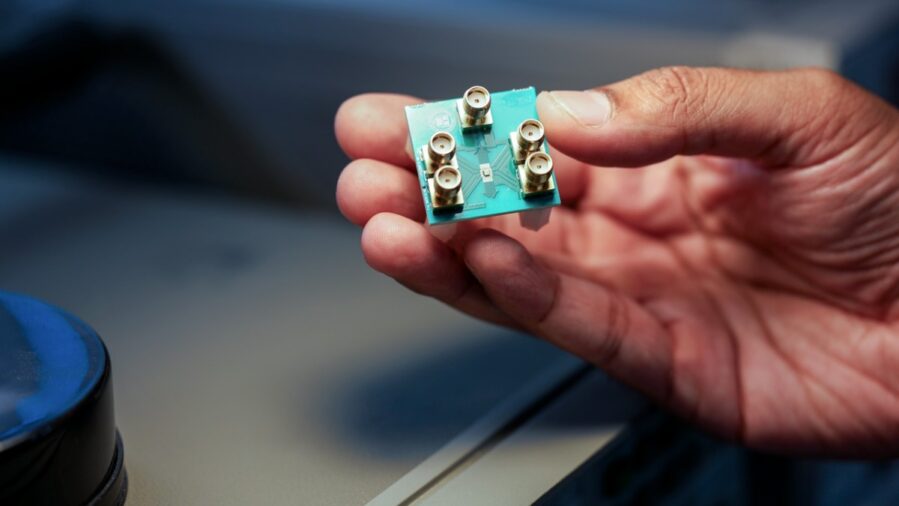
Researchers at Cornell University have created the first fully integrated “microwave brain” microchip, a neural network that processes data in the frequency domain at tens of gigahertz while using less than 200 milliwatts of power.
Reported in Nature Electronics, the advance opens the door to real-time, ultrafast computing in applications from radar tracking to wireless communication, without the heavy energy costs of conventional processors.
The chip, officially called an integrated microwave neural network (MNN), sidesteps the bottlenecks of digital processors that rely on clocked, step-by-step logic. Instead, it uses interconnected, tunable waveguides fabricated in standard CMOS technology to mimic the nonlinear, analog dynamics of a brain-like network.
By directly manipulating microwave signals in the tens of gigahertz range, it can analyze high-speed data streams without sampling or conversion to the time domain.
“Because it’s able to distort in a programmable way across a wide band of frequencies instantaneously, it can be repurposed for several computing tasks,” said lead author Bal Govind. “It bypasses a large number of signal processing steps that digital computers normally have to do.”
Clockless Speed, Tiny Power Draw
Traditional high-speed electronics, like those in data centers, must reconstruct distorted signals in the time domain, using power-hungry amplifiers, equalizers, and clock recovery circuits. These steps consume kilowatts of power and introduce delays.
In contrast, the Cornell MNN tolerates time-domain distortion and focuses on the input’s spectral features, compressing information into a narrow, comb-like frequency band for fast and easy readout.
This frequency-domain approach, similar in spirit to optical frequency combs but implemented in the microwave regime, allows the device to mimic both simple and complex logic functions from basic NAND gates to population counters, without a clock. Tests showed accuracies near 85% for digital gate emulation and 81% for multi-step, sequential logic, even when handling 10 gigabit-per-second data streams.
From Radar Tracking to Edge AI
Because the chip is extremely sensitive to frequency variation, it can also detect subtle changes in radar carrier waves, such as those caused by moving aircraft. In simulated scenarios, it accurately identified polygonal flight paths, tracked the fastest targets, and counted the number of objects in the air, all without traditional multi-channel radar receivers or heavy digital post-processing.
The researchers also tested the MNN on wireless signal classification tasks using the RadioML2016.10A dataset. Feeding a 50-MHz modulated carrier into the chip produced spectral patterns distinctive enough to identify 11 modulation formats, both analog and digital, with about 88% accuracy. This is on par with leading digital neural networks, but in a much smaller and more power-efficient package, well-suited for edge computing on devices like smartphones or satellites.
Harnessing Physics for Computing
The heart of the device is a set of coupled nonlinear and linear microwave resonators, linked by slow-speed parametric switches. These switches are driven by “control bitstreams” at just 150 megabits per second, which dynamically reprogram the system’s oscillatory modes. This low-speed programming can dramatically alter how the MNN transforms fleeting, broadband inputs into stable, narrowband output patterns.
As co-senior author Alyssa Apsel put it, the design abandons the goal of replicating a digital neural network’s structure exactly. Instead, it embraces what she calls “a controlled mush of frequency behaviors” that delivers high-performance computation from complex microwave physics.
Looking Ahead
The team sees multiple pathways to improving accuracy and scalability, including adding more tunable parameters, reducing on-chip component counts, and connecting arrays of MNNs for richer spectral features. They also envision training methods that jointly optimize the slow control sequences and the backend model, potentially enabling a “band-agnostic” neural processor that spans from millimeter-wave frequencies down to narrowband communications.
Beyond speed and efficiency, the work hints at a broader idea, using the inherent dynamics of electronic hardware not just to carry information, but to compute with it in real time. If future iterations fulfill their potential, microwave neural networks like Cornell’s could shift a range of AI and communication tasks out of data centers and onto the smallest, most power-constrained devices.