
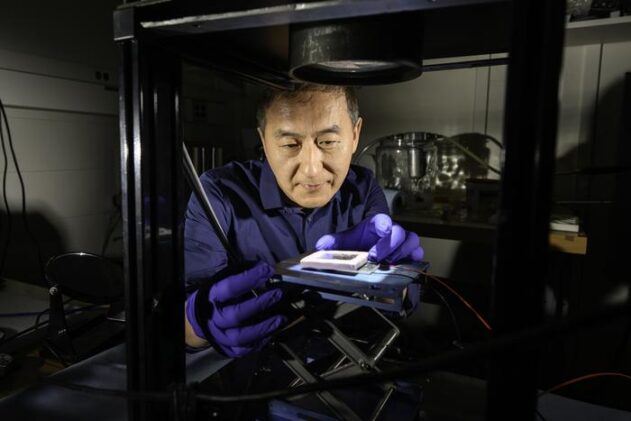
In a Rochester lab, sunlight met its match: blackened tungsten etched with femtosecond lasers that trap light with uncanny efficiency.
Researchers at the University of Rochester report a solar thermoelectric generator (STEG) that is 15 times more efficient than previous designs, potentially opening new paths for renewable power in places where traditional solar panels struggle.
How Black Metal Traps the Sun
Unlike photovoltaics that convert light directly into electricity, STEGs rely on heat. They generate power from a temperature difference between hot and cold sides, a phenomenon called the Seebeck effect. The catch has always been poor efficiency: less than one percent of sunlight usually becomes electricity. By comparison, rooftop solar panels average around 20 percent.
Professor Chunlei Guo and colleagues flipped the problem on its head. Instead of redesigning the semiconductor core, they re-engineered the device’s surfaces:
- Hot side: Tungsten was transformed into “black metal” that absorbs over 80 percent of solar wavelengths while minimizing heat loss at others.
- Mini greenhouse: A thin plastic layer, like farm greenhouse wrap, trapped more heat on the hot side.
- Cold side: Aluminum was laser-textured into a high-capacity micro heat sink, doubling its cooling performance.
“In this study, we don’t even touch the semiconductor materials,” Guo explained. “By combining better solar energy absorption and heat trapping at the hot side with better heat dissipation at the cold side, we made an astonishing improvement in efficiency.”
From Lasers to LEDs
The team demonstrated their advance by powering LEDs at brightness levels impossible for conventional STEGs. That leap is more than a lab trick; it shows how compact, lightweight generators might one day run sensors, wearable electronics, or off-grid devices where batteries fail.
“You can minimize the convection and conduction to trap more heat, increasing the temperature on the hot side,” said Guo, describing the simple greenhouse trick that magnified performance.
Why It Matters
The new design addresses a global need: affordable, decentralized energy. Solar thermoelectric generators are small, solid-state, and able to draw energy from both direct sunlight and surrounding heat. That makes them useful for remote villages, farms, or even spacecraft where bulky solar panels are impractical.
Imagine agricultural sensors in sub-Saharan Africa running indefinitely without batteries, or a smartwatch powered by the warmth of the wrist and the cool of the air. Black metal STEGs could turn these visions from speculative to practical.
What Comes Next
The Rochester group sees their work as complementary to, not a replacement for, conventional photovoltaics. A hybrid future might pair solar panels for high efficiency during peak hours with STEGs that scavenge waste heat and extend power into the night. With further materials advances, the technology could reach beyond rural energy and wearables into aerospace applications.
The research was published in Light: Science and Applications (DOI: 10.1038/s41377-025-01916-9).
ScienceBlog.com has no paywalls, no sponsored content, and no agenda beyond getting the science right. Every story here is written to inform, not to impress an advertiser or push a point of view.
Good science journalism takes time — reading the papers, checking the claims, finding researchers who can put findings in context. We do that work because we think it matters.
If you find this site useful, consider supporting it with a donation. Even a few dollars a month helps keep the coverage independent and free for everyone.