

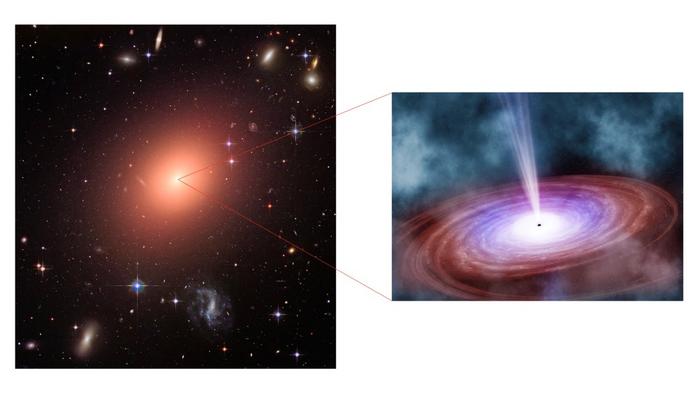
The universe was barely 900 million years old when astronomers discovered something that shouldn’t exist: two massive galaxies that had already lived full lives and were settling into cosmic retirement. These galactic giants, weighing 40-60 billion times our Sun’s mass, had burned through their star-making fuel at breakneck speed and transitioned into a dormant phase while still hosting active supermassive black holes at their centers.
Using the James Webb Space Telescope, an international team led by researchers from the Kavli Institute for the Physics and Mathematics of the Universe found these ancient systems by studying quasars, brilliant beacons powered by matter spiraling into supermassive black holes. The discovery, published in Nature Astronomy, captures a critical moment in cosmic evolution when galaxies and their central black holes were learning to grow together.
Racing Against Cosmic Time
The two galaxies, designated J2236+0032 and J1512+4422, exist at redshifts corresponding to when the universe was just 12.9 billion years old. What makes them remarkable isn’t their age, but how quickly they matured. Spectroscopic analysis revealed telltale signatures of A- and F-type stars—the cosmic equivalent of middle age, indicating these galaxies had already experienced intense starburst episodes at even earlier times.
“It was totally unexpected to find such mature galaxies in the Universe less than a billion years after the Big Bang. What is even more remarkable is that these ‘dying’ galaxies still host active supermassive black holes.”
The researchers determined that J2236+0032 had its peak star formation around redshift 9, when the universe was only 550 million years old, churning out stars at rates exceeding 1,000 solar masses per year. By the time astronomers observed it, star formation had virtually ceased, with the galaxy producing fewer than one solar mass worth of new stars annually.
Black Holes as Galactic Undertakers
The timing suggests supermassive black holes played a crucial role in shutting down star formation in their host galaxies. As these cosmic giants fed on surrounding gas, they expelled material through powerful winds, potentially starving their galaxies of the raw materials needed to form new stars. The researchers found evidence of these outflows in blueshifted emission lines, indicating gas moving at velocities exceeding 800 kilometers per second.
This process appears to have been remarkably efficient in the early universe. J1512+4422 sits right at the boundary between active star formation and quiescence, suggesting astronomers caught it in the act of transitioning. The galaxy shows characteristics of both phases: still forming some stars but already displaying the spectroscopic signatures of an aging stellar population.
The relationship between galaxy mass and central black hole mass in these ancient systems closely matches what astronomers observe in the local universe today, indicating this fundamental scaling relationship was already established within the first billion years of cosmic time. However, the scatter in this relationship appears larger at early times, suggesting the co-evolution process was still being refined.
Direct measurements of stellar velocities in these distant galaxies—among the most challenging observations possible with current technology—revealed velocity dispersions consistent with their massive black holes. This provides additional evidence that the tight correlations between galaxy properties and central black hole mass were already emerging in the cosmic dawn.
The discovery raises intriguing questions about how such massive systems could assemble so quickly in the early universe. Traditional models predict smooth, gradual growth over cosmic time, but these observations suggest more dramatic, episodic formation scenarios where intense starbursts rapidly build up stellar mass before being abruptly terminated by black hole feedback.
The research team continues analyzing additional targets to determine whether this represents a common evolutionary pathway or a rare occurrence in the early universe. Understanding how galaxies and black holes achieved such rapid co-evolution has implications for theories of structure formation and the role of active galactic nuclei in shaping cosmic history.