

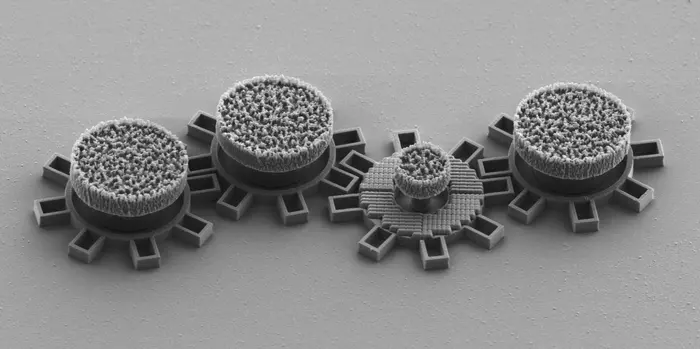
Scientists have shattered a three-decade-old barrier in miniaturization by creating functional gear systems that could fit inside a human hair. The microscopic machines, powered entirely by laser light, represent the smallest motorized gears ever built and open new frontiers for medical devices and nanotechnology applications.
For over 30 years, engineers have struggled to create gears smaller than 0.1 millimeters due to the impossibility of constructing traditional drive systems at such tiny scales. The breakthrough came from researchers at the University of Gothenburg and collaborating institutions, who abandoned conventional mechanical approaches entirely in favor of optical power systems.
Light Replaces Mechanical Drive Trains
The key innovation lies in optical metasurfaces – specially patterned structures that manipulate light at the nanoscale. These metasurfaces are etched directly onto silicon gears using standard lithography techniques, creating rotors as small as 8 micrometers in diameter. When illuminated with a 1064-nanometer laser, the metasurfaces generate forces that spin the gears with remarkable precision.
“This is a fundamentally new way of thinking about mechanics on a microscale. By replacing bulky couplings with light, we can finally overcome the size barrier,”
explained Gan Wang, the study’s first author and researcher in soft matter physics at the University of Gothenburg.
The system offers unprecedented control over microscopic motion. Researchers can adjust gear speed by changing laser intensity and even reverse rotation direction by altering the light’s polarization. Multiple gears can operate simultaneously under uniform illumination, creating complex mechanical systems at scales previously thought impossible.
The fabrication process builds on established semiconductor manufacturing techniques, making the technology scalable for mass production. Tens of thousands of micromotors can be fabricated on a single 5mm x 5mm chip, with the potential for wafer-scale manufacturing.
From Rotation to Complex Motion
Beyond simple rotation, the researchers demonstrated sophisticated mechanical systems including gear trains that multiply torque or speed, and rack-and-pinion mechanisms that convert rotational motion to linear displacement. One particularly elegant design creates oscillating motion under constant illumination by incorporating metasurfaces on both the pinion and rack components.
The team also built microscopic mirrors controlled by the gear systems, demonstrating how the technology could dynamically manipulate light paths within optical devices. This capability suggests applications in advanced imaging systems and optical communications.
Performance testing revealed the motors can generate up to 36 piconewton-micrometers of torque and operate continuously for up to eleven hours. While the energy conversion efficiency remains low at approximately 10^-14, this matches other light-driven micromotors and proves sufficient for intended applications.
The research, published in Nature Communications, addresses longstanding challenges in microrobotics and precision manufacturing. Traditional approaches using electric or magnetic fields face limitations in integration and control, while optical tweezers require focused beams that limit scalability.
“We can use the new micromotors as pumps inside the human body, for example to regulate various flows. I am also looking at how they function as valves that open and close,”
Wang noted, highlighting potential biomedical applications.
The 1064-nanometer wavelength used in the system minimizes damage to biological tissues, making the technology suitable for in-vivo applications. The indirect energy delivery mechanism allows mechanical actuation of passive structures without directly exposing biological samples to laser light.
Future developments may incorporate phase-transition materials that could reconfigure optical properties in real-time, addressing current limitations of pre-designed metasurfaces. Integration with other optical components like metalenses could enable even more sophisticated microsystems.
The technology represents a significant step toward practical nanoscale manufacturing and medical devices. With gears approaching the size of human cells – typically 16-20 micrometers – the applications span from targeted drug delivery systems to microscopic sensors capable of measuring forces at the femtonewton scale.