

Nobody expected the bacteria to commit suicide. But that is essentially what happens when polymyxin antibiotics attack, according to stunning new microscopy images that reveal how these last-resort drugs actually work after 80 years of clinical mystery.
Researchers at University College London and Imperial College London have captured the first real-time images of polymyxin B piercing bacterial defenses, and the mechanism turns out to be far stranger than anyone predicted. The antibiotic does not simply punch holes or dissolve the protective outer membrane of Gram-negative bacteria. Instead, it tricks the cell into frantically overproducing its own armor until the whole defensive system collapses.
When Defense Becomes Self-Sabotage
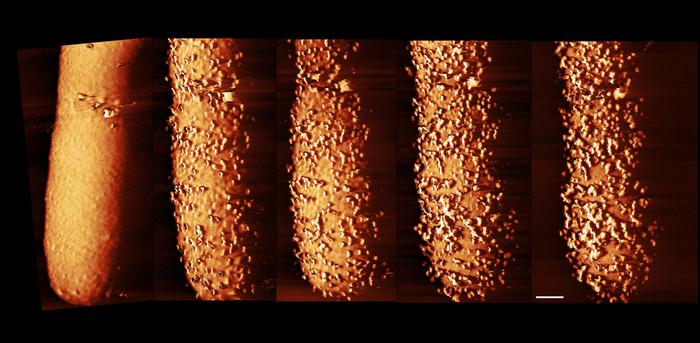
Using atomic force microscopy with a needle just nanometers wide, the team watched E. coli cells respond to polymyxin exposure. Within minutes, bulges erupted across the bacterial surface. The cells began shedding their outer membrane at an accelerating rate, desperately trying to replace what they were losing.
“It was incredible seeing the effect of the antibiotic at the bacterial surface in real-time,” said Carolina Borrelli, a PhD student at UCL’s London Centre for Nanotechnology.
“It is as if the cell is forced to produce ‘bricks’ for its outer wall at such a rate that this wall becomes disrupted, allowing the antibiotic to infiltrate.”
The more armor the bacterium produced, the more it shed, creating gaps that allowed the antibiotic to penetrate and kill the cell. It is a vicious cycle, and a fatal one.
But here is where things get interesting: the entire deadly process requires the bacterium to be awake. Dormant bacteria, those in a hibernation-like state with metabolism switched off, proved completely immune to polymyxin attack. The antibiotic bound to their surface but caused virtually no damage.
The Sleeping Bacteria Problem
This discovery upends decades of assumptions about how antibiotics work. Doctors and researchers have long believed that polymyxins could kill bacteria regardless of metabolic state. That confidence now appears misplaced.
“Through capturing these incredible images of single cells, we’ve been able to show that this class of antibiotics only work with help from the bacterium,” explained Dr. Andrew Edwards from Imperial College London.
“If the cells go into a hibernation-like state, the drugs no longer work, which is very surprising.”
The team tested this effect by exposing dormant E. coli to polymyxin B with and without sugar. When sugar was absent, dormant cells survived indefinitely. When sugar was added, the bacteria consumed it, reactivated their membrane production systems, and died, but only after a 15-minute delay while they woke up and resumed making armor.
This has immediate clinical implications. Many bacterial infections involve dormant cells that can persist for years before reactivating to cause recurrent disease. If polymyxins cannot touch these dormant populations, treatment strategies may need fundamental revision.
Professor Bart Hoogenboom, based at UCL’s London Centre for Nanotechnology, suggests a counterintuitive approach: combining polymyxin treatment with therapies that wake up dormant bacteria or stimulate armor production. Force the bacteria to metabolize, and they become vulnerable.
The findings also raise questions about how antibiotics are tested. Current assessment methods may not account for bacterial metabolic states, potentially overestimating drug effectiveness against real-world infections where dormant cells hide among active populations.
Polymyxins were discovered more than 80 years ago and remain crucial weapons against Gram-negative bacteria, which cause many drug-resistant infections. These bacteria possess an outer membrane that blocks most antibiotics, making polymyxins among the few options left when other treatments fail. With drug-resistant infections already killing over a million people annually, understanding how these last-resort antibiotics actually work has become urgent.
The research employed atomic force microscopy to “feel” the shape of individual bacterial cells at resolutions far beyond what light microscopy can achieve. The resulting images show the bacterial surface transforming over time, from smooth to bumpy to catastrophically breached, as the antibiotic triggers the cell’s self-destructive overproduction cycle.
Dr. Ed Douglas from Imperial noted that once the team observed disruption only occurring when bacteria consumed sugar, the mechanism became clear. The work, funded by UK Research and Innovation and Wellcome, represents a collaboration between UCL, Imperial, and the University of Nottingham.
Whether these insights lead to better combination therapies or entirely new approaches to fighting bacterial infections remains to be seen. But at minimum, they reveal that even our oldest antibiotics still harbor secrets, and that bacteria’s greatest vulnerability might be their own compulsive need to rebuild their defenses.