

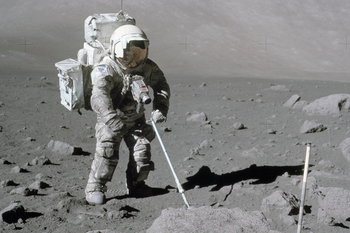
A 155-gram fragment collected during Apollo 17 more than half a century ago is forcing scientists to reconsider the timeline of giant impacts that shaped the Moon – and by extension, Earth – during the solar system’s violent infancy.
The rock, designated sample 76535, has been puzzling researchers since the 1970s. Its mineral makeup indicates it crystallized nearly 50 kilometers below the lunar surface, yet it shows almost no evidence of the extreme shock pressures that typically accompany such a violent journey to the surface. For decades, many scientists assumed only the most massive impact in lunar history – the one that created the enormous South Pole-Aitken Basin on the Moon’s far side – could have blasted the rock upward without pulverizing it.
New computer simulations from Lawrence Livermore National Laboratory suggest a simpler explanation that carries surprising implications. Lead researcher Evan Bjonnes and his team demonstrated that the Serenitatis Basin impact, a massive crater on the Moon’s near side, could have gently lifted the rock during the later “collapse” phase of crater formation.
“This rock may be small, but it carries a huge story about the Moon’s early history. It’s like a time capsule from 4.25 billion years ago,” Bjonnes said.
The Collapse Changes Everything
The finding hinges on understanding how giant craters form. After the initial explosive excavation phase, the crater undergoes a dramatic collapse as material flows inward and upward, somewhat like a slow-motion splash frozen in rock. Using the iSALE shock-physics code, Bjonnes’ team simulated Serenitatis-scale impacts and tracked how material moved during this collapse stage.
The models revealed that roughly 140,000 cubic kilometers of deep crustal material – about 2 percent of near-surface ejecta – could reach the surface with maximum shock pressures under 6 gigapascals, matching the rock’s preserved state. At the distance where Apollo 17 astronauts found sample 76535, material fitting its profile comprised about 1.76 percent of surface material in the simulations.
The team tested their models under various thermal conditions representing different stages of lunar cooling. Material from 45 to 65 kilometers deep consistently reached the surface with minimal shock damage across most scenarios, suggesting this process occurred frequently during the Moon’s early bombardment.
Pushing Back the Clock
If sample 76535 does date the Serenitatis impact, that event occurred around 4.25 billion years ago – roughly 300 million years earlier than consensus estimates based on other Apollo 17 samples. This seemingly technical adjustment cascades through our understanding of early solar system history.
Because Serenitatis is classified among the Moon’s Pre-Nectarian basins – older than the well-dated Nectaris Basin – other ancient impacts must be pushed back even further in time. The South Pole-Aitken Basin, likely the Moon’s oldest major impact structure, would necessarily predate 4.25 billion years ago.
“By pushing Serenitatis back in time, we’re shifting the entire timeline of when big impacts happened across the solar system,” Bjonnes said. “That has ripple effects for understanding Earth’s early environment too.”
The revision matters because Earth’s oldest surface rocks have been recycled by plate tectonics, leaving the Moon as our best laboratory for reconstructing the bombardment history of the inner solar system. A different impact timeline affects theories about when Earth’s oceans formed, when the planet became hospitable to life, and whether there was a spike in impacts known as the Late Heavy Bombardment between 3.5 and 4.1 billion years ago.
The research also challenges the conventional assumption that only extraordinary impacts can excavate deep rocks without destroying them. If crater collapse routinely brings up material from tens of kilometers down, future lunar missions exploring other impact basins may find similar “out-of-place” rocks that preserve information about the Moon’s deep interior.
Sample 76535 itself is a troctolite – 58 percent plagioclase and 37 percent olivine – that formed as a cumulate in the mid-to-deep crust. Its mineral assemblage indicates it cooled slowly at first, at a rate of about 3.9 degrees Celsius per million years, consistent with deep burial. Then something rapid happened: orthopyroxene crystals show a cooling rate of 0.04 degrees per year near 500 degrees Celsius, indicating the rock reached the surface in just a few thousand years.
The convergence of radiometric dating (argon-argon dating yields 4.249 billion years), shock pressure constraints (under 6 gigapascals), depth estimates (48 to 58 kilometers), and proximity to Serenitatis Basin now points toward a local origin rather than a convoluted journey from the far side.
Other Apollo 17 samples have complicated the picture. Impact melt breccias from the site average about 3.89 billion years old, likely recording the Imbrium Basin impact whose ejecta blanketed the region. A few older samples – norite breccias 78155, 78235, and 78236 – show shock events around 4.2 billion years ago, but their ages don’t quite overlap with sample 76535 at high confidence levels and they exhibit more complex shock histories.
The research team, which included scientists from Purdue University, the German Aerospace Center, the Lunar and Planetary Institute, the University of Arizona, UC Santa Cruz, and MIT, emphasized that their findings apply beyond Serenitatis. The process of crater collapse lifting deep material appears to be common during basin-forming impacts, meaning many lunar basins likely contain accessible samples from the Moon’s lower crust and upper mantle.
As space agencies plan future missions to the Moon, including NASA’s Artemis program, the work offers practical guidance: large impact basins may harbor samples that seem geologically inconsistent with their surroundings, but these apparent anomalies could be windows into the Moon’s otherwise inaccessible depths.
The study appears in Geophysical Research Letters.