

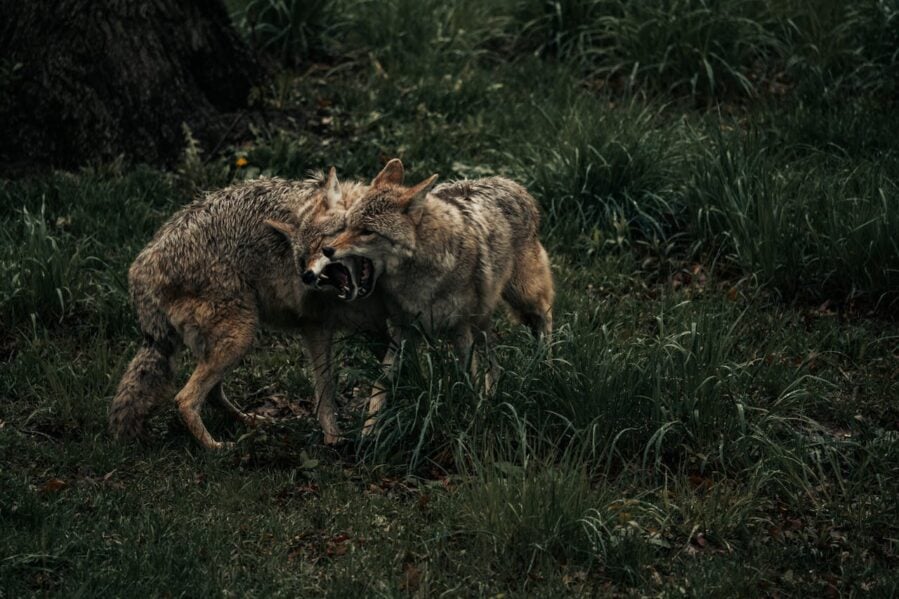
The coyotes always come back. That’s the frustrating lesson from an 18-year study of a South Carolina predator population that refused to stay down, no matter how hard wildlife managers tried to suppress it.
Researchers monitoring coyotes at the Savannah River Site found population densities averaging 50 animals per 100 square kilometers before intensive removal efforts began in 2010. After three years of professional trappers removing nearly 500 coyotes at a cost that would now reach $50,000 annually, the population crashed to just 14 per 100 square kilometers. Victory seemed at hand.
Then the coyotes staged a comeback that surprised even seasoned wildlife biologists. Within two years of ending the removal program, densities rebounded to 44 per 100 square kilometers and stabilized there, suggesting the population had simply returned to its natural carrying capacity.
“In general, predator populations are contentious to manage, but coyotes are a lot harder to manage than a lot of other predators due to their really unique, amazing ability to reproduce. They can bounce back very rapidly.”
Heather Gaya, the study’s lead author and a postdoctoral researcher at the University of Georgia’s Warnell School of Forestry, said the rapid recovery reflects something fundamental about coyote ecology. These adaptable carnivores maintain reservoir populations of transient individuals in surrounding landscapes, ready to flood into any area where resident coyotes have been removed.
Forest-Dwelling Coyotes Challenge Assumptions
The research team employed an unusual analytical approach, integrating five different monitoring techniques into a single population model. They combined howl surveys conducted at 43 locations, scat deposition counts from road transects, baited camera trap images, genetic analysis of 591 scat samples from 462 individual coyotes, and records of animals removed by professional trappers.
This methodological mosaic proved necessary because funding constraints and shifting priorities meant no single monitoring approach continued throughout the entire study period. The integrated model allowed researchers to extract reliable population trends from spatially and temporally patchy data, something traditional analytical methods struggle to accomplish.
One finding that caught researchers off guard: the Savannah River Site supports this robust coyote population despite being predominantly forested. Conventional wisdom suggests coyotes prefer open, agricultural landscapes. Yet here they thrived in loblolly pine plantations and bottomland hardwood forests.
“Coyotes have the ability to occupy and adapt to many different habitats, and SRS is apparently one that can sustain a lot of coyotes with enough prey and resources for a long time.”
Co-author Gino D’Angelo attributes the population’s success partly to an ecological vacuum. For over 75 years, the region lacked apex predators like red wolves, allowing coyotes to fill that niche. White-tailed deer, wild pigs, and small mammals provided abundant prey for a predator population that faced minimal competition from other carnivores.
The Economics of Futility
The researchers calculated removal costs for just their 780-square-kilometer study area would run between $30,000 and $50,000 annually, requiring sustained effort indefinitely. Scale that up to state or regional levels, and the price tag becomes prohibitive for most wildlife agencies already operating on thin budgets.
GPS collar data from the site revealed why removal programs face such steep odds. More than half the coyotes captured between 2015 and 2017 displayed transient behavior, moving through the landscape rather than establishing permanent territories. Some individuals dispersed over 500 kilometers, suggesting a vast regional population capable of rapidly refilling any local void.
The genetic data told a similar story. Even between annual trapping seasons during the removal period, population recoveries occurred too quickly to result solely from reproduction by resident animals. Immigration from surrounding areas appeared to be the primary driver.
Growth rates proved highly variable during the recovery phase, ranging from 0.40 in 2010 to 1.72 in 2014, before settling into more stable patterns. The population briefly spiked above pre-removal levels in 2014, then stabilized around the apparent carrying capacity of 44-50 coyotes per 100 square kilometers.
These findings have significant implications for game management across the Southeast. Coyotes are now the leading cause of white-tailed deer fawn mortality in the region, raising questions about sustainable hunting limits. But if coyote removal is economically impractical as a long-term strategy, wildlife managers must adapt.
The researchers suggest adjusting deer harvest regulations to account for permanent coyote presence, rather than attempting to recreate pre-coyote population dynamics. This might mean lower bag limits or shorter hunting seasons, politically unpopular moves that nonetheless reflect ecological reality.
Alternatively, managers could focus on habitat improvements that promote more robust deer populations capable of sustaining both natural predation and human harvest. Either approach represents a fundamental shift from the control-focused mentality that has dominated predator management for generations.
The study appeared in the journal Ecosphere, representing one of the few long-term assessments of eastern coyote population dynamics. Most studies lack the temporal scope to distinguish between colonization-phase growth and true equilibrium densities. This 18-year dataset suggests coyotes in the region have indeed reached carrying capacity and will persist at current levels indefinitely.
Whether that carries capacity applies across the broader Southeast remains unclear. The Savannah River Site, as a protected research area with minimal human development, may represent an unusually favorable combination of abundant prey, absent competitors, and low human-caused mortality. Long-term monitoring at additional sites will be necessary to determine if these patterns hold more generally.
For now, the message seems clear: coyotes are here to stay, and the sooner wildlife managers accept that reality, the sooner they can develop practical strategies for coexisting with a predator that has proven remarkably difficult to control.