

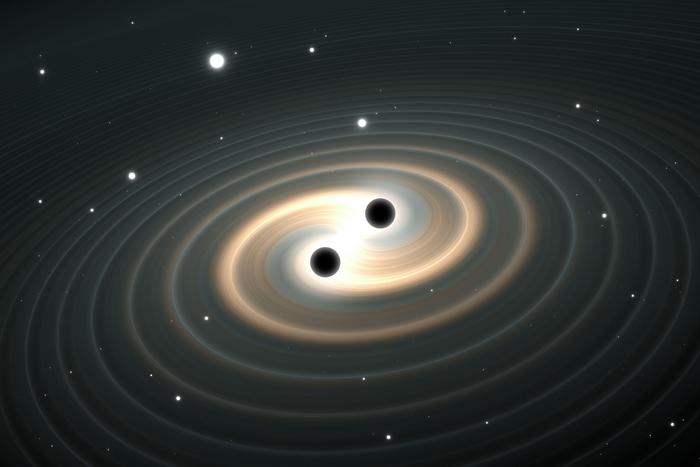
The next frontier in gravitational wave astronomy might not require kilometers of laser-equipped tunnels or billion-dollar satellites. Instead, it could fit on a laboratory bench.
Researchers from the Universities of Birmingham and Sussex have proposed a new type of gravitational wave detector that leverages technology originally developed for atomic clocks to sense ripples in spacetime that current instruments cannot detect. Published today in Classical and Quantum Gravity, the design targets the milli-Hertz frequency range, a scientific blind spot that has remained largely unexplored since Einstein first predicted gravitational waves over a century ago.
The proposal arrives at a curious moment in gravitational wave science. Ground-based observatories like LIGO and Virgo excel at detecting high-frequency waves from colliding black holes and neutron stars. Pulsar timing arrays pick up ultra-low frequency rumbles from supermassive black hole mergers. But the middle band, between 0.00001 and 1 Hz, remains mostly silent. This gap matters because it conceals signals from white dwarf binaries in our galaxy, intermediate-mass black hole mergers, and potentially echoes from the early universe.
When Rigid Becomes Flexible
The detector’s operation hinges on a counterintuitive principle. Unlike LIGO’s massive interferometer arms, which physically stretch and compress as gravitational waves pass through, these compact optical cavities remain mechanically rigid. The spacer holding the mirrors in place does not budge. What changes is something more subtle: the optical path that light travels between the mirrors.
Gravitational waves alter the curvature of spacetime itself. As laser light bounces thousands of times between ultra-stable mirrors in the cavity, those tiny distortions in spacetime accumulate into measurable phase shifts. The researchers propose using two perpendicular cavities and an atomic frequency reference to create multiple measurement channels, allowing them to confirm detections and determine wave polarization.
By using technology matured in the context of optical atomic clocks, we can extend the reach of gravitational wave detection into a completely new frequency range with instruments that fit on a laboratory table.
Dr. Vera Guarrera from Birmingham emphasized the practical advantages. The compact design makes these detectors relatively immune to seismic noise and Newtonian disturbances that plague larger facilities. More importantly, they could begin operations now rather than waiting for space missions scheduled for the 2030s.
Racing Against Space Missions
The proposed detectors would not match the sensitivity of LISA, the Laser Interferometer Space Antenna that the European Space Agency plans to launch next decade. But LISA remains more than ten years away from collecting science data, leaving a window for ground-based discoveries in essentially pristine parameter space.
The science possibilities span from nearby to cosmological distances. A network of these detectors could spot compact binaries of white dwarfs in the Milky Way, catch intermediate-mass black hole mergers in the Virgo cluster, and probe stochastic backgrounds from the early universe. They might even detect gravitational waves coincident with type IA supernovae, potentially confirming that some of these stellar explosions result from white dwarf mergers.
This detector allows us to test astrophysical models of binary systems in our galaxy, explore the mergers of massive black holes, and even search for stochastic backgrounds from the early universe.
Professor Xavier Calmet from Sussex noted the detector provides tools to probe these signals from the ground, opening paths for future space missions.
The detector concept leverages decades of work improving optical atomic clocks. Modern ultrastable cavities achieve fractional frequency instabilities below one part in 10 to the 16th power. The mirrors, mounted on ultralow-expansion spacers and sometimes cooled to cryogenic temperatures, maintain their separation with extraordinary precision. Brownian thermal noise from mirror coatings dominates at higher frequencies in the target band, while slow material drift affects lower frequencies, but both sources are well-characterized and manageable.
Each detector unit would require two orthogonal ultrastable optical cavities and an atomic frequency reference. The configuration enables multi-channel detection, which not only enhances sensitivity but allows identification of wave polarization and source direction. Building a global network could improve detection sensitivity proportionally to the square root of the number of stations.
The researchers suggest these detectors could integrate with existing atomic clock networks, potentially extending gravitational wave detection to even lower frequencies. That would complement high-frequency observatories like LIGO and create an unprecedented multi-band view of the gravitational wave universe.
Whether intermediate-mass black holes exist in the predicted numbers remains uncertain. Merger rates for massive black holes at cosmological distances remain highly uncertain as well. The proposed detectors offer a relatively cost-effective way to explore these questions before space missions launch. Even null results would constrain astrophysical models and guide future observatory designs.
The study arrives as gravitational wave astronomy enters its second decade. Since LIGO’s first detection in 2015, the field has cataloged hundreds of black hole and neutron star mergers. Pulsar timing arrays recently reported hints of a gravitational wave background. Now researchers propose filling the remaining frequency gap with technology that could be deployed within existing laboratory infrastructure.
The next generation of gravitational wave science might not require waiting for satellites or building new massive facilities. It might just require looking at atomic clock technology in a new light.