

Scientists have figured out how to use ultrasound waves like a hologram, stimulating several spots in the brain simultaneously rather than just one. The technique drops the energy needed to trigger neural activity by roughly 90%, opening potential pathways for treating everything from Alzheimer’s to epilepsy without surgery.
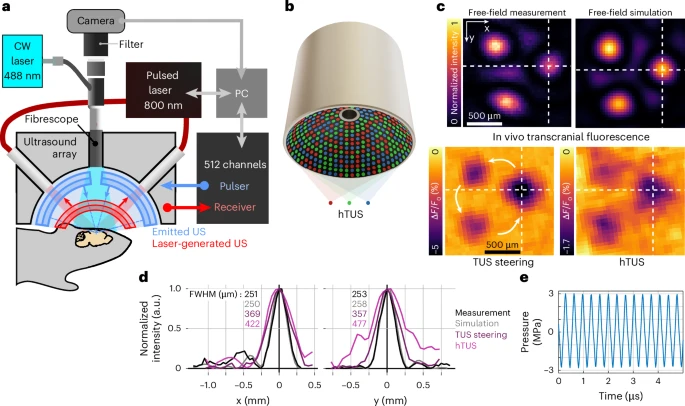
The work comes from researchers at ETH Zurich, the University of Zurich, and New York University, who built a device with 512 ultrasound transducers arranged in a spherical hood. When a mouse places its head inside, the transducers fire coordinated pulses that interfere with each other inside the brain, creating multiple focal points of stimulation at once.
Given that the brain operates in networks, it’s easier to activate or inhibit a brain network if you stimulate it at multiple points simultaneously.
That’s Daniel Razansky, a professor at ETH Zurich and the University of Zurich who led the study. His team calls their approach holographic transcranial ultrasound stimulation, a mouthful that refers to how overlapping sound waves create patterns inside tissue similar to how overlapping light waves create three-dimensional holograms.
Networks Respond to Distributed Stimulation
Traditional ultrasound neuromodulation, which has been tested in early clinical trials for tremor and dementia, typically targets a single point in the brain. The new multi-spot approach works differently. By hitting three to five locations at once, the technique appears to recruit connected neural circuits that amplify the response.
In mouse experiments, the holographic method triggered detectable brain activity at pressures around 0.9 to 1.2 megapascals. Single-spot ultrasound needed roughly 2.5 megapascals or higher to get the same effect. That’s a substantial reduction, and it matters because higher intensities carry risks of heating brain tissue or damaging blood vessels.
The researchers used calcium imaging to watch neurons light up in real time as the ultrasound pulses arrived. They developed computational methods to filter out background noise and thermal artifacts, allowing them to pinpoint exactly where and when the brain responded. The activation appeared precisely at the targeted locations and could be electronically steered to different brain regions without moving the device.
Modeling the Mechanism
Why does spreading stimulation across multiple sites require less energy? The team built two mathematical models to explore that question. One model focused on physical properties of the ultrasound field itself, particularly radiation force, which is the pressure that sound waves exert on tissue. The other model simulated simplified neural networks where interconnected populations of neurons reinforce each other’s activity.
Both models pointed toward the same conclusion. When ultrasound hits several connected brain regions simultaneously, neurons receive converging inputs from their neighbors. This cooperative recruitment lets the network reach activation threshold at lower intensities than would be needed to force a single isolated region into activity.
We rely on animals for our research. It won’t be possible to research these developments at such an early stage in humans. We first need to learn how to control the intervention and ensure that it is safe and effective for the treatment of brain diseases.
The finding suggests that ultrasound neuromodulation might work through network-level mechanisms, not just by directly pushing individual neurons past their firing threshold. That has implications for how researchers design stimulation protocols and interpret results from clinical trials.
Razansky’s team specialized in developing the hardware and imaging systems, while collaborators from New York University contributed neuroscience expertise. The experiments took place in Zurich using mice genetically modified to express calcium indicators that fluoresce when neurons activate.
The research was primarily funded by the United States National Institutes of Health, though that funding pipeline has become uncertain due to recent political pressure on the agency. Razansky plans to continue the work with alternative funding sources.
Next steps involve testing the technology in animal models of specific brain diseases. Beyond the conditions already in early human trials, like Alzheimer’s and essential tremor, potential applications might include depression, Parkinson’s disease, and stroke rehabilitation. The technique remains years away from clinical use, but the ability to modulate distributed brain networks non-invasively represents a different approach than stimulating single targets.
The ultrasound frequencies used in this study, around 3 megahertz, achieve tight focus suitable for mouse brains but would not penetrate the human skull effectively. Clinical applications will likely require lower frequencies, below 1 megahertz, which can traverse bone but create larger focal zones. How the holographic approach translates to those parameters remains an open question.
For now, the work demonstrates that brain networks respond to distributed ultrasound patterns in ways that single-point stimulation cannot capture. Whether that principle scales to human neurology will require more research, more animal studies, and eventually, careful clinical trials.