

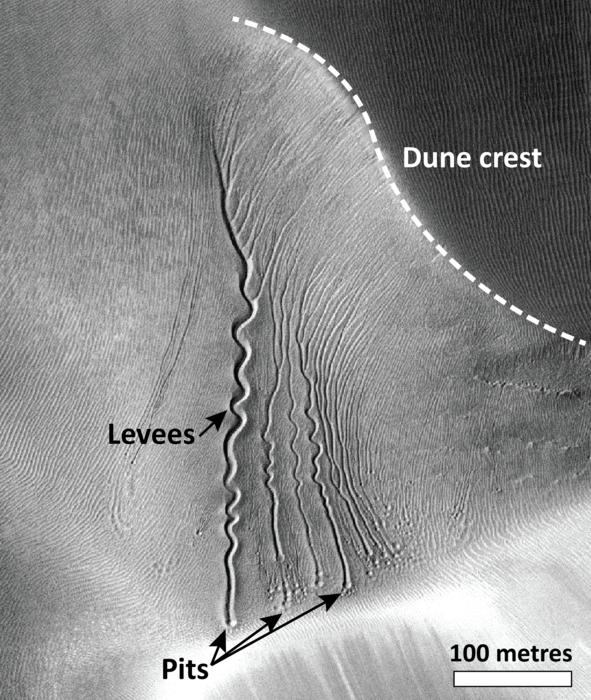
Strange trenches snake across Mars like signatures left in haste. A new study led by Utrecht University reports that blocks of CO2 ice can dig these gullies by blasting sand aside with vaporized gas, not liquid water. In lab experiments run under Martian air pressure, researchers reproduced both straight and sinuous channels with pitlike endings that match real features seen by NASA’s HiRISE camera.
The work focuses on so called linear dune gullies that cluster in Mars’s southern mid latitudes. For years, some scientists tied these channels to wet debris flows during warmer epochs. That idea carried high stakes for habitability. Yet high resolution monitoring has shown the gullies wake up in late winter and spring, right when seasonal CO2 frost forms and then vanishes. The new experiments close the loop by capturing how CO2 blocks can slide or burrow downslope and sculpt the same distinctive ridges and pits observed on Martian dunes.
Picture a steep sand slope inside a Mars chamber. The team dropped CO2 ice blocks onto the sand and filmed the results with high speed cameras. On steeper angles the blocks skimmed fast, carving shallow grooves with faint levees. On gentler slopes the physics flipped. Sublimating gas built pressure under the ice, fluidized the sand, and hurled grains ballistically. The block then tucked into the surface and crept forward while excavating deep channels flanked by tall levees. Seen from above, some tracks kinked and curled when tiny ripple like bumps nudged the block off line, a close match to the odd bends spotted on Mars.
“The CO2 ice block began to dig into the slope and move downwards just like a burrowing mole or the sandworms from Dune.”
That scene is not a metaphor layered onto theory. It is what the cameras captured, under pressures equivalent to Mars’s thin atmosphere. The group also modeled how far ejected grains should fly in Martian gravity. The trajectories scale up to levee widths and channel depths measured on Russell crater’s megadune, where HiRISE images have even caught stranded ice blocks at gully ends. The story that emerges is a two mode machine: sliding at the crest, burrowing lower down, then a final stationary phase that digs a terminal pit as the last ice disappears.
From Winter Frost To Burrowing Blocks
Here is the proposed cycle. In southern winter a blanket of CO2 frost coats dune fields, sometimes 70 centimeters thick. As spring sun warms the slopes, patches defrost unevenly. Blocks break from shaded crests and start moving. On steep faces they glide and scratch the surface. As the grade relaxes the blocks slow, gas out, and dig. Burrowing is slow but powerful, a sand thrower that builds levees grain by grain. When the block reaches the foot and stops, sublimation continues until only a pit remains.
The team stresses that grain size matters. Fine, well sorted sand promoted burrowing in the chamber. Coarser, poorly sorted sand favored sliding or stalls. That constraint could explain why linear dune gullies do not appear on every slope that sees seasonal CO2. It also hints that these landforms encode microclimate and material properties, not just a single global mechanism.
“In our simulation, I saw how this high gas pressure blasts away the sand around the block in all directions”
That quote captures the key lever. Mars’s air sits near 700 pascals. Under such low pressure, converting cold CO2 ice to gas produces strong outflows relative to Earth. Those outflows can carry sand far enough to build the signature levees. It is an elegant argument because it does not need liquid water at any step. Sinuosity is not proof of flow by fluids. It can arise from a burrowing solid that responds to small bumps and temperature quirks along the slope.
Why It Matters For Mars, And For Us
The finding reduces the case for recent liquid water in these specific gullies. That does not rule out water elsewhere or at other times. It does urge caution when interpreting curvy channels on icy worlds. Future missions that image dunes on Europa or Titan could find similar patterns. If they do, this study offers a physics first yardstick before invoking melt.
I admit a quiet satisfaction in how unromantic mechanics can still deliver wonder. A white block hisses, sand jumps like sparks, and a trench grows. On the HiRISE image of Matara crater, you can trace those trenches like dark stitches across a pale slope, each ending in a neat, round pit. Life did not carve them. But physics did, with flair.